
An agenda is a structured list of meeting items linked to a purpose, time allocation, owner, and expected outcome. For remote and cross-border work, that structure helps people prepare for the same conversation even when they don't share a location, working hours, or communication style.
You've received an interview invitation, but the description only says “discovery call.” Should you prepare a portfolio walkthrough, explain your availability, or demonstrate how you'd handle a customer problem? A useful agenda removes that guesswork before you join.
For candidates in Latin America, South Africa, and other remote-work markets, understanding agendas isn't just an administrative skill. It's a way to prepare stronger answers, recognize unclear expectations, and participate confidently when decisions affect your work.
The Practical Definition of an Agenda
A meeting agenda is a coordination document, not a list of subjects. The person preparing it should connect the reason for meeting with the work participants need to complete together.
Consider a hypothetical discovery call for a remote operations role. An invitation that says “introductions and role discussion” gives you little direction. An agenda that asks you to explain how you prioritize competing requests tells you which experience to prepare.
Start with the work, not the topic
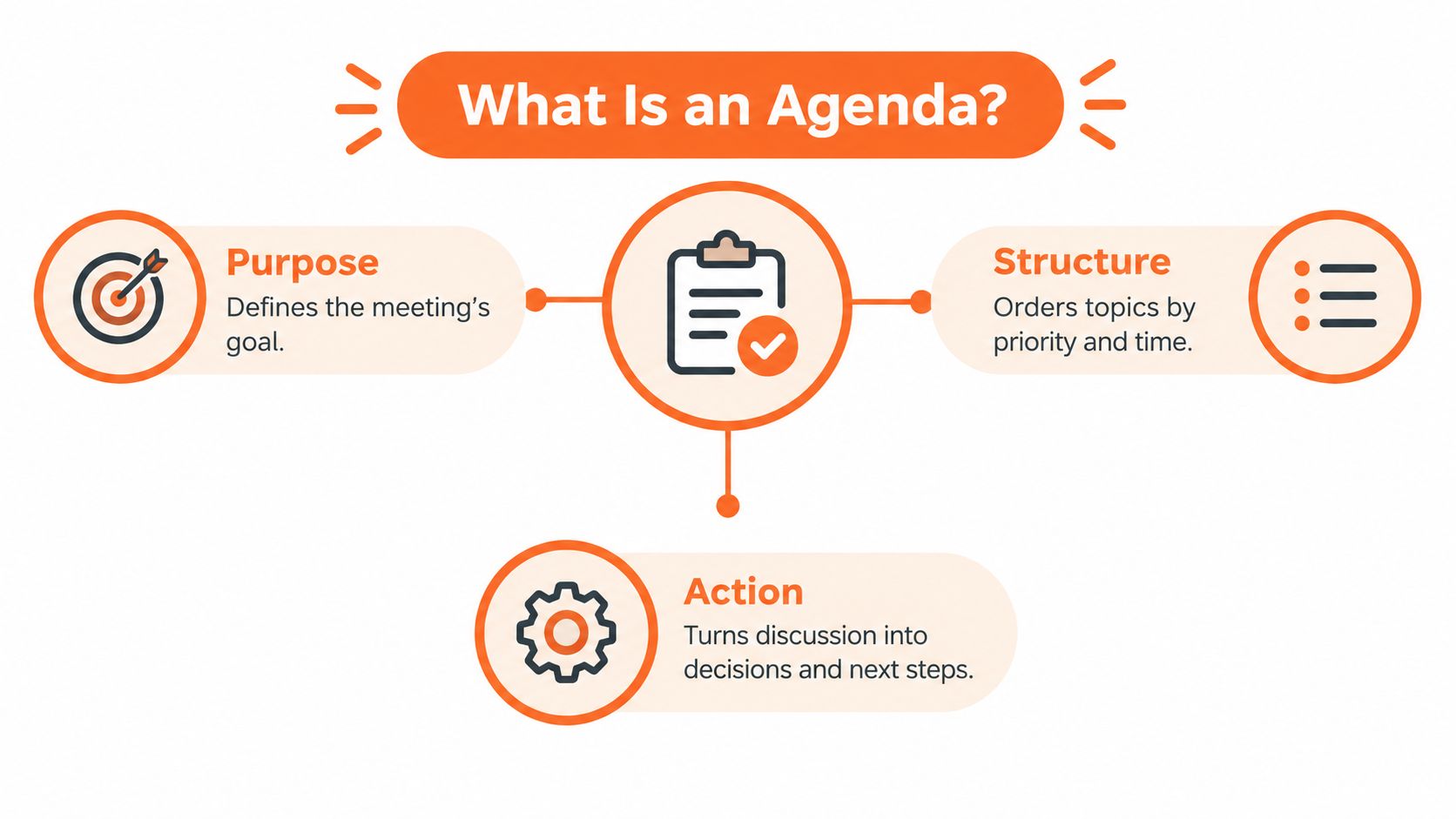
To understand an agenda, look for the relationship between these elements:
- Purpose: Why does this conversation need to happen?
- Structure: In what order will participants address the work?
- Action: What should participants leave ready to do?
The diagram below shows how those elements fit together.
Suppose the interviewer wants to assess your judgment when several colleagues need help at once. A focused agenda would identify that exercise, explain what background you'll receive, and reserve space for your reasoning. You can then prepare a relevant example rather than trying to predict an unspecified conversation.
This action-oriented meaning has deep roots. The word comes from the Latin agendum, meaning “something that must be done,” and entered English around 1745–1755, according to Dictionary.com's history and definition of agenda.
Practical rule: If you can't tell what should be different after the meeting, the agenda probably needs a clearer purpose.
An agenda doesn't guarantee agreement or prevent unexpected questions. It gives participants a shared starting point and a way to recognize whether they've accomplished the intended work.
For a candidate, that distinction matters. You're not expected to control the employer's meeting, but you can ask what to prepare and what the conversation is intended to establish.
Where the Word Agenda Comes From
Historically, agenda was the plural of agendum: things requiring action rather than an individual duty. In modern English, people generally treat agenda as a singular noun, meaning an organized plan or list of matters to address.
That explains a common language question. You would normally write “the agenda is attached,” not “the agenda are attached.” When referring to separate plans for separate meetings, you can use “agendas.”
The meaning extends beyond meetings
A government can have a policy agenda, an organization can have a strategic agenda, and an individual can have a personal agenda. In each case, the word identifies matters someone intends to prioritize, although the document and timescale may differ considerably.
A major example is the United Nations 2030 Agenda for Sustainable Development, adopted by all UN Member States in September 2015, with 17 Sustainable Development Goals and 169 targets guiding development through 2030, as described in the UN's Sustainable Development Goals framework.
The useful connection isn't that a job interview resembles an international development program. It's that both require a distinction between broad intentions and more specific work:
- A broad intention identifies a direction, such as improving a process.
- An organized agenda identifies the matters that deserve attention.
- An actionable commitment identifies what someone will undertake.
You may also hear that someone “has an agenda.” Depending on context, this can mean they have their own priorities, potentially different from the group's stated purpose. It doesn't automatically mean dishonesty.
For remote work, the practical lesson is to clarify which meaning someone intends. A manager's strategic agenda describes priorities; a meeting agenda organizes a conversation about them. Neither should be mistaken for proof that the resulting work has already been assigned or completed.
What Every Strong Agenda Includes
Read an agenda as a set of working instructions. You should be able to tell why you're involved, what preparation is expected, and which contributions belong in the meeting.
Meeting-design research on perceived effectiveness identifies written agendas and completion of planned items as characteristics associated with participants' perceptions of effective meetings. That's an association, not a promise that adding a document will automatically improve every call.
Check the preparation fields
Before reviewing individual discussion items, look for the information that makes preparation possible:
- Meeting title and purpose: Use a recognizable title and a sentence describing the intended result. “Candidate work-sample review” is more useful than “Catch-up.”
- Participants and roles: Identify the facilitator, contributors, and person authorized to make the relevant decision.
- Pre-reading: Provide the role description, brief, document, or work sample participants should review.
- Preparation requirements: State whether attendees should bring questions, recommendations, or completed work.
Without these fields, you may arrive ready to present when the interviewer expects a collaborative exercise. If something is missing, ask for clarification rather than assuming the format.
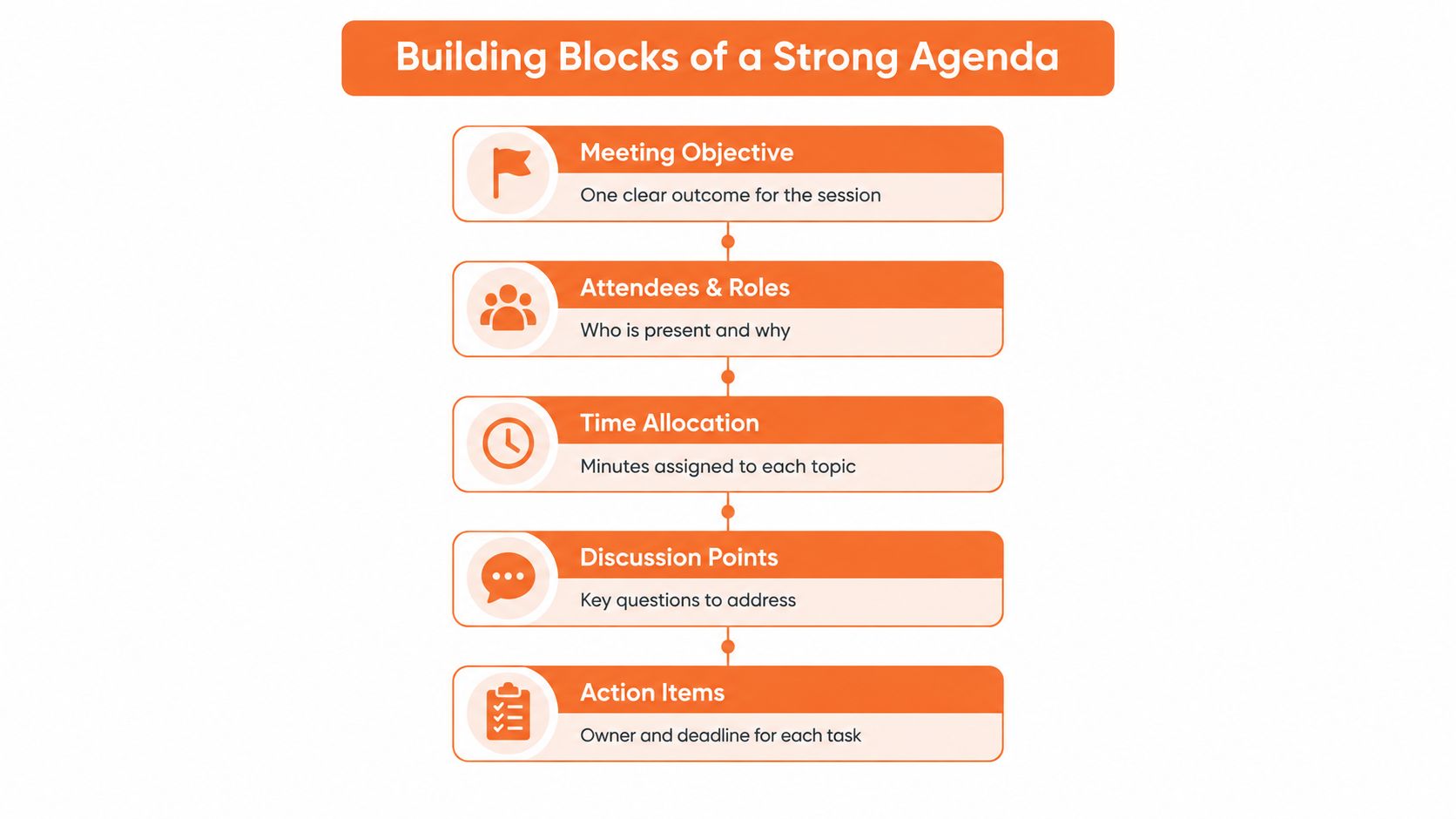
The building blocks below provide a useful checklist.
Check the execution fields
Each substantive item needs enough detail to guide the work:
| Field | What to look for | What becomes unclear without it |
|---|---|---|
| Time allocation | A realistic allowance for the item | How much depth is expected |
| Item owner | The person leading that part | Who should prepare or introduce it |
| Expected output | Information, discussion, decision, or assignment | Whether participants need to reach a conclusion |
| Decision method | Who approves and what criteria matter | How disagreement will be resolved |
| Closing record | Commitments and unresolved questions | What happens after the call |
Distinguish the item owner from the decision-maker. A recruiter might lead a discussion about scheduling while another person approves the working arrangement. Knowing that boundary helps you direct questions appropriately.
For additional preparation alongside this checklist, consider SpecStory, Inc.’s meeting tips for small teams.
Don't judge agenda quality by length. A short document with clear expectations is more useful than a detailed attachment that leaves every responsibility implicit.
Weak Agendas Versus Outcome-Driven Agendas
“Project update, blockers, next steps” looks organized on a calendar invitation. But a new remote teammate still has to infer what to bring, how to contribute, and whether anyone expects a decision.
An outcome-driven agenda uses more precise language. Instead of naming a subject, it identifies the work participants should perform. The following comparison is illustrative, not a report of an actual hiring process.
Weak agenda versus outcome-driven agenda
| Element | Weak agenda | Outcome-driven agenda |
|---|---|---|
| Opening | Introductions | Recruiter confirms the purpose and explains the interview format |
| Candidate experience | Background | Candidate presents a relevant example of handling competing priorities |
| Work sample | Portfolio | Candidate explains a selected sample; interviewer assesses the stated role requirements |
| Blockers | Questions | Participants identify missing information needed to continue |
| Time | No allocation | Each item has a defined time box, with space reserved for candidate questions |
| Responsibility | Everyone contributes | A named participant leads each item |
| Closing | Next steps | Recruiter confirms the next stage and any outstanding commitments |
The difference is particularly useful when you prepare examples. “Background” could invite a chronological account of your entire career. “Explain a relevant example of handling competing priorities” lets you choose a focused situation and show your reasoning.
Translate nouns into useful verbs
When you're invited to contribute to an agenda, replace vague labels with verbs such as compare, assess, confirm, select, clarify, or assign. Choose the verb that matches the actual authority and purpose of the meeting.
For example, a candidate shouldn't describe an interview item as “approve the work schedule” if neither participant can approve it. “Clarify required working hours and identify any unresolved scheduling questions” is more accurate.
A discussion can be useful without producing a decision. The problem is expecting a decision from an item designed only for discussion.
This distinction is relevant when preparing for remote project manager roles. Practice describing how you would frame a decision, surface dependencies, and document an unresolved issue without pretending you have authority you haven't been given.
You can apply the same approach to your interview questions. Instead of asking broadly about communication, ask how the team handles a blocked task when the person who can approve the next step is offline. That produces a more concrete conversation about how remote work happens.
Reusable Agenda Templates You Can Copy
A reusable template should save preparation effort without encouraging people to copy irrelevant items. Delete fields that don't apply, and replace placeholders with actual expectations before sharing the invitation.
These template layouts distinguish team coordination from interview preparation.
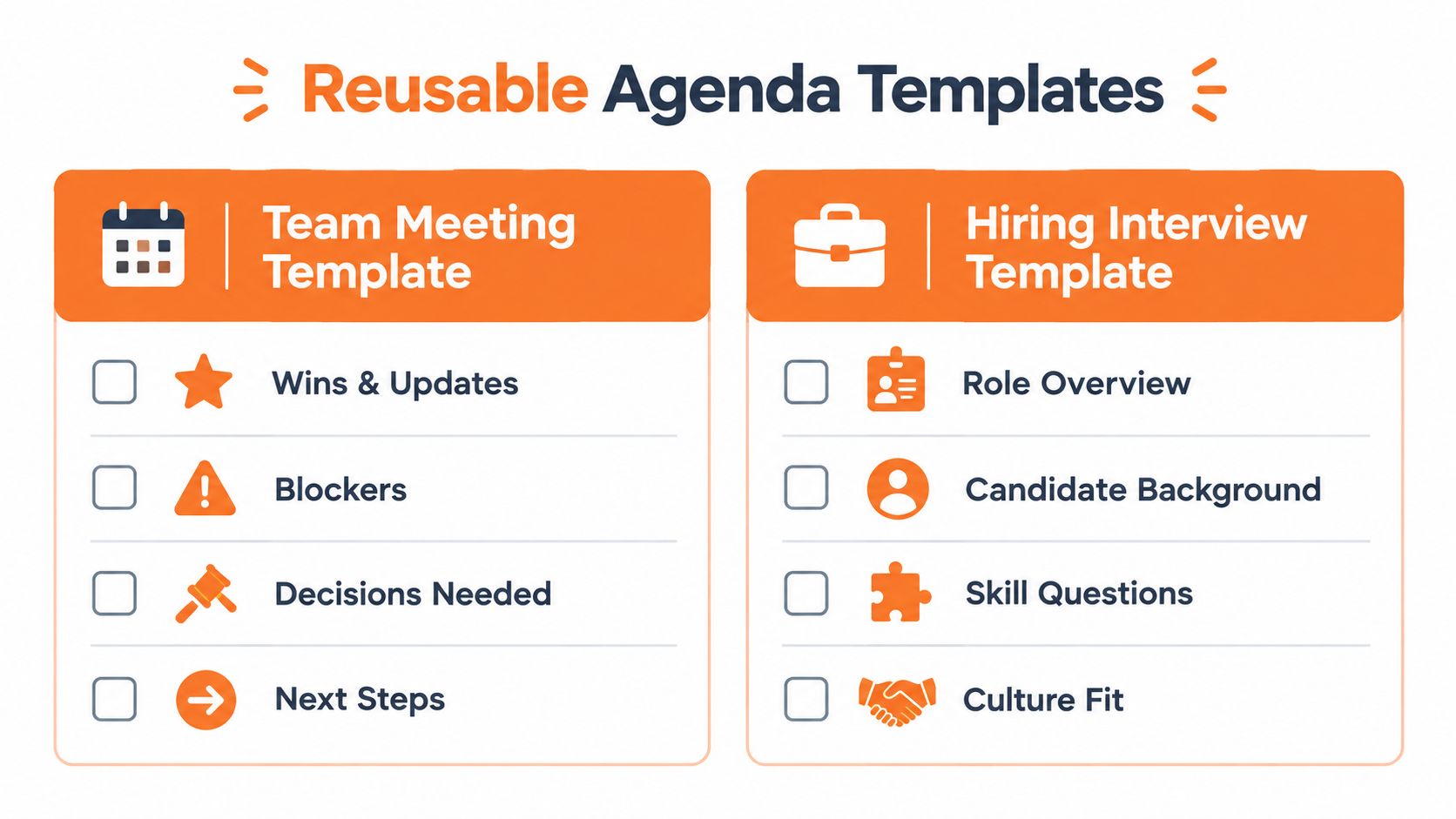
Team meeting template
Meeting title: [Name of meeting]
Purpose: [Result participants need to achieve]
Date, start, end, and time zone: [Details]
Required participants: [Names and roles]
Facilitator, timekeeper, and note-taker: [Names]
Preparation: [Documents to review and contributions to bring]
| Item | Lead | Time box | Expected output |
|---|---|---|---|
| Relevant updates | [Name] | [Allocation] | Shared understanding of changes affecting the work |
| Blocked work | [Name] | [Allocation] | Agreed route for resolving each blocker |
| Decision required | [Name] | [Allocation] | Decision recorded, or missing evidence identified |
| Closing review | [Name] | [Allocation] | Commitments checked and confirmed |
Action register: [Owner] will deliver [specific output] by [agreed due date and time zone].
Unresolved matters: [Question, person responsible for investigating, and review point]
Ohio University's agenda guidance recommends identifying who owns an action, what they will do in deliverable-focused language, and when it must be completed. Its example also includes a closing action-item summary.
Hiring interview preparation template
Use this as a private preparation sheet if the employer hasn't asked you to create the interview agenda.
Role and interview stage: [Details]
Interviewer names and roles: [Known information]
Shared agenda: [Items provided by the employer]
Format to confirm: [Conversation, demonstration, or collaborative task]
| Expected item | Candidate preparation |
|---|---|
| Role overview | Identify responsibilities or expectations that need clarification |
| Relevant background | Select experience directly connected to the role |
| Skills discussion | Prepare an appropriate example, work sample, or explanation |
| Collaboration | Prepare an example of receiving feedback or resolving uncertainty |
| Candidate questions | Ask about responsibilities, support, and working arrangements |
| Closing | Record the agreed follow-up and any submission requirements |
Keep confidential client information out of portfolio examples. If you need to demonstrate a process, prepare a suitably anonymized or independently created sample.
For a video companion to your agenda practice, use the following resource.
After the conversation, compare your notes with the commitments agreed. Don't turn a tentative possibility into a promised deadline in your follow-up.
Using Agendas to Make Remote Work Fair
An orderly meeting can still be unfair. If the same colleague must attend outside their normal working hours, a polished document doesn't remove that burden.
For a candidate in Latin America interviewing with a U.S.-based team, or a professional in South Africa joining an international team, fairness starts with visible expectations. You need enough information to decide whether the proposed arrangement is workable.
A shared agenda can make those expectations easier to examine.

Make participation possible, not merely available
MIT's guidance on meeting agendas emphasizes preparation, objectives, and time frames. For distributed work, apply those principles through explicit participation arrangements:
- State the time zone: Don't assume everyone interprets the calendar description the same way. For regional preparation, consult this guide to time zones in South America.
- Mark attendance requirements: Separate people whose live input is necessary from those who only need the result.
- Identify asynchronous items: Specify what participants can review or answer in writing before the call.
- Provide a response window: Give absent colleagues a defined opportunity to contribute before a decision closes.
- Rotate unavoidable inconvenience: When live attendance is necessary, propose sharing the scheduling burden rather than assigning it permanently to one region.
- Publish the outcome: Make the decision and its rationale available to colleagues who couldn't attend.
Written preparation also gives someone working in an additional language room to organize their thoughts. That's a useful design choice, not a reason to make assumptions about their capability.
Candidate check: Ask how colleagues who miss a live meeting can contribute to the decision, not just watch a recording afterward.
Treat the answer as a point for further evaluation, not proof of the employer's overall culture. A clear agenda is encouraging, but you should also ask about recurring schedules, expected overlap, and how the team handles genuine disagreement.
When an Agenda Helps and When It Does Not
Not every conversation needs a formal document. Use the lightest structure that helps the people involved do the work.
A shared decision, complex handoff, or discussion involving several contributors usually deserves written preparation. A quick clarification between colleagues may need only a question and enough context to answer it.
The comparison below is a starting point, not a rigid rule.
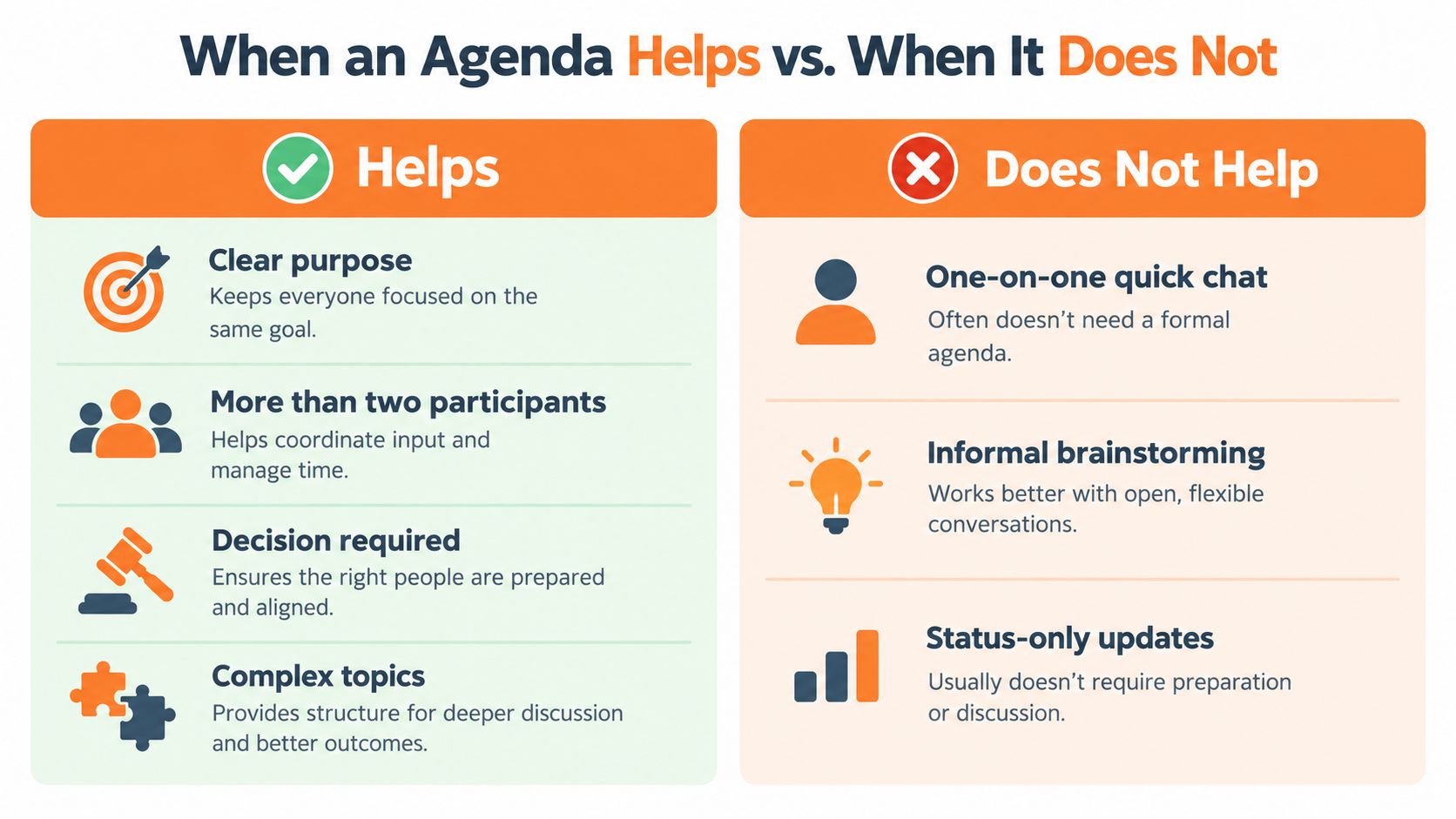
Choose the format by the uncertainty
- Use a structured agenda when participants need preparation, competing options need assessment, or responsibilities cross team boundaries.
- Use a short written brief when someone can review the evidence and respond without a live conversation.
- Use a lightweight prompt for exploratory brainstorming or an informal debrief. State the question without prescribing every contribution.
MIT's description of agendas presents them as ordered discussion topics that can identify leaders and actions. The practical test is whether those details help participants address the work, rather than merely making the invitation look complete.
Watch for agenda theater: unchanged recurring items, preparation nobody uses, and unresolved questions carried forward without explanation. A document can be present while coordination is absent.
If that happens, ask what prevents progress. The group might lack evidence, the right decision-maker, or a shared understanding of the problem. Reformatting the agenda won't solve those issues by itself.
Putting Agendas to Work in Your Career
Use interview agendas to choose relevant evidence. A customer-support candidate might prepare an escalation example; a designer might select a portfolio piece that shows how they interpreted a brief. Match the example to the stated purpose, not just the job title.
For administrative candidates, reviewing what an administrative assistant does can help connect meeting preparation with broader coordination responsibilities.
Turn understanding into a routine
- Plan your search: Give applications, skill refreshers, and portfolio updates distinct places in your weekly plan.
- Prepare your evidence: Add relevant skills and experience to your candidate profile, keeping claims specific and accurate.
- Apply selectively: Review responsibilities and schedules in current remote openings before applying.
- Follow up clearly: Summarize agreed commitments without inventing deadlines or assuming the hiring decision.
Your aim isn't to sound like a meeting expert. It's to show that you understand expectations and can follow through.
Virtustant Jobs is a remote job platform connecting qualified candidates with remote opportunities. Create or complete your profile, review openings that match your experience and working availability, and use the agenda habits above to prepare for your next interview.