Most advice about remote project manager jobs starts in the wrong place. It tells candidates to add Jira, Asana, Agile, and Gantt charts to their CV, then wait for recruiters to notice. Those tools matter, but they won't distinguish you from dozens of other applicants who can update tickets and schedule meetings.
The stronger question is whether you can move a distributed project from an unclear business request to a finished outcome. For LATAM professionals, that means showing executive communication, ownership across workstreams, dependable English, time-zone discipline, and evidence that your decisions improved delivery. Remote hiring managers aren't looking for a remote version of an administrator. They're looking for someone who can make complex work easier to execute.
The Reality of Modern Remote Project Management
Basic task tracking is an entry requirement, not a positioning strategy. A hiring manager may expect you to understand Jira, Asana, Monday.com, or Microsoft Project, but software proficiency alone doesn't prove that you can resolve a dependency, protect a budget, or explain a delivery risk to an executive stakeholder.
The market supports a more ambitious view of the role. The U.S. Bureau of Labor Statistics projects that the broader project-management labor market will grow 6% from 2024 to 2034, with about 78,200 annual openings driven by growth and replacement needs, according to the data summarized by Remote Job Assistant's overview of remote project manager jobs. The same source cites remote project manager compensation around the low six figures, including an average of $102,682 per year as of September 30, 2026, and another estimate of $104,519 in median annual pay from December 2025 data.
Those figures don't mean every LATAM role will offer U.S.-level compensation. They do show that project management is a mature professional category with a durable hiring pipeline. Remote work has expanded the opportunity, but it has also raised the standard. Companies can recruit across borders, so candidates must demonstrate why they can coordinate complexity better than someone who only maintains a task board.
What senior remote roles actually require
Remote project management has become one of the largest remote career fields. FlexJobs reported that project management was the largest remote career field overall, that openings increased 11% in the final quarter of 2025, and that project management ranked as the top remote career category between January 1, 2025, and October 1, 2025, with nearly 200,000 jobs posted with remote or hybrid arrangements, as reported in Plaky's summary of project management statistics.
Volume doesn't make the application easier. It makes weak positioning less effective. Recent remote-job analysis points toward mid-senior experience and adjacent work such as product operations and transformation leadership, while senior opportunities increasingly involve multiple workstreams, executive stakeholders, and measurable business outcomes, according to JobGether's analysis of remote project manager roles.
Rewrite your experience around those responsibilities:
- From task updates to delivery control: Explain how you identified dependencies, escalated decisions, and kept teams aligned.
- From meetings to stakeholder management: Show how you translated technical information for clients, executives, finance teams, or commercial leaders.
- From one project to a system of work: Describe how you coordinated related initiatives, vendors, departments, or product releases.
- From activity to outcome: Connect your work to delivery reliability, budget visibility, risk reduction, customer readiness, or operational clarity.
Practical rule: If your CV could describe your work without mentioning a decision you made, a problem you solved, or an outcome you protected, it still reads like coordination support.
LATAM professionals should also understand the value of a distributed team management playbook when preparing for senior interviews. The strongest candidates don't merely say they have worked remotely. They explain how they created visibility, handled ambiguity, and kept work moving when colleagues weren't available at the same time.
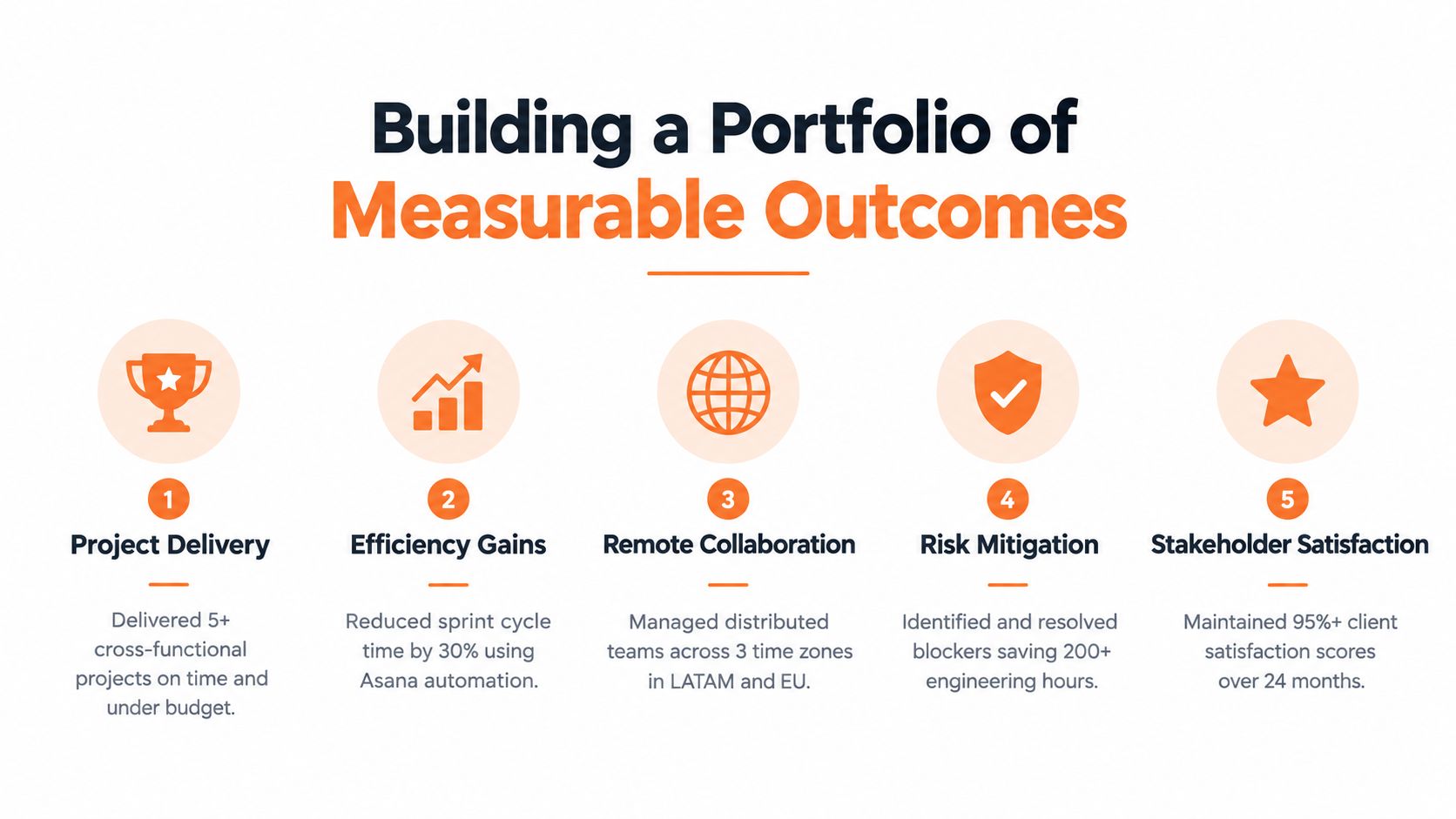
Building a Portfolio of Measurable Outcomes
A certification can confirm that you studied project management. A portfolio can show how you practice it. If your CV lists PMP, Scrum, Asana, and Jira without demonstrating the business value behind your work, recruiters still have to guess what you'll do in a live project.
Build a small portfolio with anonymized case studies. You don't need to reveal a client's name, confidential revenue, internal documents, or proprietary product details. You need to show the shape of the problem, your role in solving it, the decisions you made, and the result that followed.
Use a case study structure that proves ownership
Start with the operating context. State whether the project involved software development, marketing operations, an implementation, a client delivery, or an internal transformation. Identify the stakeholders, locations, dependencies, and constraints without exposing confidential details.
Then describe your actions in sequence:
- Clarify the objective. Explain the business request in plain language and define what completion meant.
- Map the work. Show how you organized milestones, owners, dependencies, resources, and decision points.
- Control execution. Describe your cadence for status reporting, risk review, change management, and stakeholder communication.
- Handle friction. Include a blocker, competing priority, missing resource, or scope issue and explain how you addressed it.
- Close the loop. State what changed after delivery and how you measured whether the project achieved its purpose.
The evidence can be qualitative when confidentiality limits the detail. Instead of naming a client or disclosing a financial figure, write that you improved budget visibility, established a repeatable reporting process, clarified resource allocation, or reduced uncertainty around delivery. Those statements are more useful than a generic line such as “managed projects from start to finish.”
Make distributed delivery visible
A hiring manager needs to see that your process works across locations. Include a sample weekly status report, a redacted RAID log, a project timeline, a stakeholder map, or a decision register. Remove names, logos, customer data, source code, and commercially sensitive information.
Your portfolio should answer practical questions:
- Who owned each major decision?
- How did you report progress?
- What happened when a dependency slipped?
- How did you allocate scarce specialist capacity?
- Which communication channel handled urgent issues?
- How did you confirm that stakeholders understood the change?
For presentation guidance, the social media manager portfolio examples can help you think about structure, evidence, and readability even though the role focus is different. Apply the same principle to project management: make the work easy to scan, then make the evidence hard to dismiss.
Don't build a portfolio that looks like a software catalogue. Tools belong in context. “Used Asana” is weak. “Created an Asana workflow that clarified ownership, surfaced blocked tasks, and gave stakeholders a single delivery view” demonstrates judgment. Your goal is to show that you design a reliable operating rhythm, not that you know where to click.
Mastering Distributed Team Tooling and Workflows
Remote project failure rarely begins with a missing feature in a project-management platform. It usually begins when people lack shared information, can't reach the right person, or discover a dependency too late. Research on remote project management identified lack of communication as the biggest challenge for nearly 46% of respondents, while related findings connected deadline slippage and remote-work failure with communication barriers, technical disruption, time-zone coordination, distractions, limited resource access, and cybersecurity threats, according to Hubstaff's state of remote project management research.
That evidence should change how you present technical skills. Don't list Jira, Asana, Slack, or Notion as isolated competencies. Explain the workflow you built around them.
Design the workflow before naming the tool
A credible remote project manager can describe the system behind the software:
- Work intake: Define how a request enters the system, who validates it, and what information is required before work begins.
- Planning: Break the objective into milestones, dependencies, owners, acceptance criteria, and decision dates.
- Execution: Use a consistent status model so everyone understands whether work is active, blocked, at risk, or complete.
- Escalation: Establish what qualifies as a risk, who receives the escalation, and how quickly the team must respond.
- Reporting: Give executives a concise view of progress, decisions, risks, budget, and the next action.
Jira may be appropriate for software delivery, while Asana may suit a cross-functional launch involving marketing, design, operations, and sales. The platform matters less than the operating logic. In an interview, explain why you selected a workflow and what failure mode it prevented.
Build resilience into communication
Distributed teams need more than one way to exchange information. Use an asynchronous project record for decisions and status, a structured channel for questions, and a live meeting only when discussion or resolution requires it. Record decisions in writing after a call. Don't let a critical approval live only in a private message or a meeting that half the team couldn't attend.
Access control also belongs in your project-management story. Explain how you gave people the information they needed without exposing confidential files or unnecessary systems. A senior candidate should understand permission levels, document ownership, version control, and the consequences of giving broad access by default.
Demonstrate time-zone judgment
A calendar can show that you scheduled a meeting. It can't show that you scheduled it fairly or protected focused work. Describe how you identify overlap windows, rotate inconvenient meetings when necessary, document handoffs, and set response expectations for asynchronous work.
Hiring managers want confidence that a project won't stop when one region signs off. Show them a handoff template, an escalation path, a decision log, or a sample communication cadence. Those artefacts turn “strong communicator” from a vague claim into visible operating practice.
Navigating Time Zones and Language Expectations
For LATAM candidates, English proficiency is often a hiring filter, not a nice-to-have. Remote project manager listings commonly involve teams distributed across locations and time zones, and LATAM opportunities can require collaboration between India and the United States, according to ZipRecruiter's remote project manager listings.
That means conversational English isn't enough for senior delivery work. You need to explain a risk precisely, challenge an unrealistic deadline without sounding defensive, summarize a decision for an executive, and write an action request that nobody can misinterpret.
Make your language level observable
Some LATAM postings explicitly request fluent written and verbal English, professional English at the C1/C2 level, or bilingual English-Spanish communication, as shown in this LATAM remote project manager listing. Don't hide behind a generic “advanced English” line on your CV.
Show evidence instead:
- Include a concise project summary written in English.
- Describe the stakeholders you supported and the type of communication involved.
- Mention whether you led client calls, executive updates, sprint reviews, or vendor negotiations.
- Prepare a short explanation of a difficult project decision in clear, direct English.
- If you're bilingual, state how you used both languages in delivery, documentation, or stakeholder coordination.
Your interview answers should follow a simple pattern. State the situation, identify the risk or objective, explain your action, and close with the result. Avoid translating complicated sentences from Spanish or Portuguese word for word. Use shorter sentences, active verbs, and explicit ownership.
Treat schedule alignment as part of reliability
Don't wait for the interviewer to discover your availability. State your location, preferred working hours, and the amount of overlap you can provide with the team. If a role follows U.S. business hours, say exactly when you can be online and whether that schedule is sustainable.
You should also ask practical questions. Which time zones are represented on the core team? Which meetings are mandatory? What must happen synchronously? How does the team handle urgent decisions outside shared hours? These questions show that you understand the operating cost of distributed work.
The South America time-zone guide can help you prepare for the scheduling side of cross-border applications. Use that preparation to give concrete answers, not to make broad claims about flexibility. A candidate who can name their working window, communication preferences, and handoff habits appears easier to onboard.
Applying Through LATAM-Focused Talent Platforms
Scattering applications across generic job boards creates noise. You may spend time completing forms for roles that don't disclose the schedule, language requirement, software stack, seniority, or actual scope. A focused search gives you better information before you invest the effort.
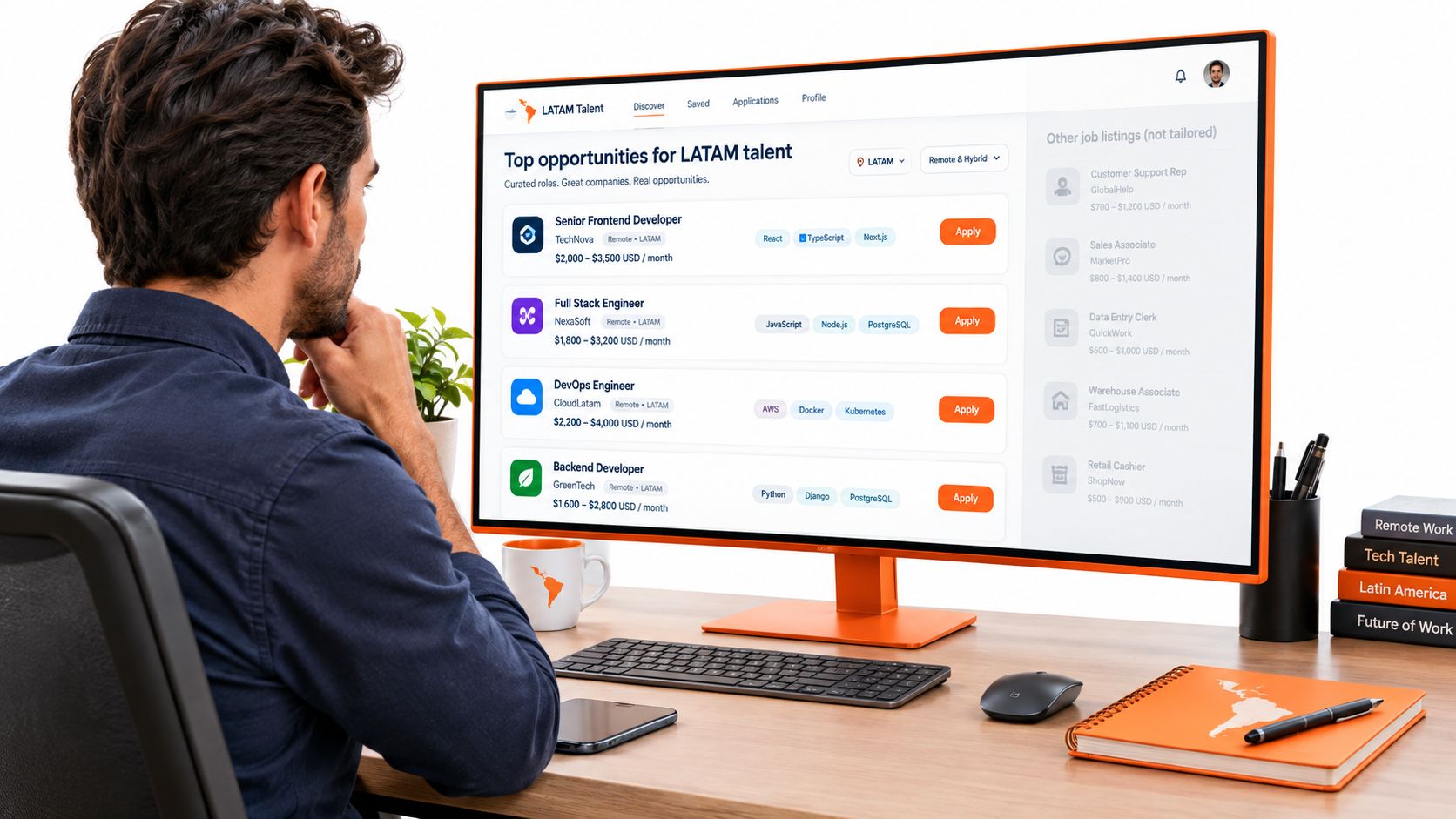
A LATAM-oriented job board can make cross-border fit easier to assess. Look for postings that state responsibilities, required experience, tools, schedule, employment type, and language expectations. That information lets you reject poor matches quickly and tailor your application to the work a company needs.
The value isn't just convenience. A specialized platform can put your profile in front of companies already considering international remote hiring, rather than forcing you to explain why your location is compatible with the role. It also helps you compare openings by operating requirements instead of applying to every job with “remote” in its title.
Apply selectively and tailor the evidence
Before submitting, check five items:
- Scope: Does the role involve end-to-end delivery, or only administrative coordination?
- Stakeholders: Will you work with clients, executives, engineers, vendors, or several functions?
- Schedule: Can you consistently meet the stated overlap requirement?
- Language: Does the posting require fluent, professional, or bilingual communication?
- Tools and outputs: Can you show experience with the stated systems, reporting, budgets, timelines, or documentation?
Use the posting's language accurately in your CV, but don't copy it without proof. If the role asks for resource allocation, include a portfolio example that shows how you assigned capacity or managed a constraint. If it asks for executive reporting, include a redacted status update or describe the decision-making cadence you led.
For broader search strategy, these sites for finding remote work can help you compare different channels. The right approach isn't to choose one source forever. It's to prioritize channels where the job details match the way you want to be evaluated.
Use a talent profile as a second application asset
A standardized profile should reinforce your CV, not duplicate it mechanically. Lead with the type of projects you manage, the functions you coordinate, the regions you've supported, and the outcomes you protect. Add tools after that context.
Complete every relevant field. Incomplete profiles create avoidable doubt about availability, communication, seniority, and technical fit. If a platform offers a talent pool, consider joining it after your application materials accurately represent your experience. Future matching only helps when the profile makes your target role clear.
The following video provides another perspective on organizing a remote job search and preparing for applications.
Your Action Plan for Securing a Remote Role
Stop treating your search as a volume contest. Treat it as a positioning project with a clear deliverable, a credible evidence base, and a repeatable application process.
Start with your CV. Remove tool-only bullets and replace them with statements showing ownership, stakeholders, constraints, decisions, and outcomes. Put your strongest cross-functional example near the top. Make your location, working hours, language level, and availability easy to find.
Then audit your portfolio. Add case studies that show planning, execution, documentation, risk management, budget awareness, and stakeholder communication. Redact confidential information, but don't redact the story. A reader should understand the problem, your intervention, and what improved.
Follow a focused weekly routine
- Select a target role family. Decide whether you're pursuing delivery management, software projects, client implementations, product operations, or transformation work.
- Prepare two or three proof stories. Practice explaining a difficult dependency, a stakeholder conflict, and a project you delivered across locations.
- Verify international readiness. Confirm your English communication, working-hour overlap, internet reliability, and availability for required meetings.
- Apply where the fit is visible. Use detailed listings and adapt your summary to the stated responsibilities instead of submitting the same CV everywhere.
- Review your evidence after each interview. If a recruiter asks for information you can't provide, add it to your CV, portfolio, or profile.
Candidates who want additional interview preparation can use this practical guide on how to land a remote job. The useful takeaway is simple: preparation should make your value easier to verify, not make your application longer.
Create your profile, complete your application information, and browse current openings with the same discipline you'd bring to a live project. Your objective isn't merely to find a remote title. It's to present yourself as the person who can coordinate people, decisions, and delivery when the team isn't in one office.
Virtustant Jobs offers remote opportunities and a structured talent profile for candidates pursuing cross-border work, including project management and operations roles. Visit Virtustant Jobs to create your profile, complete your application details, and browse current remote openings that match your experience.