
You've found a remote role that matches your skills, but the recruiter's message says the team works on U.S. Eastern Time. Your calendar shows one hour, the recruiter's invitation shows another, and a colleague in a different South American country gives you a third conversion. The problem isn't your English or your experience. It's that time zone coordination affects whether everyone understands the same working day.
For candidates pursuing remote jobs through Virtustant, knowing your local offset is only the starting point. You also need to explain your availability accurately, check whether seasonal clock changes apply, and understand how your location affects interviews, meetings, customer coverage, and response expectations. This guide treats time zone South America as a practical career skill, not a geography quiz.
Why South American Time Zones Matter for Remote Careers
A candidate in Colombia may receive a request for a morning interview from a company on the U.S. East Coast. A candidate in Argentina may receive the same request and see a different local time. Both candidates could be qualified, yet their available overlap with the employer's workday won't be identical.
That difference appears in ordinary hiring conversations. A job post may mention EST hours, a fixed support shift, or availability during a particular part of the U.S. business day. If you answer only with “I'm flexible,” the recruiter still doesn't know whether you can attend recurring meetings, handle live customer requests, or respond during the required window.

The scheduling issue behind the job post
Employers hiring across Latin America often need more than general remote availability. They may need a customer service representative to cover a U.S. workday, a virtual assistant to join recurring calls, or a sales professional to reach prospects while the client's team is online. A candidate's location becomes a scheduling variable alongside language ability, software experience, and role-specific skills.
That's why a strong application states availability in a way another person can verify. Instead of writing “available in the morning,” write your local time and the requested reference zone. If the employer lists Eastern Time, confirm whether the posting means a fixed EST reference or the current U.S. Eastern clock, which can change seasonally.
Practical rule: Never accept an interview time from a message that names only “Eastern,” “LATAM,” or “U.S. hours.” Ask for the exact time zone and confirm the time in your own location.
Where this affects your remote career
Time zone readiness matters particularly in roles with live interaction. A social media manager may coordinate content approvals, a bilingual support agent may answer conversations in real time, and an executive assistant may protect a calendar shared with people in several countries. Virtustant's guide to social media manager opportunities can help candidates evaluate role responsibilities alongside schedule expectations.
The same coordination logic applies to professionals who support clients across borders. If you're comparing career paths, resources about hiring Latin American virtual assistants can provide useful context about why availability, communication habits, and dependable overlap matter in distributed work.
A recruiter isn't testing whether you can recite every South American offset. They're looking for evidence that you can manage a shared calendar, communicate constraints early, and arrive when expected. Treat that preparation as part of your professional profile.
Mainland Time Zones and Key Offset Bands
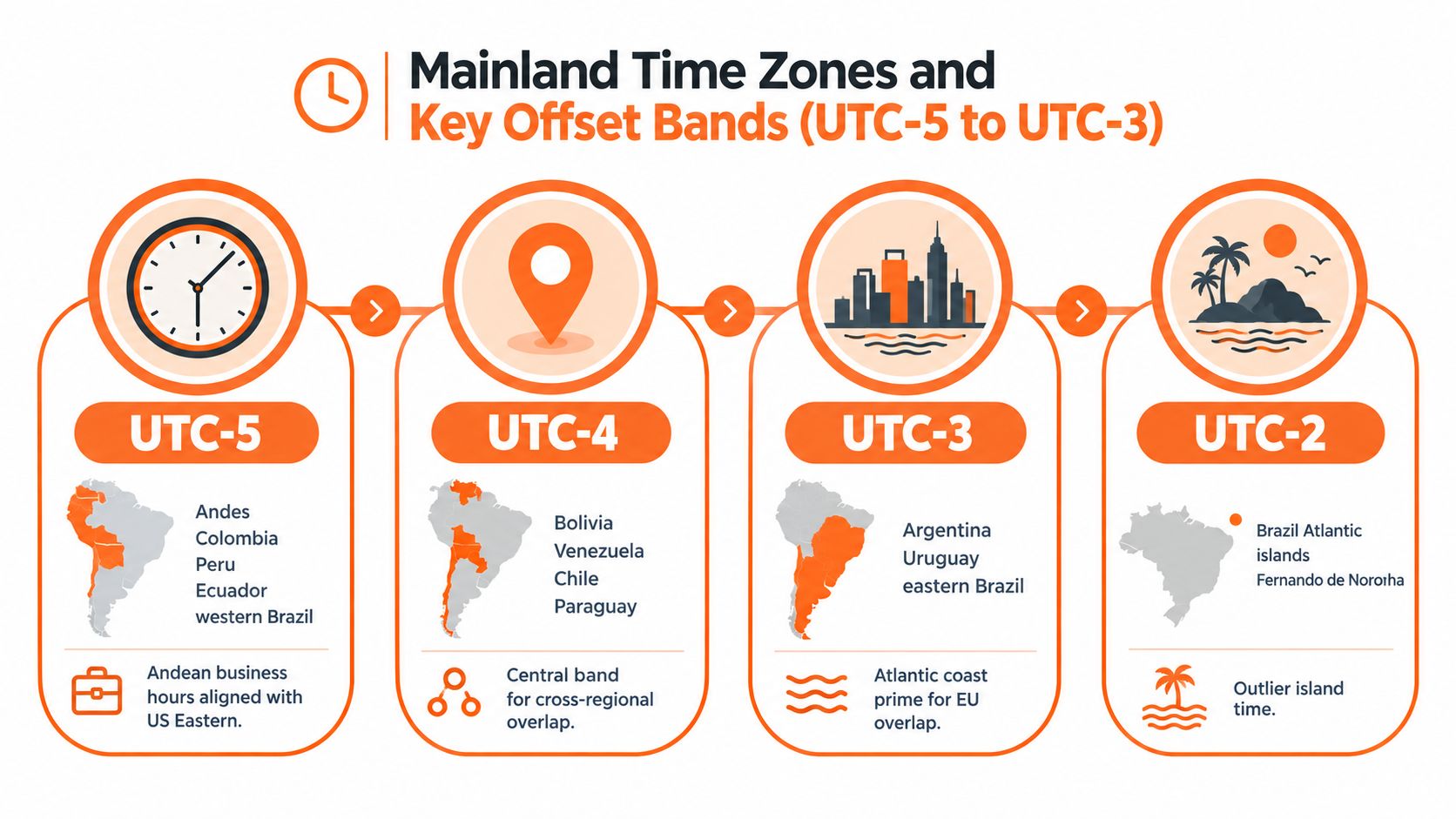
A recruiter schedules an interview for 10 a.m. U.S. Eastern Time. For a candidate in Colombia, Peru, or mainland Ecuador, that meeting falls closer to the start of the local workday than it does for someone in Argentina, Uruguay, or much of Brazil. The country matters, but the offset determines how much of the employer's day overlaps with yours.
South America's commonly used mainland time zones span UTC−5 to UTC−3, while Brazil's Atlantic islands reach UTC−2. The mainland therefore covers 3 hours, and including the islands expands the range to 4 hours (Timeanddate's South America time-zone listing).
| Offset | Countries and areas commonly associated with the band | Scheduling meaning |
|---|---|---|
| UTC−5 | Colombia, Peru, and mainland Ecuador | Closer alignment with U.S. Eastern work schedules |
| UTC−4 | Bolivia and Venezuela | Middle position for regional coordination |
| UTC−3 | Argentina, Uruguay, and most of Brazil | Later local clock compared with the western mainland |
Reading the bands as a candidate
UTC−5 usually gives candidates in Colombia, Peru, and mainland Ecuador a more direct overlap with U.S. East Coast business hours. In UTC−3, the same U.S. meeting generally occurs later in the local day. That difference can affect interviews, recurring meetings, customer coverage, and the practical end of a shift.
Bolivia and Venezuela sit in the UTC−4 grouping on the core continental map. Venezuela also uses a half-hour offset, so a meeting that appears to fall on the hour elsewhere may begin or end at a different minute locally. Candidates there should verify the displayed local time rather than convert it mentally.
UTC−3 includes Argentina, Uruguay, and much of Brazil, making it relevant to employers building coverage across large regional labor markets. The band does not automatically make a role a better fit. It indicates that managers may need to distribute meetings, handoffs, and service hours across different local business days.
Why “LATAM hours” can be too vague
A remote team can include workers separated by the mainland's three standard offsets. Two colleagues who start at the same displayed local hour may still be online during different parts of the employer's day. Interview queues, support coverage, approvals, and handoffs can shift accordingly.
If you work from Brazil while traveling or relocating, checking practical resources such as eSIM coverage in Brazil can help you assess connectivity separately from scheduling. Both affect consistent remote performance.
List your location and offset on your CV or application when a posting emphasizes U.S. hours. That gives the hiring team a clear basis for setting interviews and evaluating daily overlap.
Half-Hour Offsets, Islands, and Zone Exceptions
A recruiter schedules an interview for the hour, but your calendar shows a half-hour start. The mismatch may come from the locality, not a calculation error. South America includes UTC−4:30 in Venezuela, UTC−2 in the Atlantic islands, and UTC−6 in Chilean Easter Island and Pacific areas. A South America time-zone listing for 2026 counted eight distinct time settings after including half-hour and daylight-saving offsets (Greenwich Mean Time's South America listing).
Venezuela's half-hour offset is especially easy to miss in recruiting tools and shared calendars. A meeting set for the hour in a whole-hour zone can begin or end at a different minute locally. Collaboration remains practical, but mental conversion can produce an avoidable interview error.
Island locations add another check. Brazil's Atlantic islands use UTC−2, while Chilean Easter Island and Pacific areas use UTC−6. Before confirming an interview or recurring shift, identify the specific locality, not only the country. The locality works like the address on a delivery: the country gets the package near the right place, but the city determines where it arrives.
Chile requires closer attention
Chile combines standard and daylight-saving shifts. Mainland Chile moves from UTC−4 to UTC−3 during daylight saving time, while its Pacific areas follow different local rules, as reflected in the same regional time-zone listing. A Chile-based candidate should verify the current local offset before stating availability against a U.S. schedule.
National and regional policies explain why one country name may not be enough for an accurate calendar conversion. For remote work, provide the details that a recruiter or scheduling system needs.
A reliable availability statement includes your city, local time, and the employer's reference zone.
You could state a local availability window and confirm that meetings can be converted to the employer's current Eastern Time. If your location changes seasonally, say that you will verify the live offset before recurring meetings begin.
Scheduling software should use a locality-based time-zone identifier rather than a broad “South America” setting. The IANA Time Zone Database includes separate zones such as America/Sao_Paulo, America/Lima, and America/Manaus. City-level mapping therefore helps protect interview times, handoffs, and daily availability from the wrong local conversion.
Overlapping with U.S. Eastern Time for Remote Work
A recruiter schedules an interview for a standard U.S. East Coast workday. Your local clock may show ordinary daytime hours, a later afternoon, or an evening commitment, depending on your offset. The practical task is to measure the overlap you can sustain, not to decide eligibility from your country name alone.
A candidate in UTC−5 is generally closer to U.S. Eastern business hours than someone in UTC−3. A UTC−3 candidate may need to start or finish later locally to provide comparable coverage. A UTC−4 candidate falls between those patterns. The relationship can change when the United States changes its seasonal clock, so every interview and recurring meeting should be checked for its specific date.
A remote role may require live customer coverage, a meeting window, or timely responses during part of the client's day. Ask: Which hours must I be online, and can I maintain them every workday? A technically compatible shift can still conflict with family responsibilities, transportation, school, or another job.
Use a three-step conversion habit
Confirm the employer's reference zone. “EST” is often used informally, while “Eastern Time” may mean the current U.S. clock, including seasonal changes. Ask the recruiter which convention the team follows.
Check your locality. Country-level assumptions can fail in areas with islands, half-hour offsets, or seasonal rules. Use a calendar that recognizes location-based zones, then confirm the conversion for the interview date.
Fit the window into your routine. Write down the required local start and end times, including recurring meetings and response periods. Review the complete workday rather than judging the role by one interview slot.
Role type also changes the overlap requirement. Customer support and appointment-setting positions often depend on live coverage. Sales roles may test availability during prospecting hours, while administrative work may center on recurring client meetings. Review the posting for its schedule, language requirements, software, and responsibilities before applying.
Candidates preparing for a sales role can review sales interview questions and prepare a concise availability answer. State the hours you can reliably cover, the time zone used for the conversion, and whether seasonal changes may affect those hours.
Do not promise “full EST availability” until you have checked the local hours you can maintain.
The region includes at least three mainland offsets and up to five total time zones when islands are counted, while Chile uses UTC−4 and UTC−3 and Paraguay ended daylight saving time in 2024 (Nearshore Business Solutions' South America time-zone coverage). These differences can affect interview timing, support coverage, and hiring decisions. Clear availability language helps you avoid accepting a role whose schedule appears workable only because no one checked the conversion.
Daylight Saving Rules and How They Change Schedules
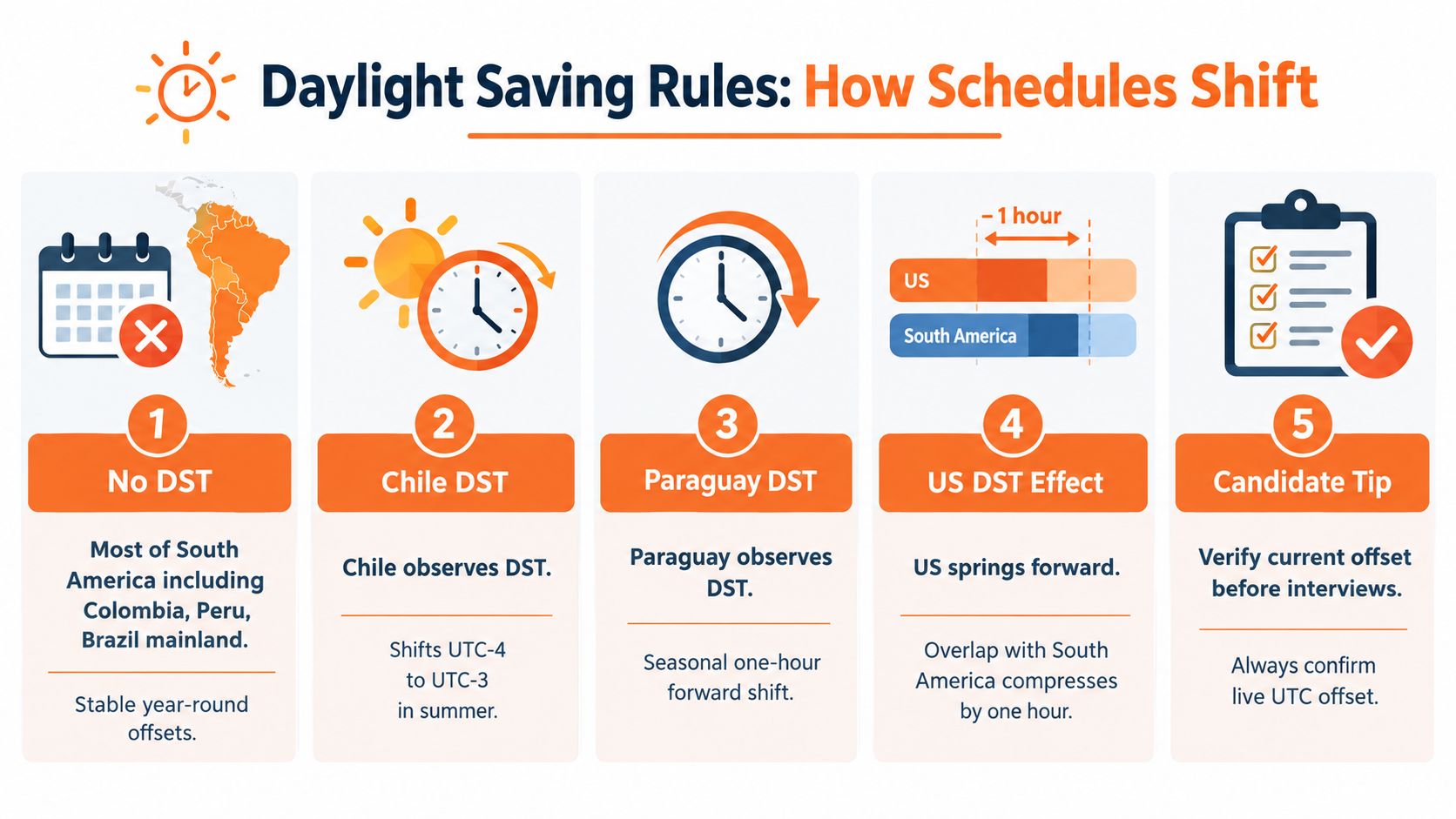
A meeting that works at 10 a.m. in February may appear at a different local hour later in the year. South America does not apply daylight saving time uniformly, and the region spans standard offsets from UTC−5 through UTC−2, including UTC−4:30 (WorldAtlas's South America time-zone guide). Peru and Colombia commonly use UTC−5, while Argentina, Uruguay, and much of Brazil commonly use UTC−3.
For remote candidates, the scheduling issue has two moving parts. Your country may change its offset, or the U.S. employer may change its seasonal clock. Either change can shift the local start of an interview, recurring meeting, support block, or other required overlap. An invitation can be correct for its original date while a recurring calendar series later converts to another local hour.
Compare the main scheduling situations
Stable local offset. A year-round fixed offset makes your routine easier to predict, but the U.S. side may still change. A meeting set by Eastern Time can move locally when the employer switches its seasonal clock.
Chile's seasonal shift. Mainland Chile changes from UTC−4 to UTC−3 during daylight saving time. Before accepting a recurring commitment, confirm the relevant date and locality rather than relying on a single conversion.
Paraguay's policy change. Paraguay ended daylight saving time in 2024, so older scheduling guides may describe an arrangement that no longer applies. Confirm the current rule before using a past schedule as a reference (Nearshore Business Solutions' time-zone coverage).
IANA's time-zone data records historical offsets for individual zones. Some South American zones remain fixed, while others change by season. That distinction affects meeting calculations, automated reminders, cron schedules, and payroll cutoffs (IANA's time-zone theory).
For a visual explanation, review the video below.
Verify before every important date
Check the interview date, the employer's reference zone, your current city, and whether either side observes a seasonal shift. Before copying an old conversion into a recurring calendar series, review the series settings and its time-zone field.
Ask directly during the interview: “Will this schedule remain at the same local time throughout the year, or does the team follow U.S. Eastern Time as it changes?” The answer shows whether you can maintain the required overlap consistently, not just attend one interview slot.
Scheduling Remote Roles Across LATAM and the U.S.
Time-zone competence becomes visible in the way you apply. Put your city and current offset in your profile, list the hours you can reliably cover, and convert the employer's requested window before you submit an application. If the role says EST, don't leave the recruiter to guess whether you mean a fixed reference or the current Eastern clock.
A clear profile also separates availability from flexibility. Availability tells the employer when you can work consistently. Flexibility explains whether you can occasionally attend an early or late meeting, with reasonable notice. Those are different commitments, and combining them can create expectations you can't maintain.
Use this short preparation checklist:
- Profile clarity: Add your location, time zone, English or other required language level, relevant tools, and preferred schedule.
- Application accuracy: Compare the posted hours with your local routine before applying, especially for customer support, sales, and executive assistance.
- Interview readiness: Confirm the date, reference time zone, meeting link, and local conversion in writing.
- Calendar discipline: Save recurring meetings using a location-based time zone instead of a generic fixed offset.
- Professional communication: If the schedule isn't clear, ask before accepting. A precise question is stronger than an uncertain promise.
Virtustant Jobs presents remote opportunities with details such as responsibilities, software requirements, language expectations, and schedules, so candidates can assess fit before applying. That can be particularly useful when comparing roles such as bilingual customer service representative jobs, where live communication and dependable coverage may be central to the work.
Remote candidates in South Africa and other supported markets can use the same method. Identify the employer's reference zone, convert the required overlap to your local time, and decide whether the routine is sustainable before you commit. Time-zone confidence isn't about claiming unlimited flexibility. It's about giving a hiring team information they can trust.
Create your Virtustant Jobs profile with your location, verified availability, skills, and preferred work schedule, then browse current remote openings that match your time zone. Complete your application information before interviews so employers can quickly understand when you're ready to work and collaborate.