You've probably had this experience already. You know the language of sales. You can talk about discovery, objections, follow-up, pipeline, and closing. Then the interview starts, and the hiring manager asks you to explain how you sell in a remote role. Suddenly, broad experience doesn't sound convincing enough.
That's the gap most candidates need to close. Strong answers to sales interview questions don't just repeat terms from a CV. They show structure, evidence, and judgment. In remote sales roles, that matters even more because interviewers want proof that you can prospect, communicate, stay organized, and move deals forward without constant supervision. Modern sales-interview guidance has become more metrics-driven, with common prompts focused on quota attainment, average deal size, sales cycle length, win rate, pipeline coverage, and missed-target recovery, while guidance also recommends preparing three to five performance metrics in advance and notes that common 2026 sales questions often fall into four buckets: metrics and quota history, behavioral scenarios, situational judgment, and live role-play, according to Final Round AI's sales interview questions guide.
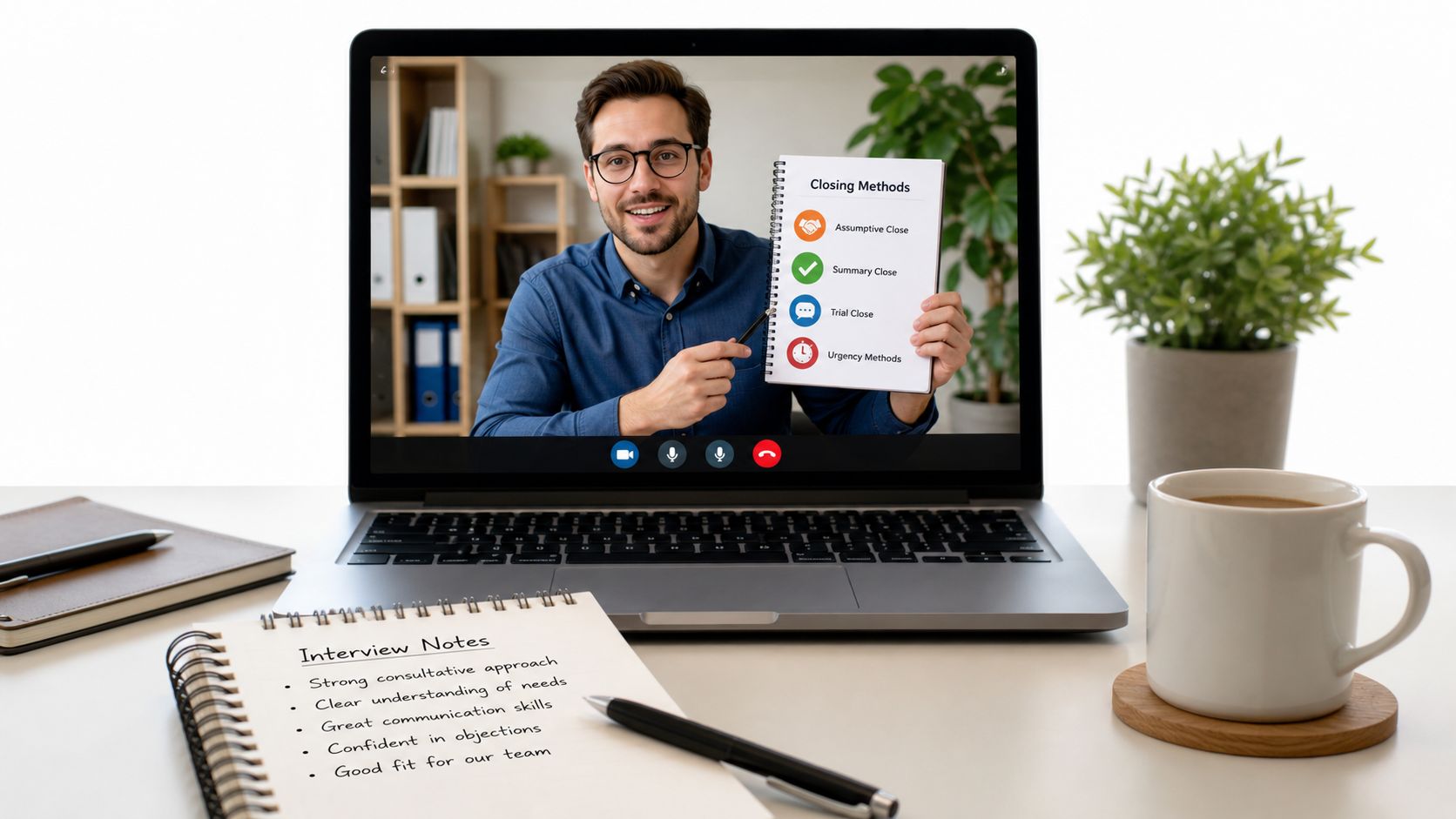
This list is built for that reality. Each question connects to the skill being tested, then shows how remote SDRs and closers can answer in a way that sounds credible. You'll see how to handle background, deal execution, prospecting, resilience, process, objection handling, prioritization, motivation, company fit, and collaboration. If you're preparing for remote opportunities you found through Virtustant Jobs, these frameworks will help you turn experience into proof.
For extra perspective, it's also worth reviewing Overvue's sales interview guide.
1. Tell Me About Your Sales Experience
This question sounds simple, but it exposes weak positioning fast. If your answer is a long career history with no through-line, the interviewer hears a candidate who hasn't learned how to sell themselves. In a remote role, they're also listening for independence, tool fluency, and whether you can manage your own output without being chased.
A strong answer should sound like a commercial, not an autobiography. Start with where you've sold, who you sold to, what motion you handled, and how your work fits the role in front of you. If you're interviewing for an SDR role, emphasize outbound activity, qualification discipline, and handoff quality. If you're interviewing for a closing role, emphasize discovery, multi-stakeholder management, demos, proposals, negotiation, and forecast ownership.
Build a two-minute version
Keep this answer tight. Pick three points: your current sales scope, a past result or challenge, and why that background matches this role.
- For an SDR answer: Focus on target account research, outreach sequencing, qualification, CRM hygiene, and booking quality meetings.
- For a closer answer: Focus on running full-cycle deals, uncovering pain, handling objections, and moving buyers from demo to signature.
- For remote credibility: Mention the systems you work inside, such as HubSpot, Salesforce, Pipedrive, Outreach, or Zoom.
Practical rule: If the interviewer can't tell whether you're better suited for prospecting or closing after your first answer, your framing is too vague.
A concise example for an SDR might sound like this: you've worked in outbound sales, built targeted lists, personalized outreach, qualified based on fit and urgency, and coordinated clean handoffs to account executives. A closer's version might explain that you managed a remote territory, ran demos over Zoom, kept deal notes current in the CRM, and stayed disciplined on follow-up when buyers went quiet.
If you're applying across borders, mention operating in U.S. business hours when relevant, especially if the role expects overlap with EST.
2. Walk Me Through Your Largest Deal From Prospect to Close
This question is where interviewers separate real operators from polished storytellers. You can't answer well without understanding your own sales process. The best responses feel chronological, specific, and honest about what nearly broke the deal.

Don't jump straight to the happy ending. Start with where the opportunity came from. Then explain what the buyer cared about, how you qualified the deal, who the stakeholders were, what friction showed up, and what you did at each stage. A remote closer should mention how they managed calls, demos, documents, and follow-up without relying on in-person momentum. A remote SDR can still answer this well by walking through a sourced opportunity that turned into meaningful pipeline.
The structure that works
Use a simple sequence:
- Origin: Inbound, outbound, referral, expansion, or partner-led.
- Discovery: What problem surfaced, and how you confirmed it mattered.
- Stakeholders: Who influenced the deal and when they entered.
- Obstacle: Budget, timing, legal, internal alignment, or competitive pressure.
- Close: What created movement at the end.
One of the strongest versions of this answer includes something you'd improve. That makes you sound trustworthy. If you present every step as flawless, experienced interviewers usually stop believing you.
You should also expect follow-ups about your role. If the deal involved a solutions consultant, customer success, or finance, be clear about what you owned versus what the team supported. Remote hiring managers especially care about this because distributed teams need reps who know how to move work forward without hiding behind “we.”
3. How Do You Approach Lead Research and Qualification
Weak candidates talk about hustle here. Strong candidates talk about selection.
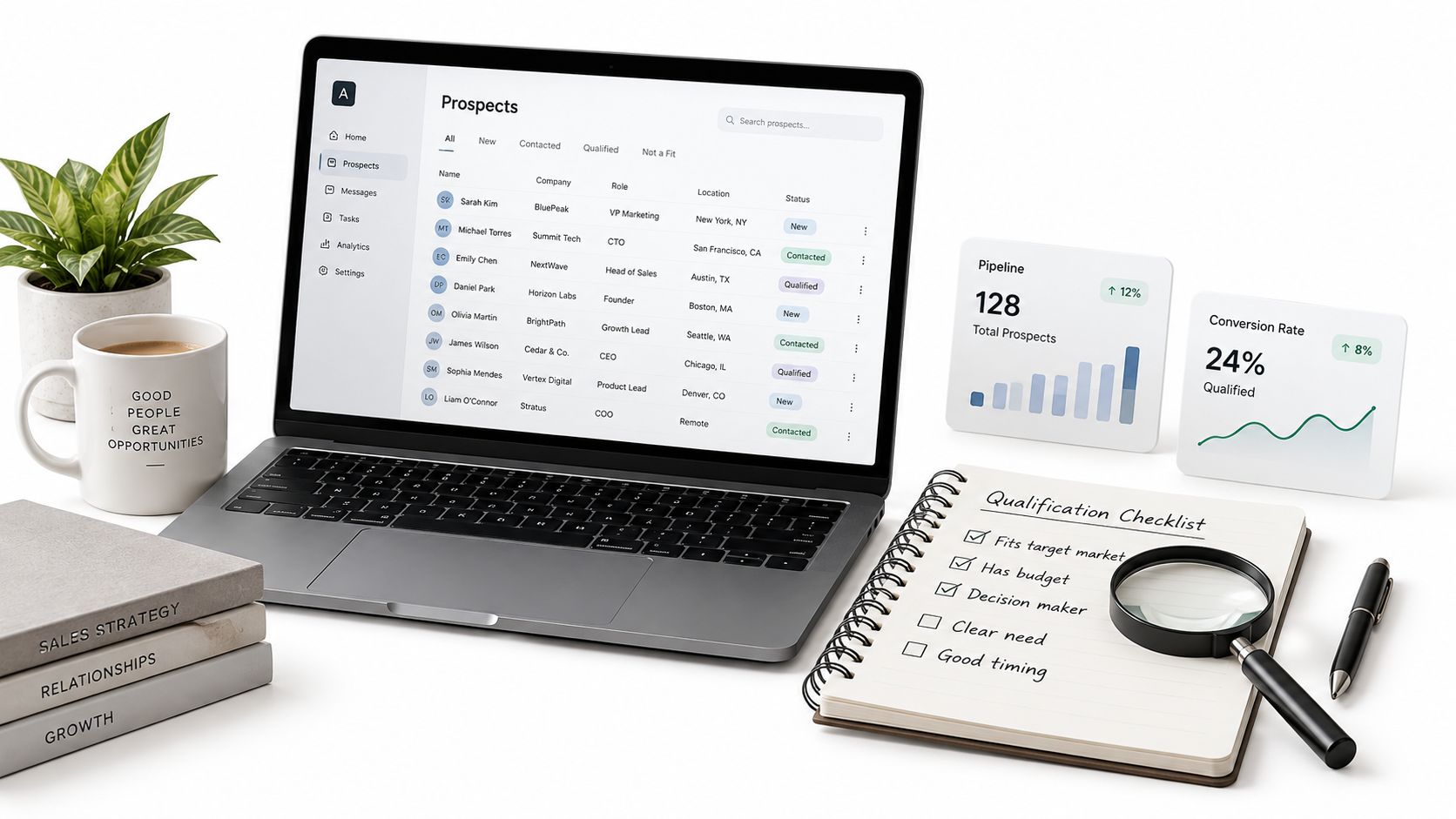
If you're interviewing for an SDR or outbound role, this answer tells the company whether you generate signal or noise. They want to know if you understand fit, timing, and messaging context, or if you just send high-volume outreach to bad targets. This matters in remote teams because your manager won't always sit beside you correcting poor targeting in real time.
A credible answer explains your research flow. For example, you identify the right company segment, confirm role relevance, look for business triggers, and then personalize based on something connected to the buyer's priorities. Mentioning tools is useful if you know how you use them. LinkedIn Sales Navigator, Apollo, Clearbit, RocketReach, Hunter, HubSpot, and spreadsheets are all fine to name when they support a real process.
What interviewers want to hear
Your answer should show judgment in four areas:
- Targeting: How you narrow the market instead of chasing everyone.
- Qualification: How you decide who is worth pursuing now.
- Personalization: How you tailor messages without wasting time.
- Tracking: How you record touches, outcomes, and next steps.
Recent sales hiring guidance also points to a newer blind spot. Questions about AI use are showing up more often, especially around prospecting, account research, and pipeline management, according to Apollo's guide to the best sales interview questions. If you use AI, explain where it helps and where you still verify manually. Good interviewers don't want “I use AI for everything.” They want to hear that you use it to accelerate preparation, not replace thinking.
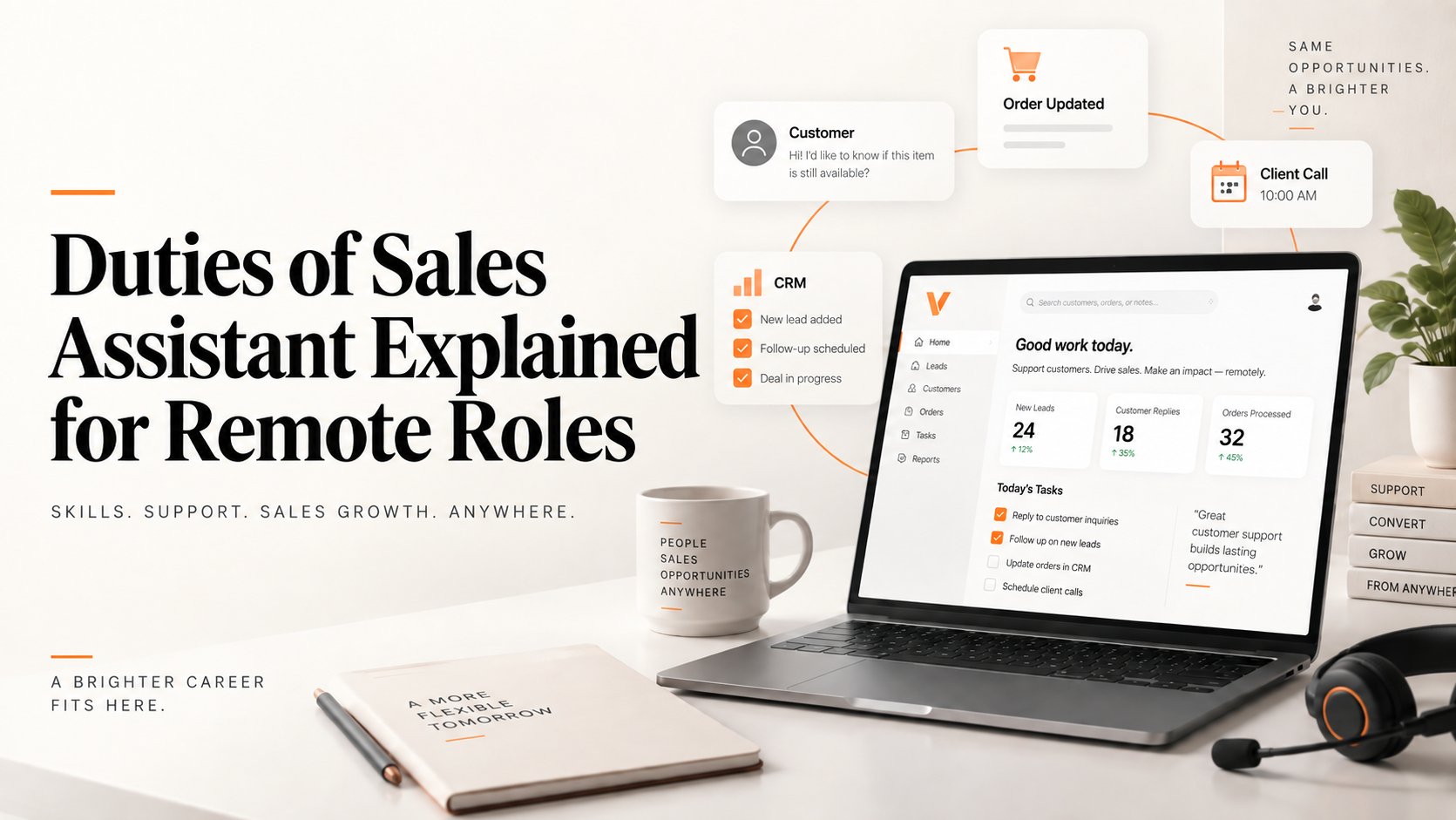
If the role includes sales support or sales-assistant responsibilities, reviewing these sales assistant duties can help you align your answer with calendar management, lead follow-up, note accuracy, and workflow support.
A short video walkthrough can also help you hear how qualification answers sound out loud before an interview:
4. How Do You Handle Rejection or a Lost Deal
This answer reveals your maturity more than your toughness. Everyone says they're resilient. Interviewers believe it when you can explain what a loss changed in your behavior.
The mistake here is trying to sound unaffected. If you say lost deals don't bother you, you may come across as detached or careless. The better move is to admit disappointment, then show how you diagnose the loss. In remote work, that matters because setbacks feel heavier when you're working alone and don't have instant team energy around you.
Show reflection, not drama
A useful answer has three parts. First, describe the loss clearly. Second, identify the lesson. Third, explain the adjustment you made afterward.
Some losses come from bad timing. Others come from weak discovery. Strong candidates know the difference.
For example, maybe you lost a deal because finance entered too late, or a prospect stopped replying because urgency was never established in the first place. A good answer doesn't blame the buyer. It shows you can separate what was outside your control from what you should have caught earlier.
For remote SDRs, this might mean explaining how you moved a ghosting prospect into a nurture sequence instead of forcing follow-up that was going nowhere. For closers, it might mean showing how you now map stakeholders earlier or confirm procurement steps before forecasting a close.
If you ask for coaching after a loss, say so. If you review calls, deal notes, or email threads to spot weak points, say that too. The point isn't to sound invincible. It's to sound coachable and accountable.
5. Describe Your Sales Process and Sales Methodology
Remote sales interviews often test whether you can explain a full process end to end. Published remote-sales question lists include prompts like “Explain your complete sales process from first contact to close,” “How have you handled objections in past sales calls?” and “How do you structure follow-ups for high-ticket clients?” in Adam Cerra's remote sales interview guide. If you can't describe your process clearly, the hiring manager may assume you rely too much on improvisation.

This answer should sound organized. Not theoretical. Walk through the stages you follow, the criteria for advancing a deal, and the tools that keep your process visible. If you use a framework such as consultative selling, MEDDIC, BANT, or your own modified version, explain it plainly.
Make your methodology usable
Break it into stages the interviewer can picture:
- Prospecting or intake: How opportunities enter your pipeline.
- Discovery: What you need to learn before presenting anything.
- Qualification: What must be true for the deal to advance.
- Presentation: How you tailor demos, proposals, or next steps.
- Commitment: What has to happen before you forecast confidently.
The strongest answers also explain what you don't pursue. Saying “If they fail our fit criteria, I don't keep pushing” signals discipline. That's especially valuable in remote teams, where self-management matters as much as energy.
You can also make this answer stronger by naming how you adapt for asynchronous communication. Maybe you recap every call in email, send short Loom videos for clarity, track next actions in the CRM, and use calendar holds to protect prospecting time. Those details show operational maturity, not just selling instinct.
6. Tell Me About a Time You Had to Overcome a Major Objection
Every sales candidate says they can handle objections. This question asks you to prove it with one real situation.
Good answers don't frame objections as battles. They show that you listened well enough to identify the concern. In many deals, the stated objection isn't the blocker. “Too expensive” can mean low urgency, weak internal consensus, fear of implementation, or lack of trust in expected outcomes.
Separate the stated issue from the real issue
Start by naming the objection exactly as the buyer expressed it. Then explain what you learned after asking follow-up questions. Finally, describe the adjustment you made.
A remote closer might explain that a prospect pushed back on price, but the deeper issue was uncertainty around adoption. So instead of discounting early, they brought in implementation context, clarified rollout steps, and reconnected the commercial terms to buyer goals. A remote SDR might describe hearing “not interested,” then discovering the timing was wrong and setting a better future entry point.
Field note: If your first instinct is to counter an objection immediately, you're probably answering too fast.
Sales-interview guidance has moved toward these more behavior-based questions partly because conversation quality matters. One cited Sales Insights Lab report found that top performers contributed more than 49% of a discovery-call conversation and spoke more slowly than less experienced reps, as noted in The Knowledge Academy's sales interview question guide. That's useful context for this answer. Interviewers often want evidence that you can stay composed, pace the conversation, and uncover what's underneath the objection.
For a useful refresher on phrasing and objection response patterns, review EmailScout's sales objection guide.
7. How Do You Prioritize and Manage Multiple Deals or Prospects
This is a remote-work question disguised as a sales question. Yes, they care about pipeline management. They're also testing whether you can run your week without someone hovering over your calendar.
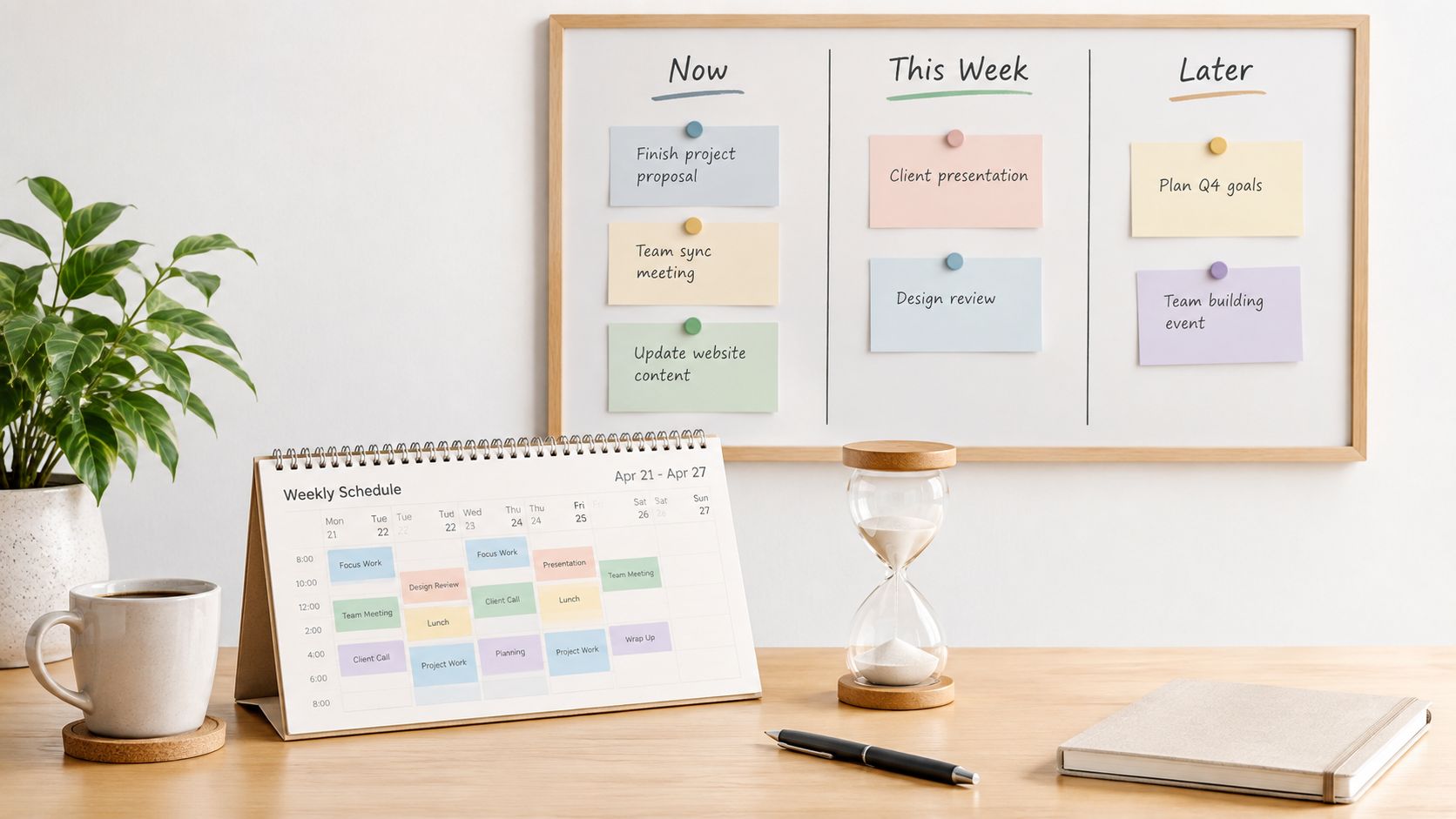
Weak answers sound emotional. “I focus on whatever feels most urgent.” Strong answers sound systematic. “I review close dates, stage, probability, stakeholder activity, and next action, then block time accordingly.” In remote roles, the second answer is much more reassuring because it suggests you won't let important work disappear inside a messy pipeline.
Explain your operating rhythm
A good answer usually includes:
- Review cadence: Daily checks, weekly pipeline reviews, or end-of-day next-step planning.
- Priority rules: Close date, value, deal health, responsiveness, and effort required.
- Tool discipline: Salesforce, HubSpot, Notion, spreadsheets, calendar blocks, task queues.
- Conflict handling: What you do when multiple deals need attention at once.
If you're an SDR, your version may focus less on forecasting and more on sequence management, follow-up timing, and list hygiene. If you're a closer, talk about stage-based planning and working backward from target close dates.
Remote candidates should also address time-zone discipline. Multiple remote-work guides recommend a defined overlap window instead of vague availability. One guide recommends 8am to 12pm EST as a strong overlap block, while another notes that 3 to 4 hours is a common target, and a separate resource says 4 to 6 hours can support productivity in nearshore LATAM collaboration, according to WorkAnywhere's time-zone overlap guide. In practice, that means your answer can include when you schedule live calls, when you do deep work, and how you keep momentum when prospects or teammates are offline.
8. Why Do You Want to Work in Sales for Our Company Specifically
Interviewers use this question to detect seriousness. Generic enthusiasm won't carry you far. “I love sales” and “your company seems great” tell them almost nothing.
A strong answer shows that you understand what the company sells, who it sells to, why the role matters, and why your background fits that environment. For remote candidates, this is also a chance to show that you've read the posting carefully. Schedules, software stacks, language expectations, market focus, and buyer type all matter. If the company sells into the U.S., mention relevant experience with U.S. working hours, cross-border communication, or English-language selling when it's true.
Research signals that actually matter
Focus on specifics such as:
- The product or service: What problem it solves.
- The market: Who buys it and why now.
- The role scope: SDR, AE, account management, partnerships, or sales support.
- Your alignment: Industry knowledge, language ability, region familiarity, or tool overlap.
The best company-fit answers connect your motivation to the buyer problem, not just the brand.
This is one of the easiest places to stand out because most candidates stop at surface-level research. Before your interview, check the company's recent product messaging, team structure, target customer, and the exact responsibilities in the job description. If you're comparing multiple remote opportunities, browsing the Virtustant Jobs blog can help you get clearer on role expectations across sales, support, and growth functions.
Keep your tone grounded. You don't need flattery. You need fit.
9. How Do You Stay Motivated and Improve Your Sales Skills
In a remote role, self-motivation isn't a personality trait. It's an operating requirement.
This question matters because distributed sales teams can't rely on office energy to carry weak habits. Hiring managers want to hear how you keep improving when no one is watching closely. They also want signs that you measure your own performance instead of waiting for annual feedback.
Make your answer behavior-based
A good response explains how you learn, how you review your own work, and how you keep momentum through repetitive parts of the job.
- Learning: Courses, certifications, books, call reviews, sales communities, or manager coaching.
- Skill review: Looking at reply quality, discovery depth, stage conversion, or objection patterns.
- Motivation: Tying activity to process goals, not just outcomes.
- Remote discipline: Creating routines that prevent drift.
If you mention improvement, anchor it in method rather than unsupported numbers. For example, say you started reviewing recorded calls to tighten discovery questions, or you began documenting what messages earned replies so you could stop repeating weak copy. If you use AI to draft first-pass research summaries or prep call questions, explain how you validate that output before using it.
Language also matters in many cross-border remote sales roles. One remote-work English resource states that customer support and sales roles typically require at least B2 English, with C1 preferred, because the work depends on live chat, email, phone calls, politeness, and persuasive communication, according to Wbridge's guide to English skills for remote work. If you're applying internationally, continuous improvement may include call clarity, written follow-up, and commercial vocabulary, not just sales tactics.
10. Describe a Time You Collaborated With Another Team to Close a Deal
Sales doesn't happen alone, especially in remote environments. This question tells the interviewer whether you can bring in the right people at the right time without creating confusion.
The best answers show judgment. You recognized that another team had expertise you didn't. You made a clear request. You helped them help you. Then you used that collaboration to move the deal forward. That's what mature cross-functional work looks like.
Show clean coordination
A strong example usually includes four elements:
- The reason collaboration was needed: Technical validation, onboarding confidence, integration concerns, legal review, or customer proof.
- The team involved: Marketing, product, support, customer success, operations, or finance.
- Your role: Framing the buyer problem, summarizing requirements, setting urgency, and keeping communication clear.
- The result: Progress in the deal and a better internal relationship.
For remote teams, mention the actual coordination method. Maybe you used Slack, shared docs, email recaps, a recorded walkthrough, or a short internal brief before a live call. That level of detail reassures hiring managers that you won't create hidden work for teammates.
If you're coming from a support, assistant, or marketing-adjacent background and moving into sales, this answer can be especially powerful. Collaboration is often where your prior experience becomes an advantage. For example, understanding how content and messaging work can make you better at requesting buyer-facing assets. If that's relevant to your path, this overview of social media manager and marketing responsibilities can help you explain how marketing and sales often support the same revenue motion.
10 Sales Interview Questions Comparison
| Question (Interview Prompt) | Implementation Complexity 🔄 | Effort & Tools ⚡ | Expected Outcomes 📊 | Ideal Use Cases 💡 | Key Advantages ⭐ |
|---|---|---|---|---|---|
| Tell Me About Your Sales Experience | Low, open-ended, narrative-based | Minimal prep; reference CRM examples & 2–3 metrics | Baseline fit, communication clarity, remote readiness | Early-stage screens, general interviews | Controls narrative; highlights quantified achievements |
| Walk Me Through Your Largest Deal, From Prospect to Close | High, requires detailed timeline and stakeholders | High: deal docs, CRM history, stakeholder notes | Demonstrates end-to-end selling, negotiation, persistence | Final rounds, AE assessments, complex-sale roles | Hard to fake; reveals methodology & problem-solving |
| How Do You Approach Lead Research and Qualification? | Medium, process-oriented with examples | Moderate: LinkedIn, Apollo, ZoomInfo, CRM, research time | Better targeting, higher reply/qualification rates | SDR/BDR, outbound-heavy roles | Shows tool proficiency and scalable workflows |
| How Do You Handle Rejection or a Lost Deal? | Low, behavioral reflection, recent example preferred | Low: one concrete loss + lessons learned | Assesses resilience, coachability, recovery tactics | Any role; especially remote where self-motivation matters | Signals emotional maturity and iterative improvement |
| Describe Your Sales Process and Sales Methodology | Medium, needs clear framework and phases | Moderate: reference MEDDIC/SPIN, Salesforce/HubSpot | Predictable pipeline management, cultural alignment | AE roles, teams needing repeatable processes | Demonstrates repeatability and alignment with company approach |
| Tell Me About a Time You Had to Overcome a Major Objection | Medium, specific objection + resolution required | Low–Moderate: concrete example, possible data/compare | Shows listening, reframing, and objection-handling skill | Closers, negotiation-heavy interviews | Reveals empathy, creativity, and composure under pressure |
| How Do You Prioritize and Manage Multiple Deals or Prospects? | Medium, requires framework and examples | Moderate: CRM discipline, Kanban, calendar blocking | Better forecasting, fewer dropped deals, higher throughput | AEs, remote SDRs juggling pipelines | Evidence of self-management and strategic prioritization |
| Why Do You Want to Work in Sales for Our Company Specifically? | Low, research-driven, concise | Low: company research (press, product, mission) | Signals motivation, fit, and retention potential | Screening & cultural-fit interviews | Demonstrates preparation and genuine interest |
| How Do You Stay Motivated and Improve Your Sales Skills? | Low, habit-focused, ongoing examples | Low–Moderate: courses, podcasts, peer groups, metrics | Growth mindset, measurable skill improvements | Remote roles, self-directed development positions | Shows proactivity and continuous measurable improvement |
| Describe a Time You Collaborated With Another Team to Close a Deal | Medium, cross-functional coordination example | Moderate: Slack/docs, one-pager assets, clear asks | Faster closes, smoother implementations, stronger cases | Enterprise deals, product-integrated sales, remote orgs | Demonstrates influence, stakeholder management, teamwork |
Turn Preparation Into Your Next Remote Sales Opportunity
Most candidates don't fail sales interviews because they lack experience. They fail because they describe that experience too vaguely. They talk about being hardworking, persuasive, and motivated, but they don't show how they prospect, qualify, follow up, manage a remote pipeline, or recover when deals stall. That's what these sales interview questions are really testing.
Your preparation should be practical. Build a two-minute career summary that positions you clearly for the role you want. Prepare one full deal story that you can explain from first contact to close. Write down one objection story and one loss story, including what changed in your process afterward. Map your sales process in plain language so you can explain how opportunities move forward and where you apply judgment.
Then create separate versions for SDR and closer interviews. SDR answers should emphasize research, outreach discipline, qualification, handoff quality, and activity organization. Closer answers should emphasize discovery, stakeholder management, demos, proposals, negotiation, and forecast reliability. Many candidates blend these together and end up sounding generic. Don't make the interviewer guess where you fit.
Before applying, read each posting carefully. Verify the schedule, language level, tools, reporting line, responsibilities, and seniority. That matters even more in remote hiring, where details such as EST alignment, English expectations, CRM familiarity, and independent execution can change whether you're a match. Application experience matters too. A 2026 summary of Appcast data reported that applications taking under five minutes had a 12.47% completion rate, compared with 3.61% for applications taking more than 15 minutes, and added that long forms can cost roughly 71% of completion rate, according to PIN's summary of the application-length drop-off study. For candidates, the takeaway is simple. Complete strong applications while the role is fresh and your information is ready.
If you're actively exploring remote sales work, create or complete your profile on Virtustant talent. Then browse current remote job openings and apply to roles that match your experience, working style, and language level. Remote sales interviews reward clarity. If you can explain how you sell, how you work, and how you stay accountable without constant supervision, you'll give hiring teams what they're looking for.
If you're preparing for SDR, BDR, sales support, or closing roles, Virtustant Jobs gives you a practical place to find remote openings with clearer details on responsibilities, schedules, tools, and language expectations. Build your profile, review matching roles carefully, and submit complete application information so your interview preparation turns into real opportunities.