
You're scrolling through remote job posts from home or a coworking space, and the title looks simple enough, Sales Assistant. Then the posting starts asking for customer follow-up, CRM updates, quote support, and maybe even U.S. business hours, and the job suddenly feels less like a store floor role and more like a hybrid operations job. That confusion is normal, because the duties of sales assistant have expanded far beyond the old image of someone just standing at a till.
Across major labor markets, official occupation profiles show the role has always combined service with transactions and store support. Australia's official occupation classification includes processing sales transactions and handling payments through point-of-sale systems, while Canada's national description includes greeting customers, discussing needs, quoting prices, preparing sales contracts, and accepting several payment types. The UK profile also includes returns, stock rotation, unpacking deliveries, merchandising, and keeping the store tidy. Together, these responsibilities show how broad the job can be, even before remote sales support is added to the mix.
For candidates applying to remote roles, this matters because many listings now look like a blend of customer service, sales operations, and documentation. You're not just deciding whether you can “talk to customers.” You're deciding whether you can handle the full flow, from first inquiry to follow-up, while staying organized in tools like POS systems, CRMs, and inventory platforms.
Introduction to the Modern Sales Assistant Role
A customer asks a question, an associate answers, rings up the sale, and keeps the line moving. That is part of the job, but only part. Government-backed role descriptions, including Australia's occupation profile, show that sales assistants also handle stock, returns, promotions, and operational support across retail settings. The role therefore sits somewhere between customer service and day-to-day business operations.
For professionals reviewing remote work opportunities, that broader definition matters. Some postings still resemble traditional retail support, but others ask for lead routing, CRM upkeep, quote tracking, inbox triage, and follow-up coordination. The same job title can therefore ask for the calm tone of a store associate and the discipline of a sales coordinator.
A useful rule is simple. If a posting mentions both customer contact and systems work, treat it as a hybrid role.
The daily focus also changes with the employer. A local shop may care most about floor presence, till accuracy, and merchandising. A cross-border remote team may care more about written English, response speed, documentation, and how reliably you move a lead from one step to the next. Floor work is like serving customers on the shop side of the counter, while remote sales support often works like the back office that keeps the whole flow organized.
This guide breaks the role into duty clusters, then compares remote and in-store expectations. It also covers the skills and tools employers usually expect, the wording that signals seniority, and how to tell whether a post fits retail support, inside-sales support, or a broader hybrid function.
What a Sales Assistant Really Does
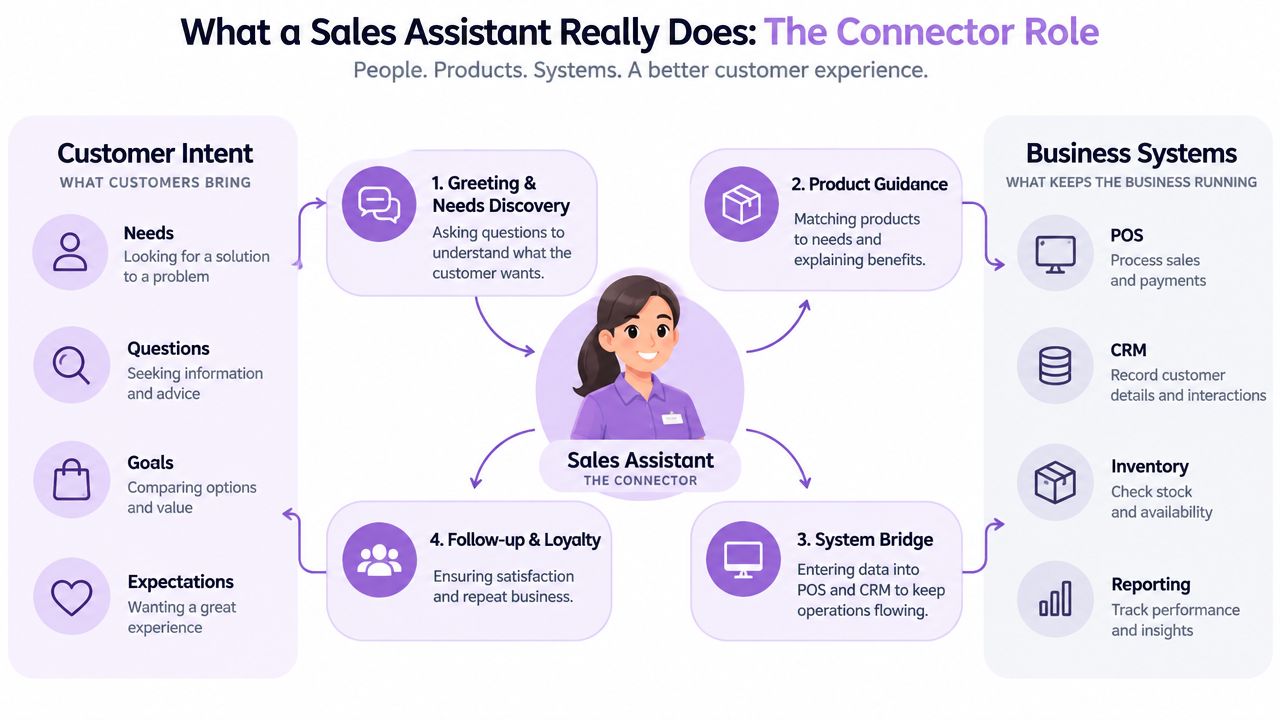
A sales assistant sits between customer intent and business systems. The customer explains a need, the assistant turns that need into a clear action, and the business gets a clean transaction, a correct record, or a next step for the sales team. That is why the role is more than being pleasant at the front line. It helps prevent customer interest from getting lost before it becomes action.
The role starts with discovery
The first task is to understand what the customer wants. That usually means greeting people, asking a few focused questions, and narrowing the options so the customer does not have to sort through everything alone. A strong assistant translates a vague request into a practical recommendation.
The job begins to resemble a guide. In a store, the assistant may help a shopper choose a size, style, or model. In a remote sales team, the same skill can mean reading a short inquiry, clarifying the offer, and preparing the next reply so the conversation keeps moving.
The role then bridges to the system
Once the customer is ready, the assistant must make the handoff accurate. That can mean processing payment through a POS system, recording the order, checking pricing, or updating customer details in a CRM. If the conversation is good but the record is wrong, the work still falls apart.
For remote job seekers, this is the part that often matters most in cross-border postings. The assistant may not stand in front of a shelf all day, yet still has to keep the sales pipeline organized, route leads correctly, and manage inboxes so the right person sees the right message at the right time. It is back-office coordination with a sales purpose.
The role does not end at checkout
Post-sale work belongs here too. Returns, packaging, inventory checks, and follow-up all sit inside the same job family. In retail, that keeps the store moving. In remote sales support, it keeps the pipeline clean and prevents the next person from starting with missing information.
The simplest way to judge the role is this, if the assistant's work helps the customer decide and helps the company record that decision correctly, it belongs in the job.
That is why the title shows up in retail stores, wholesale settings, and remote commercial teams. The setting changes, but the logic stays the same, reduce friction, improve service, and keep the sales process organized.
Core Duties That Define Daily Work
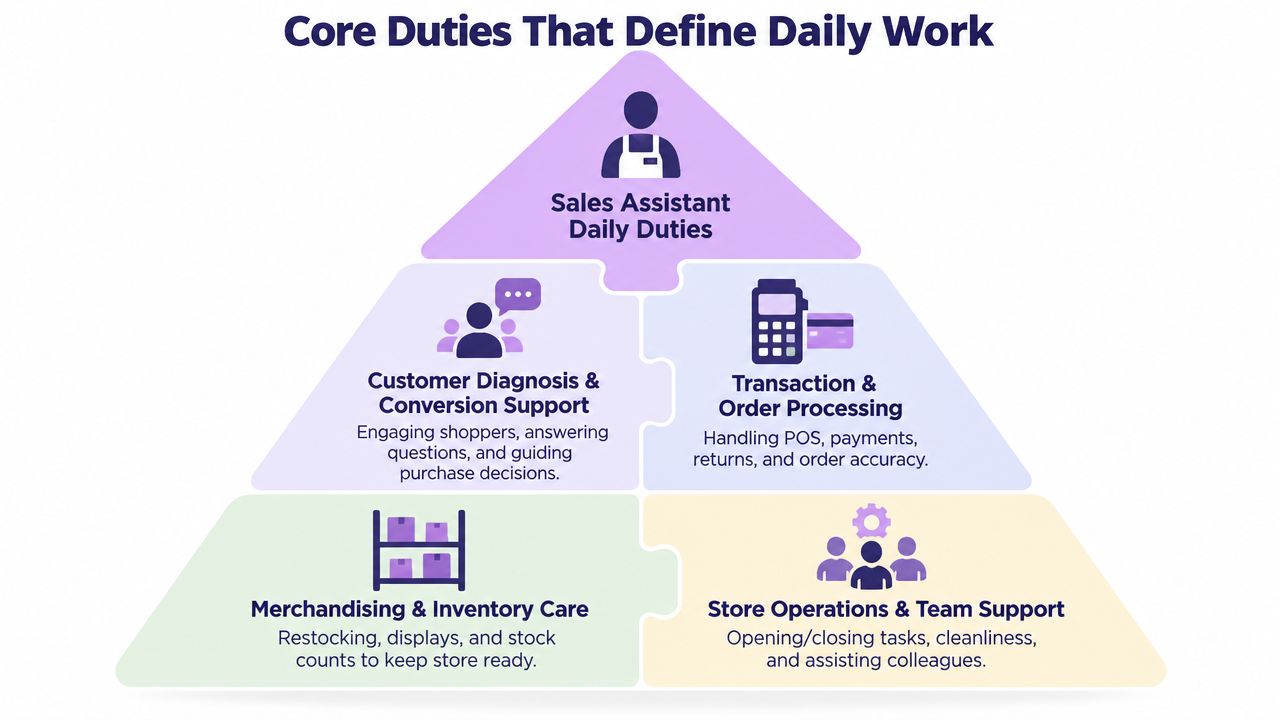
A sales assistant's day usually falls into four overlapping duty clusters. The tasks look separate on paper, yet they all serve one goal, turning interest into completed sales without letting the store or support system get messy. The mix changes by employer, but the pattern stays familiar across retail floors and remote support roles.
Customer diagnosis and conversion support
This is the conversation side of the job. The assistant greets the customer, asks what they need, and points them toward the right product or service. In a store, that may mean helping someone choose a size, style, or model. In a remote sales team, it can mean clarifying an offer, answering a first question, or handing the lead to the right person once the conversation is ready to move.
This duty shapes whether curiosity becomes action. Product knowledge, tone, and timing all affect the customer's next step. If the assistant moves too fast, the customer may drift away. If the assistant listens carefully, the sale often gets easier.
Transaction and order processing
This is the accuracy side. Sales assistants process sales, accept payments, handle returns, and make sure the record matches what the customer bought. Official job descriptions for the role also point to point-of-sale software and routine payment handling, which shows how much the job depends on clean records.
A mistake here creates immediate friction. Wrong prices, missing items, or poorly handled returns slow the work down and can weaken trust. In remote settings, the same problem shows up when a quote, lead, or order is entered badly, because the next step starts with incomplete information.
Merchandising and inventory care
A sales assistant also helps keep the selling space ready. That includes restocking, arranging displays, rotating stock, unpacking deliveries, and checking inventory levels. The job profile for the role lists these duties directly, and the logic is simple, customers buy what they can see and what is available.
Practical rule: if a shelf is empty, messy, or outdated, the assistant is not just tidying up, they may be preventing lost sales.
Store operations and team support
The last cluster is the work that keeps everything running in the background. It can include cleaning, opening or closing tasks, promotions, and helping coworkers during busy periods. It is less visible, but it protects service quality and keeps the floor usable for the next shift.
How Remote and In Store Duties Differ
The same title can hide very different day-to-day work. Traditional retail versions still center on the floor, while remote cross-border versions often add messaging, documentation, and pipeline coordination. That's the part many applicants miss, and it's why the job can feel familiar at first glance but much broader once you read the tasks carefully.
| Duty Area | Traditional In Store Focus | Remote Cross Border Focus |
|---|---|---|
| Customer contact | Greeting shoppers, answering product questions, serving at tills | Answering inquiries, following up by email or phone, supporting online conversations |
| Sales movement | Helping customers choose, suggesting add-ons, closing at the register | Routing leads, tracking quotes, coordinating follow-up, supporting booking or conversion steps |
| Systems work | POS handling, returns, stock updates, basic records | CRM updates, lead organization, documentation, inbox management, light e-commerce support |
| Operations rhythm | Stock shelves, unpack deliveries, arrange displays, keep the floor clean | Keep records current, manage response timing, support U.S.-aligned schedules, maintain consistency across time zones |
Remote postings also tend to put more weight on written communication. For cross-border roles, that can mean strong English, clear documentation, and the ability to work on a schedule aligned with the hiring company's business hours. Those are not side notes, they're part of the operating model.
A practical way to read a posting is to ask where the work happens. If most tasks live on the sales floor, the role is probably retail support. If most tasks live in a CRM, inbox, or quote workflow, it's closer to inside-sales support. If both are present, you're looking at a hybrid job.
The title tells you very little. The duty mix tells you almost everything.
That's why applicants should read for verbs, not just labels. “Greet,” “stock,” and “serve” point to store work. “Route,” “document,” “follow up,” and “update CRM” point to sales-operations work. If both sets appear, the role probably expects you to move between conversation and systems with very little handholding.
Essential Skills Software and Tools You Will Use
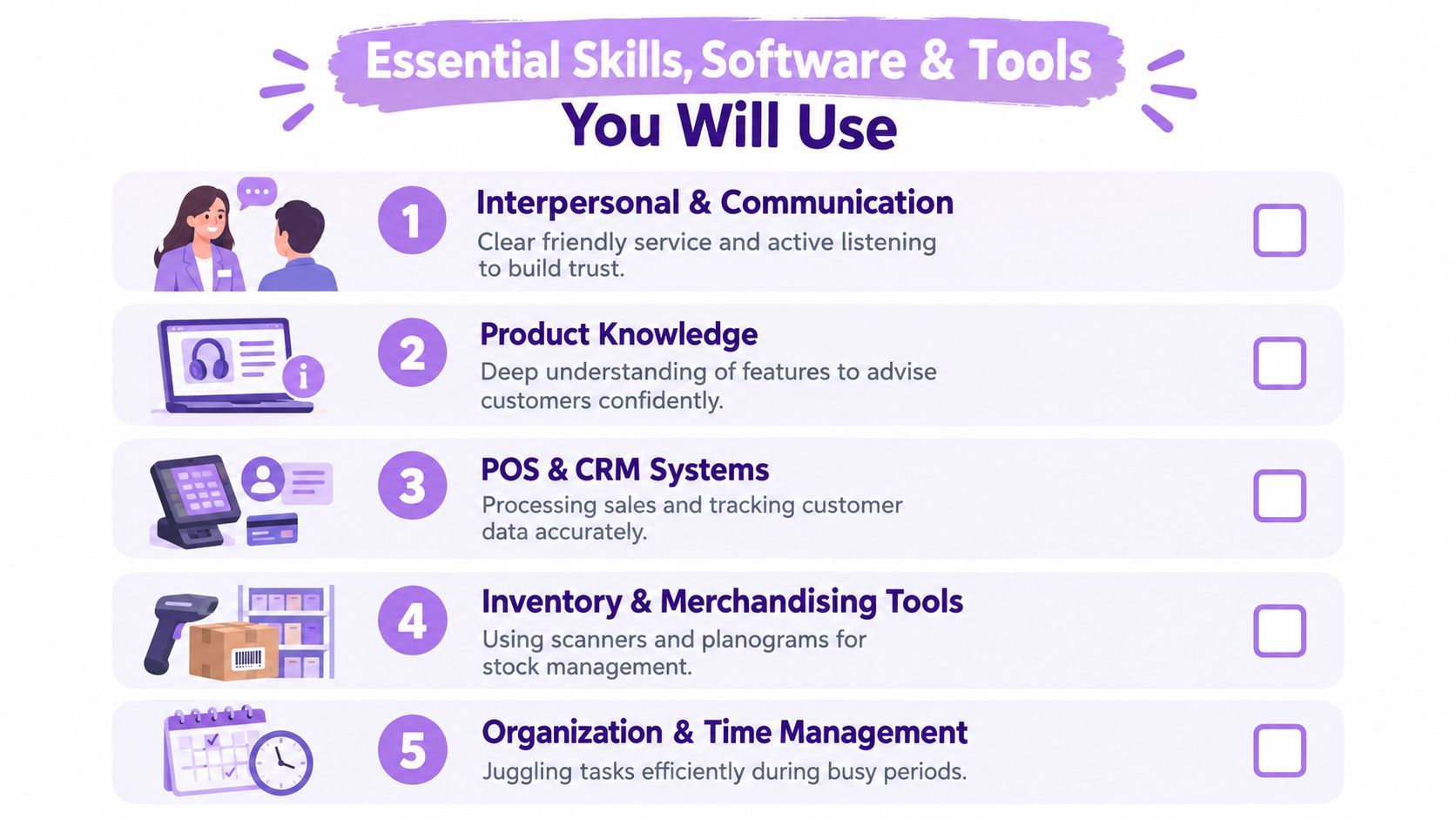
A sales assistant's duties become much easier to read once you connect them to the skills and tools behind the work. Employers are usually looking for people who can speak clearly, keep records accurate, and stay steady when the pace picks up. If that role is mainly in a store, the toolkit centers on customer contact and transaction support. If it is a remote or hybrid sales-operations role, the same foundation extends into inboxes, CRM updates, and lead handoffs.
Skills that matter in almost every version
Interpersonal communication sits at the center. You need to ask good questions, listen closely, and explain options in plain language. That matters whether you are helping a shopper compare products or helping a lead understand the next step in a sales process.
Product knowledge comes next. The better you understand features, benefits, and common objections, the easier it is to guide people without sounding scripted. In retail, that supports suggestions at the counter. In remote sales support, it helps with quote handling and early-stage questions.
Tools that connect service to operations
POS systems handle payments, returns, and transaction accuracy. As noted earlier in role descriptions and occupational classifications, point-of-sale software belongs in the job, because it supports the daily flow of retail work. A sales assistant who understands the register is handling the cash-and-customer side of the role.
CRM platforms matter more in remote roles. They help you track leads, organize deals, and keep follow-up visible. If a posting mentions deal creation, lead assignment, or customer records, CRM familiarity should be treated as part of the core job. In practice, the system works like a shared notebook for the whole sales team, so nothing gets lost between one handoff and the next.
Inventory and merchandising tools support stock counts, display work, and reordering. That can include scanners, inventory databases, or other systems that show what is on hand and what needs attention. For in-store work, these tools keep shelves accurate. For cross-border support, they help you stay aligned with what the team can sell.
What to show on a resume
List the tools you have used, then connect them to results. Instead of saying you “used software,” say you handled POS transactions, updated customer records, or maintained stock visibility. If you have worked with light e-commerce support, include that too, because many remote postings now sit closer to sales operations than to classic retail.
Resume test: if a hiring manager cannot tell which system you used and what task you completed, the bullet is too vague.
For remote job seekers, the most useful habit is to match each tool to a duty. POS for payments. CRM for follow-up. Inventory systems for stock control. Communication tools for customer contact. That mapping shows that you can step into a real workflow, not just list general office experience.
How to Spot Seniority and Expectations in Job Posts
Job posts often hide their real difficulty in the wording. Two roles may both say “Sales Assistant,” but one is entry-level retail support and the other expects you to manage leads, document activity, and coordinate handoffs with little supervision. The difference shows up in verbs, tools, and the level of judgment required.
Read the verbs first
When a post says greet, help, ring up, or stock, it's usually describing a more task-based role. When it says qualify, route, document, maintain CRM, or follow up, the role is asking for more process ownership. That second group usually means the company expects you to move work forward, not just respond to it.
Watch for hidden operating requirements
Some remote listings build in rules that affect fit even if they're not framed as duties. U.S.-aligned hours, strong English, and written documentation standards are often part of the job itself, because the team needs someone who can work inside a shared schedule and keep records clean across borders. For international candidates, those details are often more important than the title.
| Signal in the posting | What it often means |
|---|---|
| Lead routing, quote support, CRM upkeep | More sales-operations responsibility |
| Answering calls, inbox monitoring, follow-up emails | Stronger communication and coordination load |
| Booking, documentation, metrics | More autonomous remote work |
| POS, stocking, displays, returns | Traditional retail floor responsibility |
A quick self-check helps. If you have examples of customer conversation, order accuracy, and tool use, you can usually apply to a broader set of roles. If your experience is mainly in-store, target roles that emphasize floor service and transaction handling first. If you've already done CRM work or coordinated leads, you can reasonably consider remote sales support postings that expect more structure.
Read the posting like an operations map, not a title tag. The real question is whether you're being asked to serve, sell, record, or coordinate.
One place candidates can search for these clearer postings is Virtustant Jobs, because the listings are organized around remote roles with explicit responsibilities, software stacks, schedules, and language expectations. That makes it easier to compare your background with the actual work instead of guessing from the title alone.
Your Next Steps to Landing a Remote Sales Assistant Role
The modern sales assistant role is no longer just a counter job. It can include customer guidance, payment handling, merchandising, CRM updates, lead routing, and follow-up work, especially in remote cross-border settings. If you remember only one thing, make it this, the title is simple, but the duty mix is what decides whether the job fits you.
A good application starts with matching your experience to the four duty clusters, customer support, transactions, merchandising, and operations support. Then add the software you've used, such as POS, CRM, inventory databases, or e-commerce tools. If a posting asks for written communication, schedule alignment, or documentation discipline, show evidence of that too.
Before you apply, check three things. First, are the tasks mostly retail floor work or sales-operations work. Second, do your tools and language skills match the posting. Third, can you explain your experience in the same operational language the employer uses. That's how you move from “interested” to “credible.”
If you're ready to compare your background with real remote openings, visit Virtustant Jobs and review roles that spell out duties, tools, schedules, and language expectations clearly. It's a practical way to find sales assistant positions that match the hybrid work you've just learned to recognize, and to apply with a stronger sense of fit.