You're in the middle of a familiar mess. One tab is TikTok comments, another is an Instagram draft, LinkedIn needs a post by noon, and customer DMs keep piling up while someone in sales asks whether social is driving pipeline. That's the moment a social media manager stops being “the person who posts” and becomes the person who keeps the whole social engine moving.
For remote teams, especially LATAM hires working with U.S.-based growth orgs, that role matters even more. The job isn't just to make content look good, it's to connect audience signals to brand voice, search visibility, retention, and revenue, while keeping everyone aligned across time zones and channels. If you're hiring, onboarding, or stepping into the role yourself, you need a simple mental model before you can do the work well, and a practical way to judge what success looks like. Virtustant Jobs blog
Introduction to Social Media Manager Marketing Today
A brand can look busy online and still be moving nowhere. One teammate schedules a reel, another replies to comments, someone else handles a LinkedIn announcement, and sales keeps asking why no one can connect social activity to actual business outcomes. In that chaos, social media management is the function that turns scattered activity into a system.
For a new LATAM remote hire, that system thinking is essential. You're often joining a team that expects clean handoffs, clear documentation, and fast context switching between platforms, languages, and markets. You're not just filling a content calendar, you're learning how social supports discovery, trust, and conversion across the customer journey.
The easiest mistake is to think the role starts and ends with posting. It doesn't. A strong manager reads comments like customer research, sees platform data like a mini dashboard, and treats every post as one more signal in a larger growth loop. That's why social teams sit close to content, paid media, lifecycle marketing, customer support, and sales.
For candidates, understanding the role this way makes it easier to show employers that you can do more than create posts. Strong social media managers can explain how their work supports brand awareness, customer engagement, lead generation, retention, and the wider growth team. That matters even more in remote roles where clear communication and ownership are essential.
Good social work is less about filling feeds and more about connecting signals.
This guide moves from basics to execution, then into measurement, tools, team fit, and remote collaboration. By the end, you'll know how the role works, what to optimize, how to measure value, and how to spot whether a candidate or team structure is ready for modern social media manager marketing.
What a Social Media Manager Actually Does
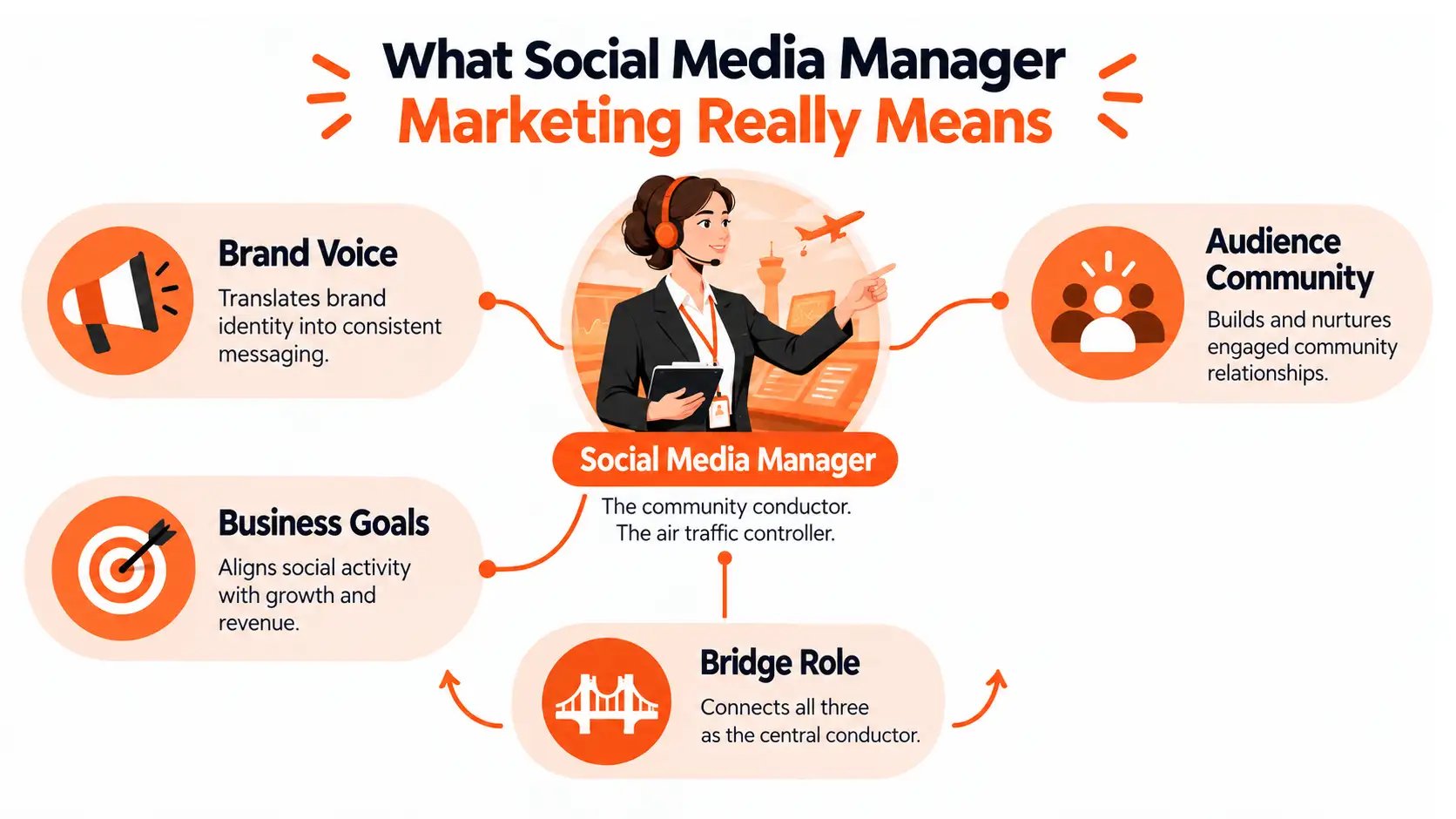
A social media manager works like a community conductor and an air traffic controller at the same time. One side keeps the brand voice steady. The other makes sure content, comments, timing, and business goals reach the right place without collisions. That is a better fit than “content poster,” because the job is coordination.
The role sits between brand, audience, and business goals. Brand sets the voice and positioning. Audience brings signals, questions, objections, and needs. Business goals decide what social should support, whether that is awareness, demand, retention, or customer care. The manager keeps those three pieces aligned.
That is also why the role differs from general marketing. Broader marketing often sets campaign direction, while social media management runs the day-to-day operating system that keeps the campaign active. It also differs from pure content creation, because a creator can make posts without owning response loops, publishing cadence, listening, reporting, or channel-specific judgment.
Why companies keep investing in the role
The role has become a specialized marketing function rather than a task simply handed to an intern or junior team member. Compensation varies significantly by experience, location, industry, platform expertise, and whether the position includes broader growth responsibilities. The Robert Half salary guide is a useful reference for understanding how employers value experienced social media professionals.
For remote candidates, the bigger takeaway is that social media management has developed into a genuine career path with room to progress into content strategy, community leadership, growth marketing, and broader marketing management roles.
A practical way to define the function
A social media manager owns the operating layer of social, not just the creative layer. The person is responsible for how a brand shows up, how it responds, and how it learns. Companies invest in that role because inconsistency is expensive, and social is one of the few channels where brand perception can shift in public, in real time.
That is also why freelancers and generalists can struggle once the channel becomes strategic. If the brand needs steady cadence, bilingual moderation, reporting, and cross-functional coordination, the job becomes a real business function. It needs ownership, not just output.
Core Responsibilities That Drive Marketing Results
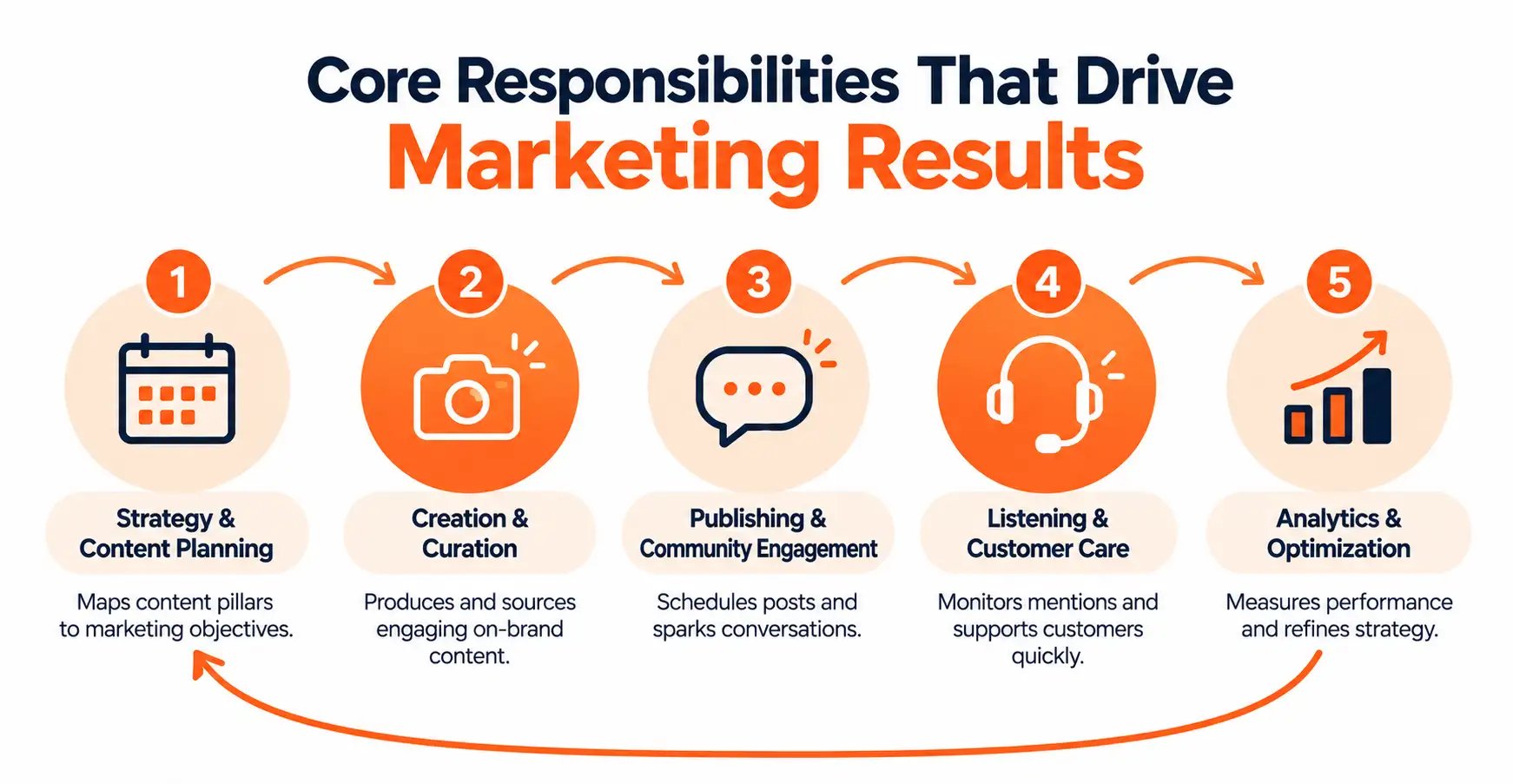
A good manager doesn't wake up and “make posts.” They run a loop. The loop starts with planning, moves through creation and publishing, and comes back through listening and reporting so the next week is better than the last. That's the difference between activity and a system.
The weekly operating rhythm
The first responsibility is strategy and content planning. That means mapping content pillars to business goals, deciding which platform deserves attention, and choosing formats that fit the channel instead of forcing one idea everywhere. A manager who does this well is usually planning a week or two ahead, not improvising at the last minute.
The second step is creation and curation. Some posts are built from scratch. Others come from product demos, customer stories, podcast clips, webinar snippets, or founder commentary. If your team works remotely, async handoffs matter, because design, copy, and approvals may happen in different time zones.
The third responsibility is publishing and community engagement. That's not just scheduling. It's reviewing the post before it goes live, checking that the timing fits the platform, and being ready to answer or escalate once comments start landing. For LATAM managers supporting U.S. teams, EST-aligned publishing windows often matter because the broader team is usually watching performance during U.S. business hours.
Practical rule: keep the cadence steady enough to stay visible, but never post so often that quality drops.
The fourth area is listening and customer care. A social manager should watch mentions, replies, and message threads for patterns. If the same question shows up three times, that's product feedback. If people keep asking for pricing, that's an opportunity for sales alignment. If sentiment shifts, customer care needs to know before the issue spreads.
The fifth responsibility is reporting and optimization. Social becomes a growth function instead of a content habit. Managers review what worked, what didn't, and what should change in the next cycle.
AI tools can help teams produce drafts, repurpose content, generate variations, and speed up repetitive production work. The important thing is to keep the workflow human-led, because automation should improve efficiency without replacing strategy, judgment, or brand understanding.
A simple workflow for remote teams
Remote social teams work best when they document handoffs clearly. Copy gets approved in one place, creative lives in one folder, and performance notes are shared asynchronously. If someone in LATAM is owning community replies while a manager in the U.S. handles final approvals, the team needs one calendar, one message log, and one source of truth for what's live.
A stronger workflow also respects format differences. A product video, a carousel, and a short text post may all support the same campaign, but they need different creative treatment and different performance expectations. The manager's job is to keep those moving parts coordinated, not identical.
How to Measure Success With the Right KPIs
A post can get attention and still miss the business goal. Start by matching each metric to the job the content was meant to do, the same way you would check whether a team handoff reached the right person.
Read the platform, not just the dashboard
Engagement rate is a useful place to begin. Quid defines it as total interactions divided by follower count in its 2026 industry benchmark report (Quid benchmark report). That definition matters because raw interaction counts can look strong on one network and weak on another, even when audience intent is very different. Analysts at Quid also reported a 2.01% engagement rate across major platforms, and noted TikTok's median engagement peaking at 35.9% in Q3 2025 before easing to 27.6% in Q4 2025.
TikTok, LinkedIn, and Instagram should not be judged by the same yardstick. Format, feed behavior, and audience mindset all shape how people respond. The manager's job is to compare like with like, then explain why a post that works in one channel may fall flat in another.
A simple table helps remote teams keep cadence and engagement in view:
| Platform | Median Monthly Posts | Median Engagement Rate |
|---|---|---|
| 35 | 3.6% | |
| 17 | 4.3% | |
| TikTok | 8 to 9 | 4.86% |
| X | 9 | 2.15% |
| Not provided | 6.5% |
Those guidance figures from Buffer benchmarks show why posting rhythm matters as much as creative quality. Too much volume can drag quality down. Too little activity on faster channels can leave the audience without a reason to return. A social media manager should tune frequency to the platform's pace, then review results by format, not by habit.
Build a dashboard that reflects influence
ROI is the hardest part to measure cleanly. Current Sked Social ROI coverage points to formulas, UTM tracking, and dashboards, but attribution still gets oversimplified. AI-driven feeds, social search, and cross-platform discovery make last-click measurement incomplete, so a single click rarely captures the full path from post to purchase.
A better dashboard tracks discovery, retention, and assisted value alongside conversions. Discovery can include reach, profile visits, and search-driven traffic. Retention can include replies, repeat engagement, and signs that the community stays active. Assisted value can include shared posts, creator mentions, and conversations that help sales later, even if the first interaction never becomes a click.
For LinkedIn, many teams eventually need more reporting depth than the native feed provides. The important thing is to track metrics that connect content activity to real outcomes, rather than focusing only on impressions, likes, or follower growth.
Essential Skills and Tool Stack for Modern Managers
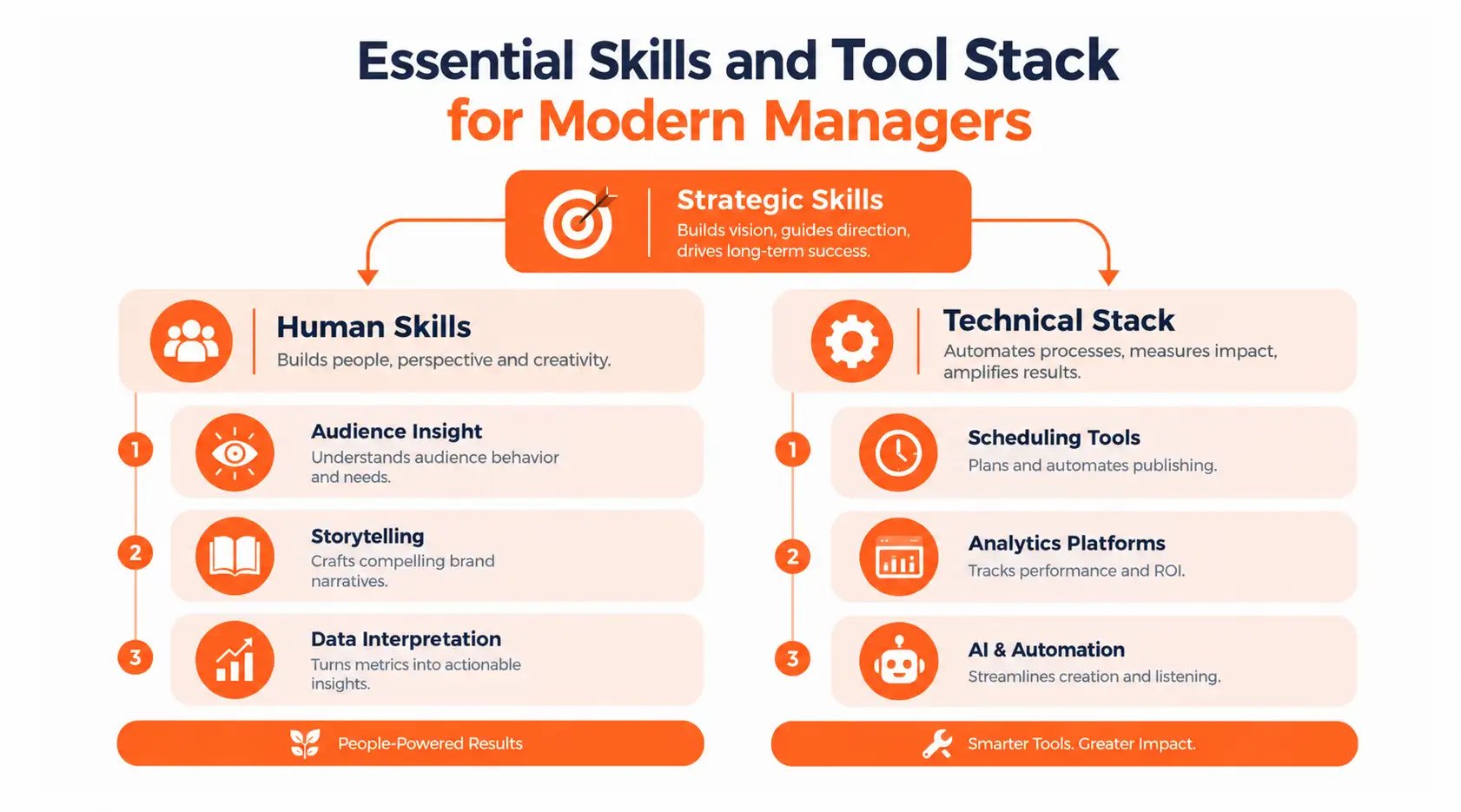
A strong manager needs two skill sets at once. One is human judgment. The other is technical execution. If either side is weak, the whole system gets shaky.
What the person has to know
The human side starts with audience insight. A manager has to notice what people ask, what they ignore, and what makes them respond. That's how content stays relevant instead of generic.
Next comes storytelling. Social posts need hooks, pacing, and a clear point of view. A manager who can't tell a good story will keep producing content that feels correct but forgettable.
Then there's data interpretation. The manager doesn't need to be a full analyst, but they do need to read patterns, spot weak creative, and explain results to other teams in plain language. That skill matters a lot in remote environments, because written clarity often replaces hallway conversations.
What the tech stack needs to do
The technical side usually breaks into a few categories.
| Skill | Tool type | What it supports |
|---|---|---|
| Audience insight | Listening platforms | Tracks mentions, sentiment, and recurring questions |
| Storytelling | Design and video tools | Builds scroll-stopping posts and short-form edits |
| Data interpretation | Analytics platforms | Shows what content is working and why |
| Publishing | Scheduling tools | Keeps cadence consistent across platforms |
| Scale and speed | AI-assisted creation | Helps with drafts, caption variants, and content repurposing |
Scheduling, analytics, listening, design, and AI all solve different problems. No single tool replaces the manager. The stack just makes the work more repeatable.
A tool should reduce friction, not reduce thinking.
For LATAM candidates working with U.S. teams, English proficiency and clear written communication matter because most feedback loops happen in docs, chat, and async review threads. That doesn't mean every conversation has to be perfect, but it does mean the manager needs to write with enough precision that editors, designers, and stakeholders can act quickly.
If you want to compare responsibilities in another remote role, the duties of a sales assistant can be a helpful contrast, because both jobs rely on process, accuracy, and communication even though their outputs are different. Social managers just add more public-facing judgment and more platform nuance.
How Social Media Managers Fit Into Growth Teams Remotely
Social works best when it's not isolated. In a growth team, the manager sits near lifecycle marketing, paid media, content, and sales, so social signals can move through the rest of the funnel instead of getting trapped in the feed. That's the shift many teams miss when they treat the role as a standalone posting function.
The handoff between channels
A campaign rarely lives in one place. A product launch might start with a social teaser, move into lifecycle email, get amplified through paid social, and then get reinforced by creator content or sales follow-up. The social manager helps shape the language and timing across those touchpoints so the message feels coherent.
That coordination is especially useful in remote teams. Async communication keeps the work moving even when people aren't online together, and documentation prevents confusion when a teammate in LATAM is handing off creative to someone in EST. Clear notes, saved assets, and shared calendars reduce back-and-forth and keep approvals moving.
Why LATAM professionals can be a strong fit for cross-border teams
LATAM professionals can be a strong fit for cross-border social media teams, particularly when employers need overlapping working hours with the U.S., Spanish-language market knowledge, English communication skills, or experience working remotely across different markets. For candidates, the opportunity is to show how their language ability, platform knowledge, communication skills, and understanding of regional audiences can support an international team.
One useful place to look for these kinds of roles is Virtustant Jobs, which organizes remote openings for Latin American candidates and includes marketing roles with clear responsibilities and application flows. In practice, that kind of platform helps candidates see the expected tools, hours, and language level before they apply, which lowers friction for both sides.
Career paths also get clearer once the role is framed this way. A specialist can grow into a channel owner, then into a manager who coordinates across content, community, and reporting. From there, the next step is often broader growth leadership, where social is one input among several, not an isolated task list.
Your Next Steps to Grow in Social Media Manager Marketing
If you're an aspiring manager, start by checking whether you can do three things well. First, can you turn audience feedback into a content idea? Second, can you explain performance without hiding behind jargon? Third, can you work cleanly in a remote workflow with handoffs, deadlines, and language expectations? If the answer is yes or almost yes, you're closer than you think.
Build a small portfolio that shows range, not just pretty posts. Include one campaign example, one community reply example, and one simple performance recap that shows what you learned. Hiring managers don't just want creativity, they want proof that you can connect social activity to business thinking.
If you're hiring, structure the role around outcomes, not just tasks. Define who owns strategy, who approves creative, who monitors replies, and who reports results. Ask for examples of bilingual communication, async collaboration, and platform-specific judgment, because those are the skills that keep remote social work from breaking down.
A good 30 to 90 day target is simple. Learn the brand voice, publish with consistency, document what performs, and tighten the loop between community signals and business goals. If those habits are in place, the work starts to compound.
Looking for remote social media, marketing, or growth roles?
Create your Virtustant profile and make sure your experience, skills, English level, and remote-work background are complete.
You can also browse current remote job openings to find opportunities that match your background.