You probably know the feeling already, a campaign is live, the inbox is noisy, and someone wants to know why activation dipped, why a win-back flow stalled, and whether the new feature launch should go to the whole list or only a segment. A lifecycle marketing manager is the person who turns that chaos into a system, so the right message reaches the right person at the right point in the journey, without treating every send like a one-off blast.
That's why the role is bigger than email. It sits at the intersection of marketing, data, and product, and it's closest to how a company keeps customers moving from first touch to renewal. For remote candidates, especially in Latin America and other Virtustant markets, that means employers usually want more than copywriting. They want someone who can think in journeys, measure behavior, and coordinate work across teams and time zones.
What a Lifecycle Marketing Manager Actually Does
A Tuesday morning in this role can look messy in the best possible way. One tab shows a churn spike, another has the results of an onboarding email test, a copywriter is waiting on feedback for a win-back sequence, and a product sync is starting in ten minutes because a new feature needs messaging before launch. That mix is normal, because the job is about orchestration, not isolated campaigns.
The work is system design, not just sending messages
The modern version of the role traces back to the idea that customers move through stages, not single moments. That thinking goes all the way back to AIDA, Awareness, Interest, Desire, Action, developed by E. St. Elmo Lewis in 1898, which is often treated as an early foundation for lifecycle thinking. Today, automation makes that mindset operational at scale, with 95% of enterprise marketing teams running at least one automation platform, 78% of mid-market B2B organizations doing so, and 65% of B2C teams adopting automation too (digitalapplied.com).
The day-to-day job is to translate business goals into sequenced, behavior-driven programs. That can mean onboarding, activation, retention, renewal, cross-sell, or win-back, but the point is always the same, create the next best action based on what the customer just did. A strong lifecycle marketing manager owns the logic that makes that happen.
Practical rule: if you're only describing newsletters, you're underselling the role.
Remote hiring managers often look for candidates who can explain the system, not just the output. A good answer sounds like this, “I mapped the journey, defined the trigger logic, set the segment rules, and reviewed the downstream performance.” That framing tells them you understand how lifecycle work moves revenue.
The Customer Lifecycle From First Touch to Renewal
Think of the journey like a trip on an airline. Acquisition is the airport gate, activation is finding the right seat, engagement is the flight itself, retention is choosing the same airline next time, and renewal or expansion is the loyalty upgrade. The analogy matters because each stage has a different customer mindset, a different business objective, and different messages that make sense.
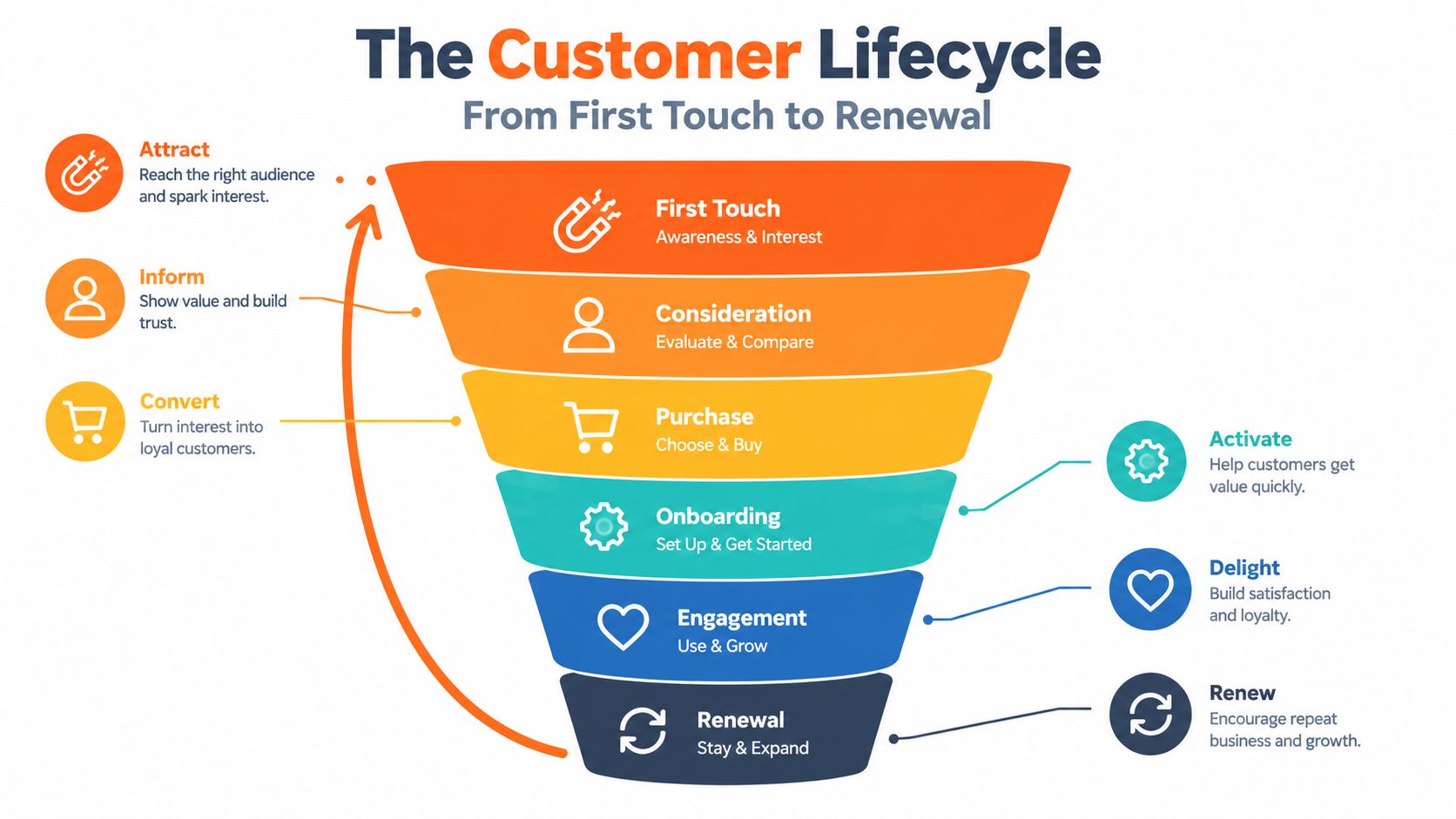
Stage by stage, the logic changes
At acquisition, the customer is still comparing options, so paid ads, landing pages, and lead capture have to do the heavy lifting. At activation, the person has signed up but hasn't seen value yet, which is where onboarding, guided checklists, and first-value nudges matter. If the experience works, the customer starts building a habit, and engagement campaigns keep the relationship active without becoming noisy.
Retention and renewal are where a lot of teams learn whether their earlier work was real or just optimistic. Re-engagement sequences, upsell offers, and renewal reminders only work when the earlier stages did their job. If they didn't, those messages feel late and generic.
For a solid overview of how practitioners frame these stages in practice, Crescade lifecycle marketing is a useful reference. The key takeaway is simple, lifecycle work is a connected system, not a random stack of campaigns.
Why the sequence matters
If you move a customer into the wrong message too early, you burn attention. If you wait too long, you miss the window where behavior can still change. That's why lifecycle managers pay attention to triggers, timing, and handoffs between programs.
A customer journey only looks linear on paper. In reality, someone can enter at acquisition, skip activation, go quiet, come back through re-engagement, and only then convert into an active user. Good lifecycle orchestration is built for that messiness.
Core Responsibilities and What You Own
The role usually breaks into five ownership areas, and hiring managers expect you to explain each one clearly. You're not just “running campaigns.” You're deciding who gets what, when they get it, how it's measured, and who else needs to be in the loop.
Strategy, execution, analytics, experimentation, collaboration
Program strategy means mapping journeys, defining segments, and deciding where automation should step in. That includes suppressions, handoffs, and the difference between a customer who needs education and one who needs a retention save.
Execution is the build and QA work. You launch flows across email, push, SMS, and in-app, then check that the logic, copy, links, and tracking all behave the way you intended.
Analytics is where the role stops being decorative. The job commonly touches open rate, click-through rate, unsubscribe rate, spam complaints, and bounce rate, because segmentation and suppression directly affect deliverability and inbox placement (Freshprints job description).
Experimentation is where you prove incremental impact instead of assuming it. Holdouts, A/B tests, and cohort analysis tell you whether the program changed behavior or only produced activity.
Cross-functional collaboration is the part that keeps the whole thing from falling apart. Product owns features, sales owns deals, customer success owns escalations, and lifecycle owns the orchestration layer that connects them.
Copy approval delays, broken tracking, and conflicting stakeholder priorities are weekly realities, not edge cases.
A strong candidate can talk about messy work without sounding rattled. They can describe the QA checklist, the review loop, and the point at which they escalate to product or ops. That calm, structured language is often what separates a senior operator from someone who's only shipped emails.
Tech Stack You Need to Be Fluent In
You don't need to know every tool in the ecosystem, but you do need to understand the categories and how they fit together. Senior hires are expected to be fluent in the stack, while junior-to-mid candidates can learn parts of it on the job if they already understand the workflow.
The core layers
Marketing automation and customer engagement platforms such as HubSpot, Braze, Iterable, and Customer.io are the orchestration layer. They send the message, apply branching logic, and make cross-channel journeys possible.
CRM systems like Salesforce or HubSpot CRM hold the customer record and usually anchor segmentation. If the CRM data is messy, the lifecycle system gets messy too.
Analytics and attribution tools such as Mixpanel, Amplitude, Google Analytics 4, Looker, and Mode help you understand behavior and performance. They're where you validate whether people moved through the journey.
Experimentation infrastructure like LaunchDarkly, GrowthBook, or Optimizely matters when product-linked behavior, feature exposure, or message variation needs testing rather than guesswork.
Event pipelines and reverse ETL tools, including Segment, RudderStack, and Hightouch, are the plumbing. They move behavioral data where it needs to go so the lifecycle system can react to what users do.
For email hygiene and deliverability work, a quick inbox test can save a lot of pain later, and MailGenius inbox placement test is the kind of resource teams use when they need to understand why a message isn't landing.
What matters most in hiring
If you're applying for a remote role, say which tools you've used, not just which categories sound familiar. A candidate who can explain how an event pipeline feeds segmentation, or how an automation platform and CRM stay in sync, usually reads as much stronger than someone who lists ten names with no context.
Figma belongs in the stack too, but as a support tool for creative handoff and asset production, not as the center of the role. The stack is about orchestration first, design second.
Key KPIs That Define Success in the Role
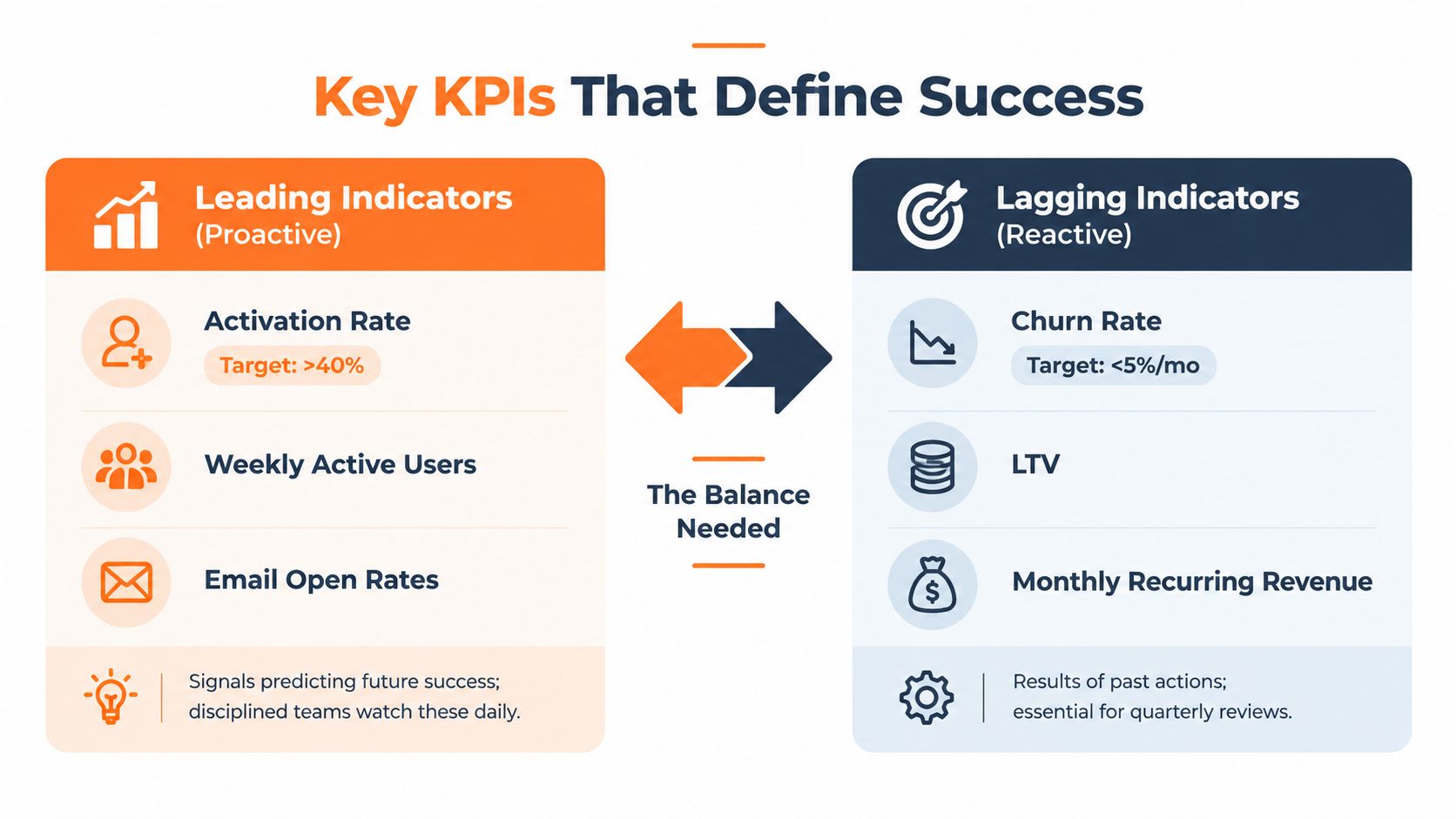
Strong lifecycle teams don't chase revenue in isolation. They track leading indicators and lagging indicators together, because early behavior tells you what the later financial result is likely to be. If you only look at the end of the funnel, you find out too late that activation was broken weeks ago.
Leading indicators
Activation rate, weekly active users, monthly active users, and product-qualified leads are the early signals. They tell you whether people are getting value soon enough to keep going. Email open rates and click-to-open ratios still matter, but only when they're read in the context of a segment, a trigger, and a customer intent.
The point of a leading metric is prediction. If onboarding improves, the rest of the journey usually gets easier. If engagement drops right after a feature launch, the messaging or product experience likely missed the mark.
Lagging indicators
Retention, churn, renewal rate, customer lifetime value, net revenue retention, expansion rate, and average revenue per user show whether the earlier work held up. These are the metrics leadership uses when it wants proof that the lifecycle system is paying off.
The internal comparison matters more than a benchmark, because a strong open rate can still coexist with bad retention. That's why mature teams present both kinds of data in the same review, so the story doesn't get distorted by one pretty metric.
For candidates who want to see how lifecycle skills overlap with adjacent marketing work, the social media manager marketing role guide is useful context on how channel work differs from journey ownership.
A disciplined weekly review usually asks one question, did the early signals improve in a way that should eventually change revenue? That's the bridge between execution and strategy.
Career Progression From Specialist to Senior
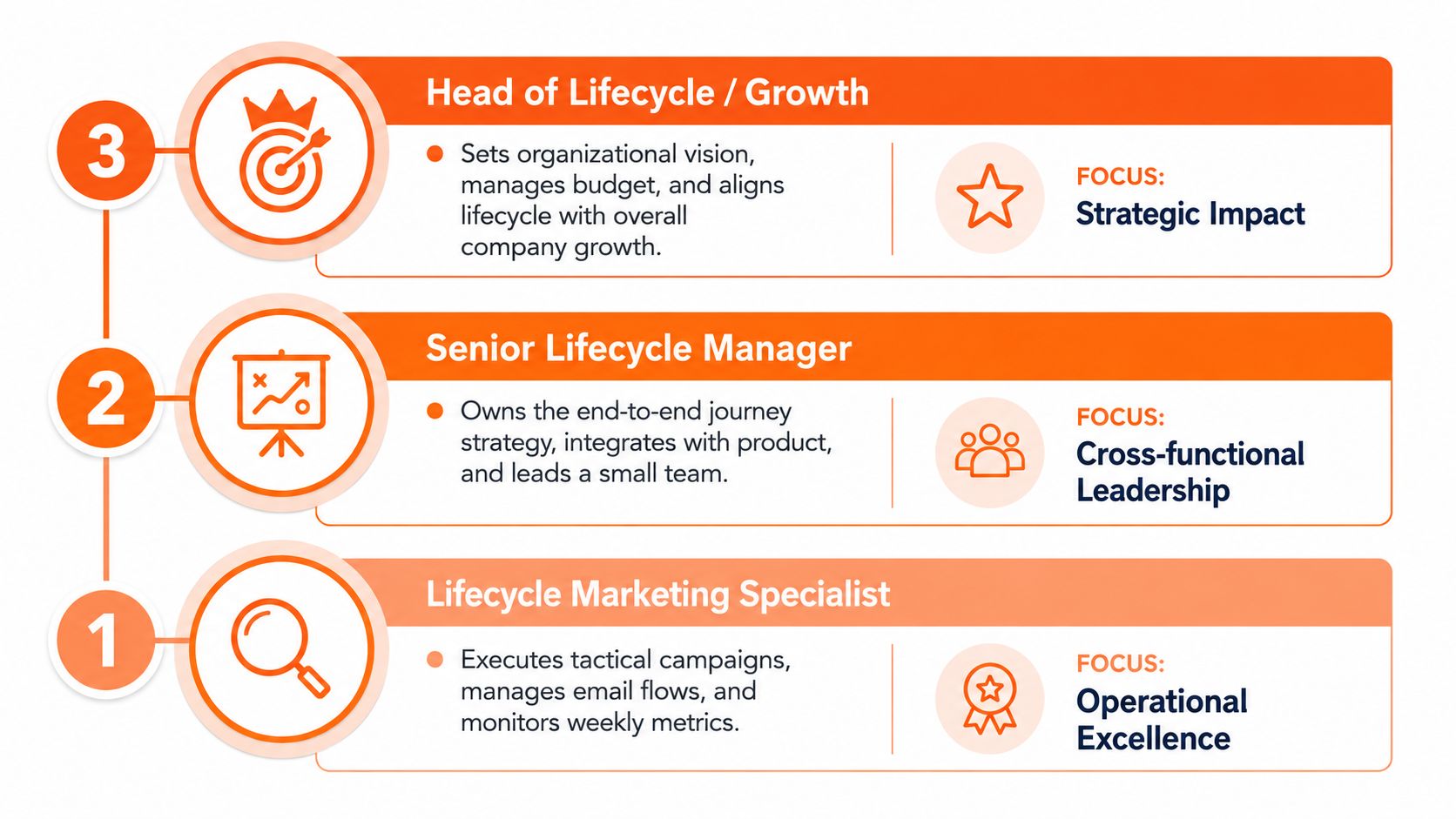
The title changes over time, but the shift is in scope. At first you execute programs. Later you own the journey. Eventually you're responsible for the business outcome and the team that delivers it.
What actually changes at each level
A Lifecycle Marketing Specialist spends most of the day building campaigns, writing copy, running QA, and owning a defined stage or product line. The work is hands-on and operational, and the best specialists know how to spot broken logic before it reaches customers.
A Senior Lifecycle Manager starts thinking in systems. They design the cross-stage strategy, coordinate with product and data, mentor specialists, and decide how the lifecycle roadmap should support retention and expansion goals.
A Head of Lifecycle or Growth role adds hiring, performance reviews, budgeting, and executive alignment. At that point, you're not only deciding what gets built, you're also defending why it matters to the business.
The faster you move up, the more your value comes from judgment, not volume.
For a remote candidate, the promotion signal is usually not “I sent more campaigns.” It's “I can own the framework, explain the tradeoffs, and lead the people who execute it.”
If you're comparing paths and titles, the lifecycle marketing jobs guide helps frame where specialist and senior roles usually sit in the market. Readiness for the next step usually shows up in how well you can move from one channel to a whole journey.
Remote Hiring Realities and CV Tips
In-house and agency environments reward different strengths. In-house teams usually expect deep ownership of one customer base, closer collaboration with product and data, and longer feedback loops. Agencies move faster across multiple clients, so the pace is broader, the timelines are tighter, and product depth is usually thinner.
What remote hiring managers care about
For remote candidates, that difference matters because it changes how your day is structured. In-house roles often ask for more async coordination with product, customer success, and analytics teams, while agencies may care more about your ability to switch contexts quickly and keep delivery moving across accounts.
A practical CV should lead with a lifecycle program you owned end to end. Name the platforms you used, explain the journey stage you touched, and describe the outcome in metric language, not vague phrases like “improved engagement.” If you worked on renewal flows, say so. If you handled reactivation campaigns, say that too.
The time zone South America guide is useful if you're checking how overlap expectations can affect remote jobs across regions.
How to talk about your work in interviews
Hiring managers often want to hear how you instrumented a funnel, dealt with deliverability issues, or partnered with sales on renewal sequences. Those stories reveal whether you understand the system or only the surface level.
If you're applying from Latin America or another supported remote market, be ready to show comfort with overlap hours, Slack, Notion, and independent experimentation. The strongest candidates sound like operators, not channel coordinators.
How to Move Forward as a Candidate
Start by auditing the lifecycle work you've already done and rewriting it around outcomes, not tasks. Then refresh your CV and portfolio so they show one clear story, you can build systems, read behavior, and improve customer movement across the journey.
If you're applying to remote roles, check whether your schedule can overlap with U.S. hours for part of the day, and make sure you can work comfortably in async tools without needing constant direction. That's often what separates a workable remote profile from a strong one.
Virtustant Jobs lists remote openings for candidates who can think in journeys, not just channels, and it also keeps a talent pool for future matching. If this role fits your background, create your profile, complete your application details, and browse current openings on Virtustant Jobs.
Virtustant Jobs connects remote candidates with roles that need real lifecycle thinking, not just campaign production. If you can show structured ownership of journeys, metrics, and cross-functional execution, you're already speaking the language that these jobs require. Visit Virtustant Jobs to explore openings and put your profile in front of remote employers looking for that mix.