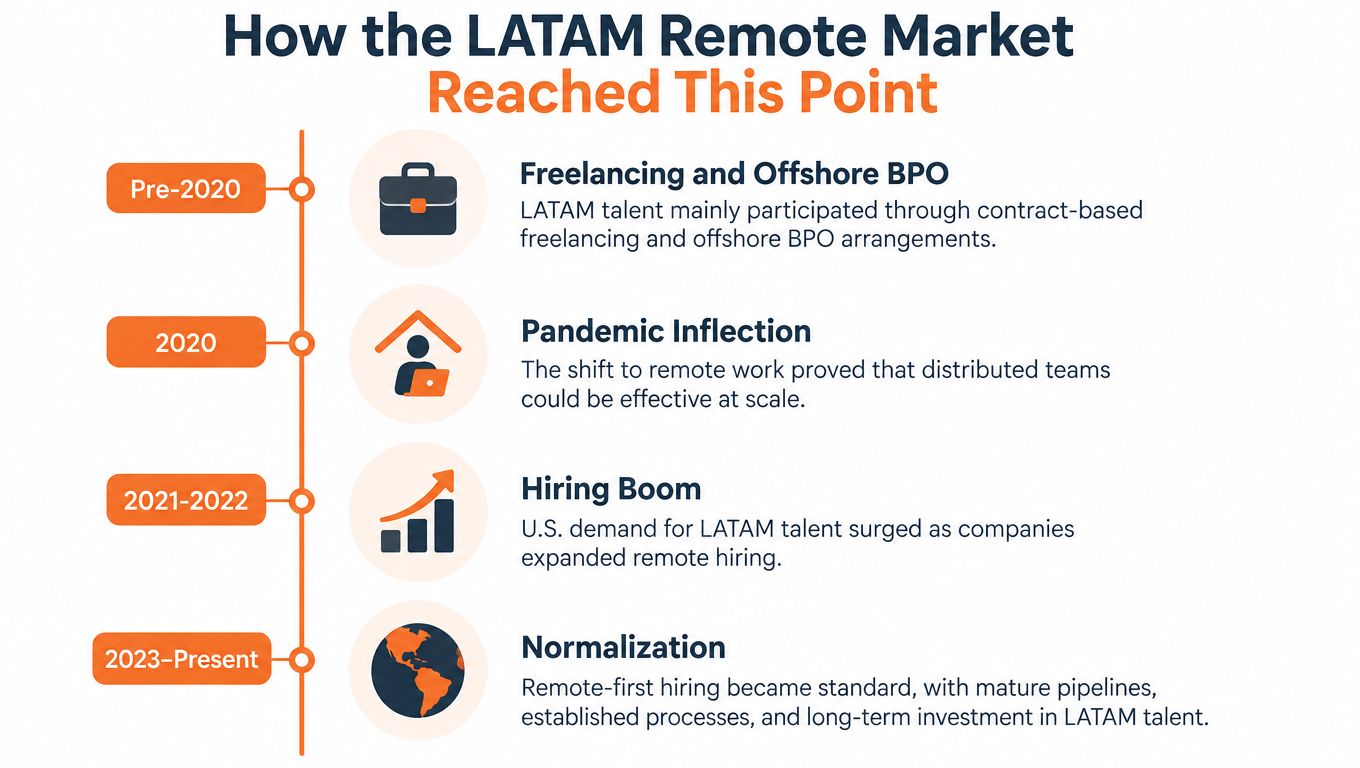
You're in Medellín or São Paulo, qualified to support legal work, and tired of seeing “remote” roles that require U.S. residency, courtroom attendance, or a completely different time zone. You may already know how to prepare filings, organize case records, or review contracts, but that experience won't automatically translate into a U.S. firm's workflow.
Remote paralegal jobs are real opportunities, but they're not ordinary work-from-home administrative roles. U.S. employers screen for jurisdictional judgment, document control, secure technology, written English, and dependable attorney support. They also need candidates who understand what they can do from abroad and what must remain with a supervising attorney.
The market is large enough to justify a targeted search. The U.S. Bureau of Labor Statistics projects approximately 376,200 paralegal and legal assistant jobs in 2024, with about 39,300 openings per year through 2034, even though total employment is projected to rise only slightly to 376,800 jobs (BLS employment projections overview). That means replacement hiring matters. Your advantage won't come from waiting for the market to expand. It'll come from showing that you can enter an existing workflow and protect it from mistakes.
What a Remote Paralegal Actually Does
At 9 a.m. EST, a paralegal in Medellín logs into a U.S. firm's document-management system. The first tasks are practical: pull deposition transcripts, check whether the attorney uploaded revised exhibits, draft discovery requests from an approved template, update the case calendar, and flag a filing deadline to an attorney working several time zones away.
That day looks familiar to an experienced LATAM legal professional, but the operating model is different. In a local firm, you may walk to a partner's office, resolve a question verbally, use a firm-specific filing routine, or work around physical folders. A cross-border team expects the same substantive judgment to appear through written updates, shared systems, naming conventions, time-zone overlap, and documented approvals.
The recurring work product
The role usually produces repeatable deliverables rather than one dramatic assignment. Common examples include:
- Pleading shells: Prepare complaints, motions, responses, and notices from approved forms for attorney review.
- Discovery organization: Sort productions, track requests and responses, maintain privilege-sensitive logs, and identify missing materials.
- Exhibit control: Build exhibit lists, check numbering, organize binders or digital folders, and verify that cited documents match the record.
- Research support: Locate authorities or procedural information under attorney direction, then summarize findings with accurate citations.
- Client intake: Capture facts, contact information, conflict-check details, and supporting documents without giving legal advice.
- E-filing preparation: Confirm formatting, attachments, signatures, filing details, and court requirements before an authorized person submits.
- Case administration: Update calendars, task lists, matter notes, status reports, and service records.
Calendar maintenance, document organization, intake updates, and status reporting may happen every week. Pleading preparation, exhibit assembly, and discovery work become more intense on litigation matters. Transactional teams may focus instead on comparison charts, signature packets, closing checklists, and contract records.
Practical rule: Your job is to make the attorney's next decision easier, not to make the legal decision yourself.
Every draft stays inside an attorney-directed review cycle. You can prepare a document, identify an inconsistency, suggest a question, or flag an approaching deadline. You can't independently advise the client or let an unreviewed draft leave the queue. For document-heavy matters, resources that explain how to streamline reviews with Documind can help you understand the review logic, but the firm's approved process always controls.
The same distinction applies to adjacent remote roles. An administrative professional may manage calendars, correspondence, and records, as described in this guide to what an administrative assistant does. A paralegal adds substantive legal support, but still works within delegated authority and attorney supervision.
Qualifications and Skills Hiring Managers Look For
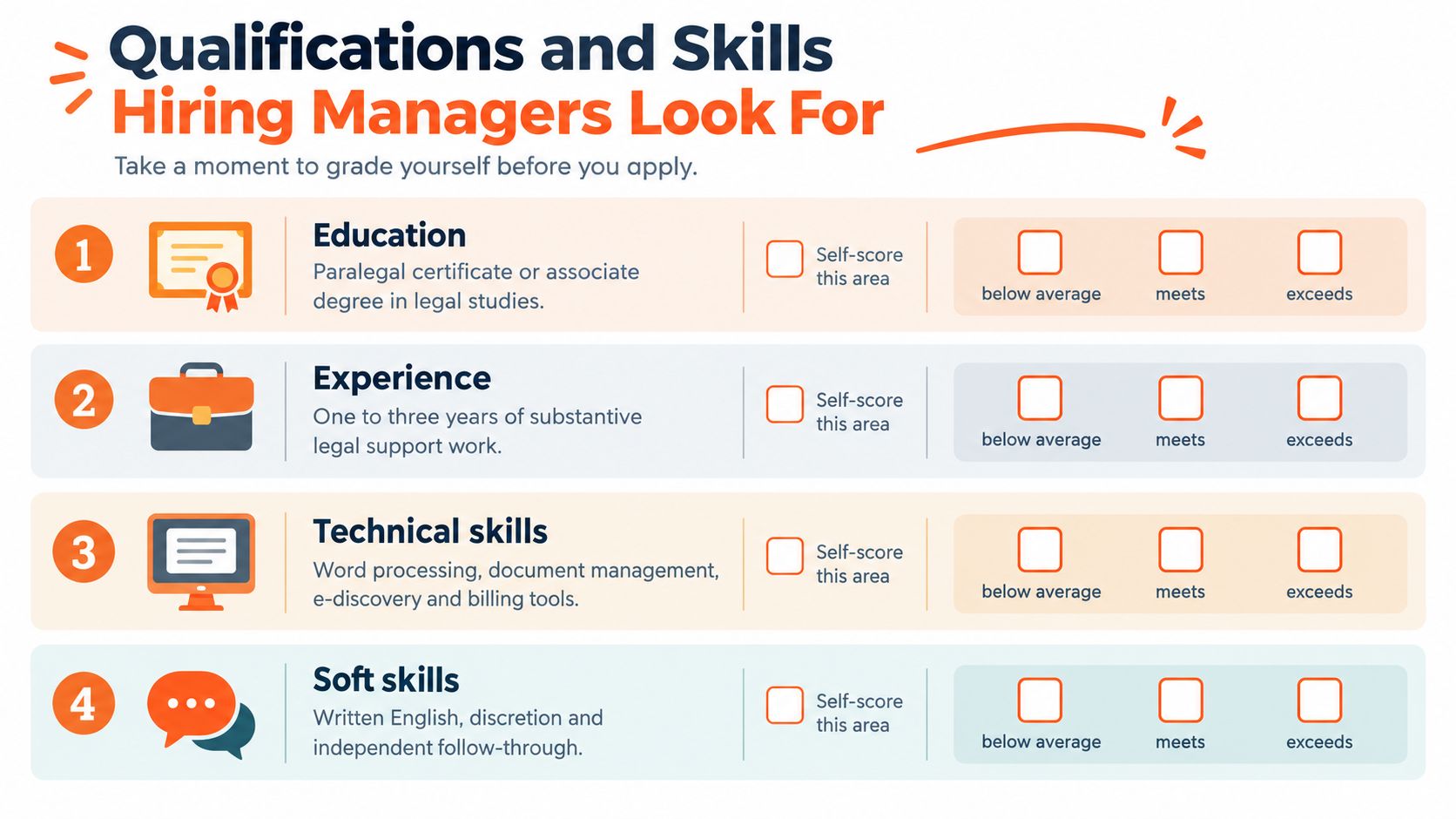
Hiring managers rarely evaluate a paralegal profile as one long list of credentials. They look for a stack of evidence. Grade yourself against four layers before applying, then fix the weakest layer instead of sending dozens of generic applications.
Education and legal foundation
A paralegal certificate, associate degree, law degree, or comparable LATAM credential gives the recruiter a starting point. The preferred profile goes beyond the credential and shows coursework or practical exposure relevant to U.S. legal work, such as legal research, civil procedure, contracts, litigation support, or legal ethics.
Don't hide a foreign law degree because it isn't a U.S. qualification. Explain what it trained you to do, then separate that education from U.S. admission or licensure. Employers want clarity, not an inflated claim that your credential authorizes U.S. practice.
The profession has formal roots. The American Bar Association endorsed paralegal use in 1967, created its first paralegal committee in 1968, and began approving qualifying education programs in 1975. NALA was founded in April 1975 and administered its first certification examination to 90 legal assistants, with 48 earning the Certified Legal Assistant credential, according to NALA's professional history. Certification is voluntary, and the ABA doesn't certify individual paralegals. NALA, NFPA, and NALS offer credentials through different combinations of testing, education, competency, and experience.
Experience and practice fit
A hiring manager wants to know which matters you can support without a long explanation. Name your practice area, jurisdictional exposure, document types, and level of attorney supervision. “Supported litigation” is weak. “Maintained discovery logs, prepared exhibit indexes, tracked service deadlines, and drafted filing materials for attorney revision” is useful.
Technical and operational readiness
Advanced Word formatting, PDF editing, spreadsheets, e-filing, document-management systems, and case-management platforms should appear in a scannable skills block. Preferred candidates explain what they did inside each tool, not just that they opened it.
Your operational baseline should include C1-level written English or an equivalent professional standard, reliable home-office access, and predictable overlap with the firm's working hours. A neutral accent can help in voice-heavy roles, but clear comprehension and precise writing matter more than sounding American.
Score yourself from below standard to strong across education, substantive experience, software, written English, security, and time-zone availability. Apply now if you can demonstrate the core workflow. If one category is weak, spend the next few weeks building a redacted sample or completing practical training before applying broadly.
The Legal Boundaries of Cross-Border Paralegal Work
Working from another country doesn't erase U.S. legal boundaries. A paralegal generally supports an attorney, and the client's jurisdiction and the firm's supervision model still matter. Remote location changes how you access information and communicate. It doesn't turn legal advice into administrative work.
What supervised support can include
| Task, allowed under supervision | Task, crosses into unauthorized practice of law |
|---|---|
| Drafting pleadings for attorney revision | Giving a client legal advice or recommending a legal strategy |
| Running cite-checks against approved authorities | Interpreting the law for a client without attorney direction |
| Organizing discovery and maintaining production logs | Negotiating a settlement or making settlement commitments |
| Preparing intake forms and summarizing facts | Deciding whether a client has a viable claim |
| Preparing e-filing materials for an authorized filer | Signing filings as the attorney of record |
| Building a chronology for attorney analysis | Appearing in court or presenting arguments as counsel |
The bright line is supervision and authority. You can identify an inconsistency in a contract and escalate it. You can compare versions and create a clean issue list. You can prepare a draft from an approved template. You can't tell the client what the clause means in their specific situation or promise an outcome.
U.S. unauthorized-practice rules are state-specific. A remote candidate in Latin America shouldn't assume that the work is governed only by the rules of the country where the candidate sits. Ask which state's matters you'll support, who reviews your work, whether the firm permits international access, and which tasks require attorney authorization.
Escalate before you interpret: If the instruction could change a client's legal position, stop and ask the supervising attorney.
Overstepping can create serious consequences. Incorrect filings, unauthorized commitments, mishandled evidence, and unsupported client advice can expose the firm to malpractice risk, undermine a matter, or require corrective work. Strong candidates don't try to sound autonomous when the role requires delegated judgment. They show that they know when to draft, when to verify, and when to wait.
Tools and Software You Need to Know
Remote paralegal work runs on systems. A recruiter may list ten tools, but the actual test is whether you can keep a matter organized when multiple people edit, upload, approve, and transmit documents from different locations.
The core stack
| Category | Common tools | What fluency looks like |
|---|---|---|
| Document management | iManage, NetDocuments | Indexing matters correctly, applying naming conventions, controlling versions, and checking permissions |
| E-signature | DocuSign, Adobe Sign | Preparing signature packets, assigning signers, tracking status, and preserving the executed version |
| Practice management | Clio, MyCase, Smokeball | Maintaining contacts, deadlines, matter notes, tasks, billing records, and activity history |
| Cloud storage | Firm-managed cloud drives | Following folder taxonomy, applying access tiers, avoiding duplicate drafts, and locating the authoritative file |
| Spreadsheets | Excel, Google Sheets | Building deadline trackers, exhibit lists, production logs, and status reports with reliable formulas |
| Communication | Zoom, Microsoft Teams | Joining depositions or meetings prepared, sharing securely, and documenting follow-up actions |
Opening a file isn't fluency. In iManage or NetDocuments, fluency means understanding the matter workspace, profile fields, version history, and check-in process. In a spreadsheet, it means spotting an inconsistent date or broken formula before an attorney relies on the output. In Teams, it means knowing where a file belongs after the meeting, not leaving the only copy in a chat thread.
Differentiators by practice area
Litigation candidates benefit from Relativity or Everlaw exposure, especially for discovery organization and document review. Legal researchers can distinguish themselves with Westlaw or Lexis familiarity. Transactional candidates should understand comparison tools, closing binders, signature workflows, and version control. Trello or Asana can help with task tracking when the firm uses them, but don't list a tool unless you can explain how you used it.
AI can assist with repetitive review or drafting, but it doesn't transfer responsibility for accuracy or confidentiality. A practical overview of AI drafting tools for lawyers can help you understand the category. Before using any tool, confirm that the firm allows it, determine where data is processed, and follow the firm's approval rules.
Hiring signal: Describe the control you applied, not only the software you opened.
Build evidence through approved training, product documentation, controlled practice files, and free trials where appropriate. Keep a record of the tasks you completed. A candidate who can say, “I created a matter structure, applied permissions, checked version history, and recovered an earlier draft,” sounds ready for remote work. The same workflow discipline supports other remote operations roles, including remote project manager jobs.
Building a Profile and Application That Get Shortlisted
Your CV must answer three questions quickly: What legal work can you support? Which jurisdictions and practice areas do you know? Can you do it reliably from another country? Put those answers near the top instead of making a recruiter search through job descriptions.
Structure the CV around evidence
Use a summary such as: “Bilingual litigation paralegal supporting U.S. civil matters through discovery organization, filing preparation, case calendaring, and attorney-reviewed drafting.” Adjust it to your real background. Then specify the jurisdictions, practice areas, matter types, and systems you've used.
Describe scope without inventing metrics. If you handled a substantial caseload, say so qualitatively or use figures you can verify from your own records. Name the documents you prepared, the attorney team you supported, and the stages of a matter you managed. Separate certifications, software, language proficiency, remote-work history, time-zone availability, and work authorization or contractor status into easy-to-scan sections.
A strong bullet explains the workflow:
- Discovery control: Maintained production folders, tracked requests, prepared privilege-aware chronologies, and escalated missing materials.
- Filing support: Prepared attorney-reviewed pleadings and exhibits, checked formatting, and coordinated submission details.
- Contract support: Compared drafts, logged open points, routed signature packets, and preserved executed versions.
Make the cover letter specific
Address the attorney, practice group, or hiring manager when the information is available. Mention the firm's practice area and connect your experience to the actual responsibilities. Two focused paragraphs are enough. Explain why your LATAM location supports the workflow, such as dependable EST overlap, bilingual communication, or experience working with distributed teams. Don't present geography as a discount. Present it as a manageable operating condition backed by evidence.
Prepare one redacted work sample
Choose a deliverable that resembles the role:
- Pleading index
- Contract comparison chart
- Discovery log
- Closing binder table of contents
- Redacted chronology
- Case-status report
Remove client names, addresses, matter numbers, and privileged information. Add a short note explaining the assignment, your process, the review point, and the final output. Never use confidential work without written permission.
Refresh LinkedIn so its headline mirrors the CV. A portfolio folder can contain practice-area subfolders with sanitized samples, software evidence, and a short description of your responsibilities. The profile, CV, and work sample should tell the same story. If one says litigation and another emphasizes only administration, the recruiter will believe the less specific version.
Finding Listings and Navigating the Hiring Process
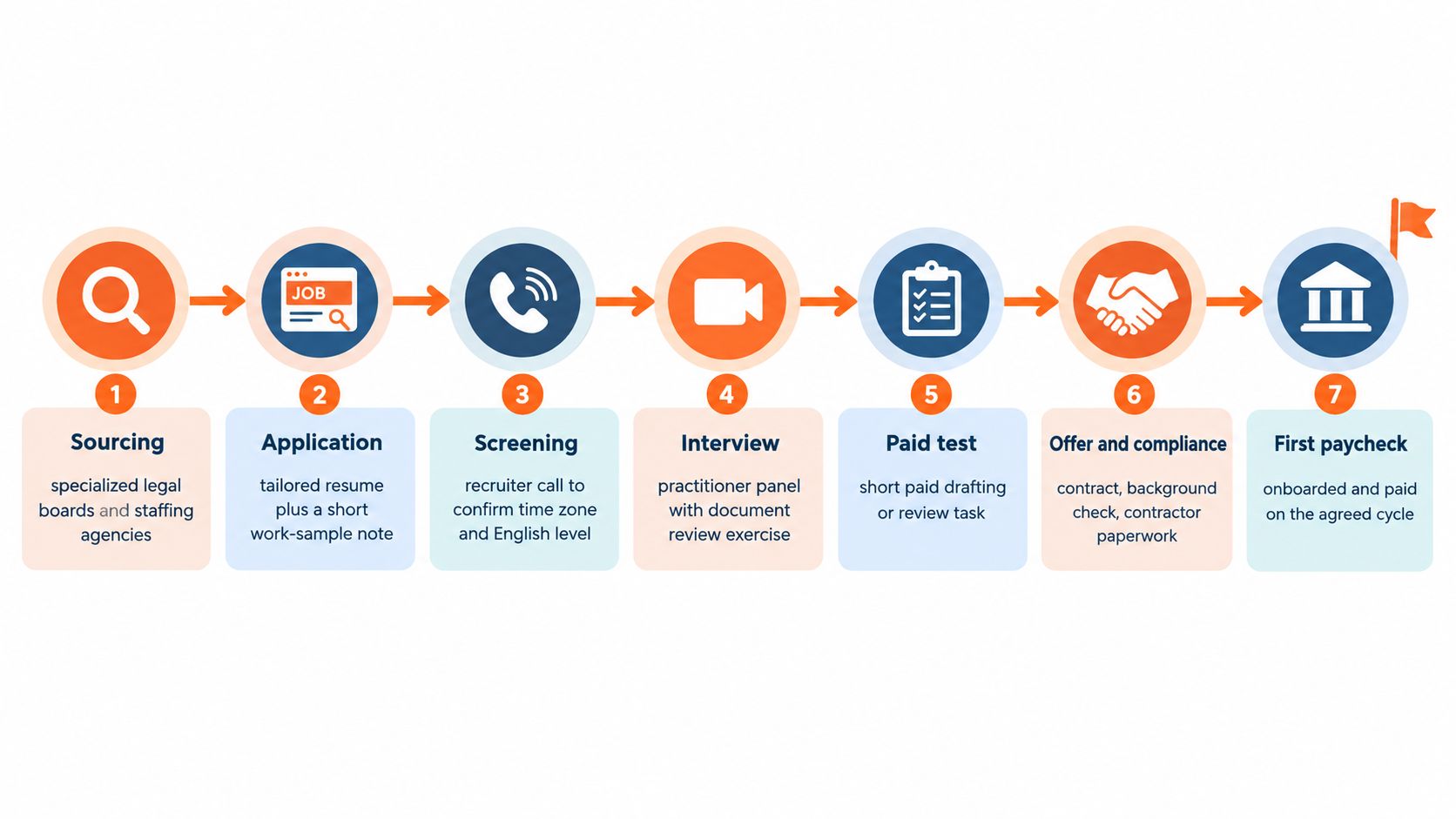
Treat the search as a pipeline, not a single application. Specialized legal boards such as Lawjobs, BCG Attorney Search, Legal.io, and LawCrossing can surface relevant roles. Remote-first legal staffing firms, LinkedIn searches for “paralegal remote,” general remote boards with legal filters, and direct outreach to boutique firms add other routes.
Use a clear Boolean search on LinkedIn, then inspect the employer's requirements before tailoring your application. Search by practice area too, such as remote litigation paralegal, contract paralegal, immigration legal assistant, or eDiscovery support.
Ask questions at each stage
Application: Is the role open to candidates in your country? Does the posting specify employee, contractor, or employer-of-record status? Which U.S. time zone and hours must you cover?
Recruiter screen: Who will supervise the work? Which practice area and jurisdictions are involved? Does the firm already hire internationally? What equipment and security controls are required?
Technical interview: Which document-management and case-management systems does the team use? Will you complete a paid or unpaid work sample? How does the firm review drafts and handle conflicts?
Attorney interview: What decisions must be escalated? Who controls client data and document permissions? Are there restrictions on data residency or access from abroad?
Offer and onboarding: What is the payment cycle and classification? Which confidentiality agreement applies? What background checks, tax forms, invoicing records, and identity documents are required?
The written exercise is often where vague profiles fail. Expect a controlled task such as organizing a matter folder, applying a naming convention, preparing a chronology, tracking deadlines, or identifying issues for attorney review. Your benchmark is operational reliability: no missed deadlines, no unauthorized disclosures, and document organization another professional can reproduce.
Red flags deserve a direct response. Avoid listings with unclear duties, requests to sign client-facing documents as counsel, pressure to provide legal advice, or platforms asking for upfront fees. A legitimate employer should explain supervision, security, classification, scope, and payment terms.
Before the first working day, confirm your payment method, sign the NDA only after reviewing it, and ask for access instructions. The first-week checklist should include the document taxonomy, matter permissions, communication channels, escalation contacts, deadline conventions, and approved devices.
For more search channels and filters, use this guide to the best sites to find remote work.
Remote legal work also requires home-office discipline. Use firm-approved storage, secure communication, strong access controls, and encrypted devices where required. Legal confidentiality continues outside the office, and practical guidance on legal ethics for paralegals working remotely highlights controls such as private workspaces, permission checks, password protection, and avoiding smart speakers during confidential work.
Next Steps Toward Your First Remote Paralegal Role
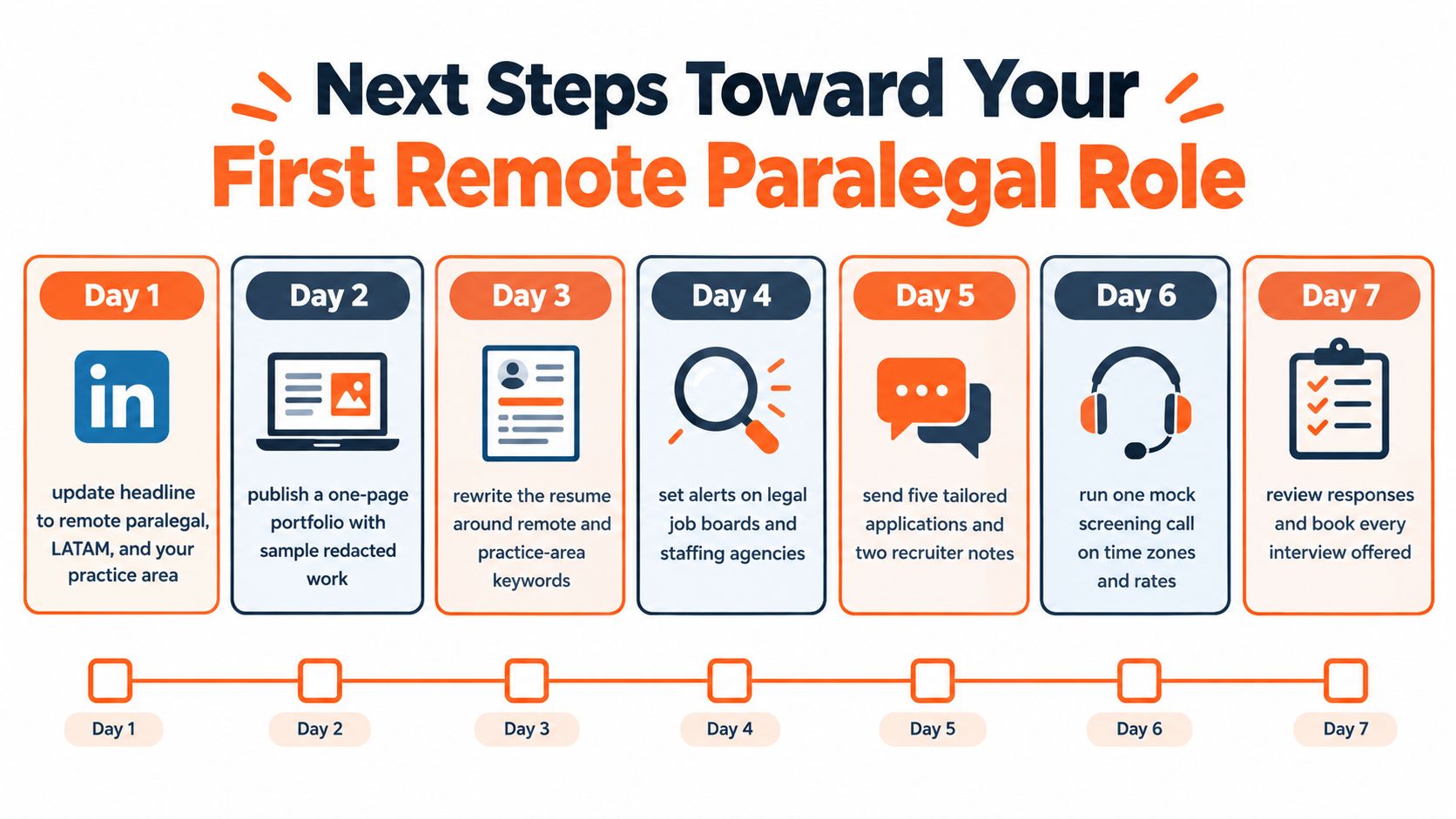
Don't spend another week passively saving listings. Use a seven-day launch plan that produces visible evidence of readiness.
Days one and two
Day one: Rewrite your LinkedIn headline to include “remote paralegal,” “LATAM,” and your practice area. Update the summary so it identifies the jurisdictions, systems, documents, and U.S. time-zone availability you can support.
Day two: Publish a one-page portfolio with a redacted memo, billing log, discovery tracker, contract comparison, or proof of controlled work in iManage or NetDocuments. Include context for each sample, but never reveal client information.
Day three: Rewrite the CV around the role you want. Move practice-area experience and software above generic soft skills. Add written English, bilingual capability, time-zone overlap, remote-work history, and contractor or employment preferences.
Day four: Set alerts on legal job boards, remote categories, and staffing firms. Add searches for your specific practice area instead of relying only on the broad phrase “remote paralegal.”
Days five through seven
Day five: Send five targeted applications and two recruiter notes. Each cover note should address jurisdiction, data handling, attorney supervision, and your ability to work during the required U.S. hours. Tailoring matters more than sending a generic application blast.
Day six: Run a mock screening call. Practice explaining how you handle a missed instruction, a conflicting deadline, a confidential file, and a request that may cross into legal advice. State your availability and rate expectations clearly.
Day seven: Review every response and book interviews that fit your scope. Complete a privacy microcredential covering GDPR or HIPAA basics if it's relevant to your target practice area. Prepare a rate card in USD, but confirm whether the engagement is employment, independent contracting, or an employer-of-record arrangement before treating the rate as final.
Security guidance should be practical. Use a private workspace, firm-approved cloud storage, secure passwords, MFA, and a reliable device. Create a backup power and connectivity plan, especially if your home internet is unstable. The firm needs to know that a local outage won't become a missed filing or an exposed document.
Finish the week with a written checklist covering contract review, tax registration, invoicing tools, data-access rules, payment details, and onboarding contacts. Remote paralegal jobs reward candidates who remove uncertainty before the first assignment. Your profile should make it easy for a recruiter to see your legal foundation, your systems experience, your boundaries, and your readiness to work inside a U.S. team.
Virtustant Jobs connects qualified candidates with remote opportunities, including roles across legal support and other business functions. Create your profile, complete your application information, and browse Virtustant Jobs for current openings that match your skills, schedule, and remote-work goals.