You've polished your CV, created a profile on several job boards, and applied for roles that all promise “remote flexibility.” Then the problems start. One employer expects you to work U.S. hours but doesn't explain which ones. Another asks for advanced English, even though the job description barely mentions client communication. A third offers a salary that sounds attractive until you compare it with the responsibilities, contract type, and lack of benefits.
That confusion is common. Remote jobs in Latin America are growing, but the market isn't uniform. The right country, English level, schedule, role category, and compensation expectations can make the difference between a strong application and a frustrating search.
Why Remote Jobs in Latin America Are Booming Right Now
Maria, a customer success lead in São Paulo, is choosing between two remote offers. A U.S. SaaS company wants her to support North American customers and communicate in English throughout the day. A regional BPO offers a familiar local structure, but the work connects less clearly to her long-term goals. The first role brings international experience and stronger earning potential. The second offers more predictable conditions.
Her choice reflects the decision facing many Latin American professionals. Remote work is no longer about avoiding an office. Candidates weigh international experience, language demands, schedule overlap, contract security, and earning potential before accepting an offer.
The cross-border market also has a wide range of working conditions. In its 2025 regional survey, the International Labour Organization covered more than 1,000 web-based platform workers across 21 countries. It found that 53% served clients outside their own country. Among workers who knew where their clients were located, 90% said those clients were outside Latin America and the Caribbean, mainly in the United States and Canada. The survey reported a median hourly income of USD 2.57 and an average of USD 5.48, showing how sharply pay can differ across remote digital work. Around 40% lacked health and social security coverage, according to the ILO's regional findings on web-based platform work.
Career rule: A remote offer is not automatically a good offer. Check the client market, working hours, responsibilities, payment terms, and benefits as one package.
U.S. employers continue hiring in Latin America because the region offers overlapping business hours, multilingual professionals, and experience serving international customers. Country selection still matters. Mexico and Colombia provide large talent pools for customer support, sales, and operations. Argentina and Brazil offer broad professional pools, while Costa Rica and Chile frequently appear in international hiring searches. Applicants elsewhere should target employers with wider location policies rather than assume every remote role accepts candidates across the region.
The opportunity is real, and so is the competition. English, dependable execution, clear writing, and familiarity with cloud tools often decide who passes the first screening. A country-by-country approach, realistic pay expectations based on skill level, and a clear understanding of how talent pools work will produce better applications than treating remote hiring like a lottery.
How the LATAM Remote Market Reached This Point
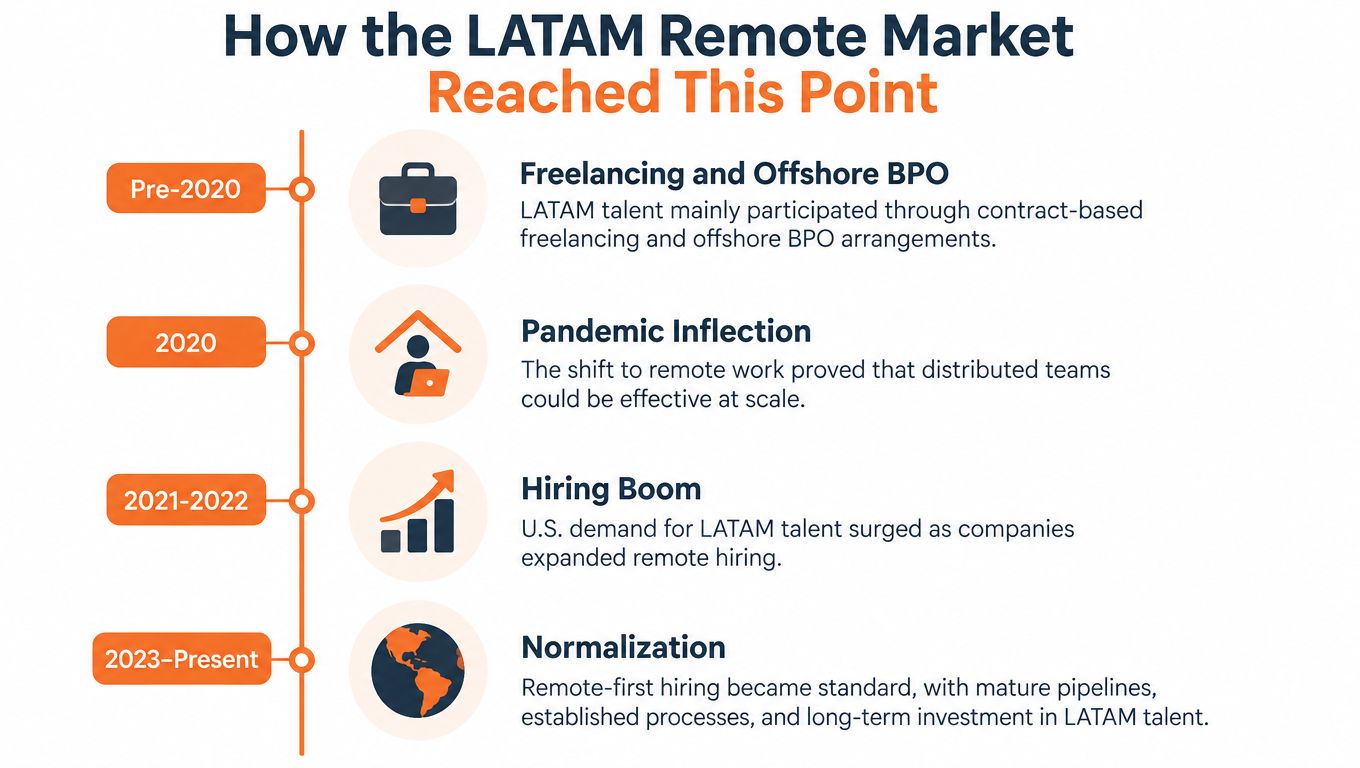
The current market developed in distinct stages. Understanding those stages helps explain why employers now ask for more than a stable internet connection and a willingness to work from home.
Before 2020
Before the pandemic, remote work in Latin America largely appeared through freelancing, offshore BPO, contractor arrangements, and specialist outsourcing. Companies hired internationally when they needed a particular skill or lower-cost operational support. Many professionals built experience through project work, call centers, agencies, or direct relationships with overseas clients.
Remote hiring existed, but it wasn't yet a standard route for customer support, sales development, executive assistance, or operations careers.
The 2020 inflection point
The pandemic forced companies to test distributed work at operational scale. A regional analysis reported that remote workers increased from 3% to 30% in three years, while an Inter-American Development Bank estimate placed the number of people who teleworked at some point in 2020 at roughly 23 million, less than 10% of the region's workforce. In Argentina, Chile, Costa Rica, Peru, and Uruguay, between 20% and 30% of salaried employees worked remotely during that year, according to the regional analysis of the remote-work surge.
That period proved that teams could coordinate support queues, sales activity, meetings, reporting, and customer operations without sharing an office. The experiment changed employer expectations permanently, even after many companies reduced their remote hiring.
After the initial surge
The later market became more structured and selective. Employers introduced clearer job descriptions, defined working-hour requirements, standardized interviews, and formal talent pipelines. Candidates were expected to communicate in English, document their achievements, and work comfortably in tools such as Slack, Zoom, Google Workspace, Excel, customer relationship management systems, and project platforms.
That shift also expanded opportunity beyond engineering. Once companies had distributed operating models, they could hire virtual assistants, support representatives, SDRs, bookkeepers, coordinators, and marketing operations specialists from the region. The modern candidate needs to understand both the role and the operating system around it.
Most In-Demand Remote Roles Across the Region
Non-technical roles now form a substantial part of the remote hiring conversation in Latin America. Employers still recruit developers, QA specialists, and technical operators, but many international openings focus on people who can manage customers, calendars, sales pipelines, financial records, or marketing workflows.
English and dependability are usually the first filters. Tool knowledge helps you pass the next one.
Customer support and customer success
Support representatives handle live chat, email, calls, ticket queues, and escalation processes. Customer success specialists usually work further downstream, helping clients adopt a product, renew a subscription, or resolve operational problems.
Common tools include Zendesk, Intercom, HubSpot, Slack, Zoom, and CRM platforms. Employers often value previous experience with customer-facing work, clear written English, calm problem-solving, and the ability to document recurring issues. U.S.-aligned schedules are common because customers expect live coverage during their business day.
Virtual assistance and executive support
Virtual assistants and executive assistants may manage calendars, inboxes, travel research, meeting preparation, CRM updates, invoices, and follow-up tasks. These roles can suit candidates without a long corporate background if they can demonstrate organization and discretion.
Useful tools include Calendly, Notion, Slack, Google Workspace, Microsoft Office, and task-management systems. A strong application should show how you prioritize competing requests, protect confidential information, and keep a busy manager from missing commitments.
Sales development and account management
SDRs and BDRs research prospects, write outreach messages, qualify leads, and book meetings. Account managers maintain existing relationships and identify opportunities for expansion.
Common systems include Salesforce, HubSpot, Outreach, spreadsheets, and sales engagement platforms. Spoken English matters more here than in many back-office roles because candidates may handle discovery calls, objections, and outbound conversations with U.S. buyers. Performance evidence, such as pipeline ownership or consistent meeting generation, is more persuasive than a generic claim that you're “results-oriented.”
Bookkeeping and accounting support
Remote finance roles can include transaction entry, reconciliations, accounts payable, accounts receivable, reporting, and month-end support. QuickBooks, Xero, Excel, and cloud accounting systems appear frequently in these workflows.
English-fluent candidates can compete for international bookkeeping roles, but accuracy is essential. Your CV should name the accounting tasks you performed, not just the software you opened.
Marketing, content, and operations
Marketing assistants, content coordinators, social media specialists, and project coordinators often work across WordPress, Figma, Google Workspace, Slack, Notion, and project-management tools. Employers want people who can execute reliably, keep assets organized, and communicate status without constant supervision.
Junior software and QA positions remain relevant for candidates with testing, frontend, automation, or support engineering skills. The schedule depends on the product team, but collaboration with U.S. colleagues can still shape the working day.
| Role Category | Typical Experience | Core Tools | Schedule |
|---|---|---|---|
| Customer support and success | Customer-facing experience, product support, or account coordination | Zendesk, Intercom, HubSpot, Slack | Often aligned with U.S. customer hours |
| Virtual and executive assistance | Administrative experience or strong organizational proof | Calendly, Notion, Google Workspace, Slack | Usually fixed overlap for calendars and communication |
| SDR and account management | Prospecting, sales support, or relationship management | Salesforce, HubSpot, Outreach, Excel | Live U.S.-business-hour calling is common |
| Bookkeeping and accounting | Transactional finance, reconciliation, or reporting experience | QuickBooks, Xero, Excel | Depends on client close and reporting cycles |
| Marketing and content operations | Content production, coordination, or campaign support | WordPress, Figma, Notion, project tools | Flexible work may still include scheduled team meetings |
| Junior software and QA | Testing, development, technical support, or portfolio work | Testing suites, code repositories, issue trackers | Often requires recurring team overlap |
Best Countries for Remote Work by Time Zone and Demand
Country choice matters, but it shouldn't become an excuse to wait for a perfect market. Employers usually care about location eligibility, working-hour overlap, communication quality, and role fit more than a country's reputation in the abstract.
Current listing data shows a clear concentration of remote opportunities. Mexico has 540 listed remote jobs, Argentina 257, Colombia 256, Costa Rica 135, and Chile 117, with U.S. Eastern Time overlap ranging from 6 to 8 hours depending on the country, according to regional hiring data by country.
| Country | Primary Time Zone Compared With EST | Hiring Demand | English Expectation | Best For |
|---|---|---|---|---|
| Mexico | Strong overlap, varying by location | Highest listed volume among the compared markets | Intermediate to advanced, depending on client contact | Support, sales, administration, and operations |
| Colombia | Close alignment with U.S. Eastern business hours | Strong listed demand | Professional English for international roles | Customer support, SDR, VA, and operations |
| Argentina | Close overlap with U.S. Eastern schedules | Strong talent pipeline | Often advanced for cross-border roles | Support, marketing, design, and technical-adjacent work |
| Brazil | Useful overlap, with local scheduling differences | Large talent pool | English is a major differentiator for international roles | Customer success, operations, finance, and technical roles |
| Costa Rica | Convenient U.S. overlap | Smaller but established pipeline | Strong English often expected | Support, shared services, and customer operations |
| Chile | Practical overlap with North American teams | Active but more concentrated demand | Professional English for international employers | Operations, finance, support, and technology |
| Peru and Uruguay | Generally workable overlap | More selective pipelines | English expectations rise with international scope | Specialist support, operations, and professional services |
Mexico and Colombia are the most practical starting points for candidates targeting high-volume support, sales, and administrative roles. Argentina can be attractive for English-fluent professionals and specialists, while Brazil offers a deep talent base but requires candidates to prove their ability to operate in English. Costa Rica and Chile can reward candidates with relevant shared-services or international experience, even though the pool is smaller.
Use Virtustant's guide to South American time zones when a posting doesn't clearly explain the schedule. Then make your own decision using three questions:
- Does your target role need live calls? Prioritize countries with reliable overlap.
- Is your English conversational or mainly written? Choose roles that match the actual communication burden.
- Can you work a fixed U.S.-aligned schedule? If not, focus on asynchronous operations, content, and back-office work.
EST Schedules and English Expectations in Practice
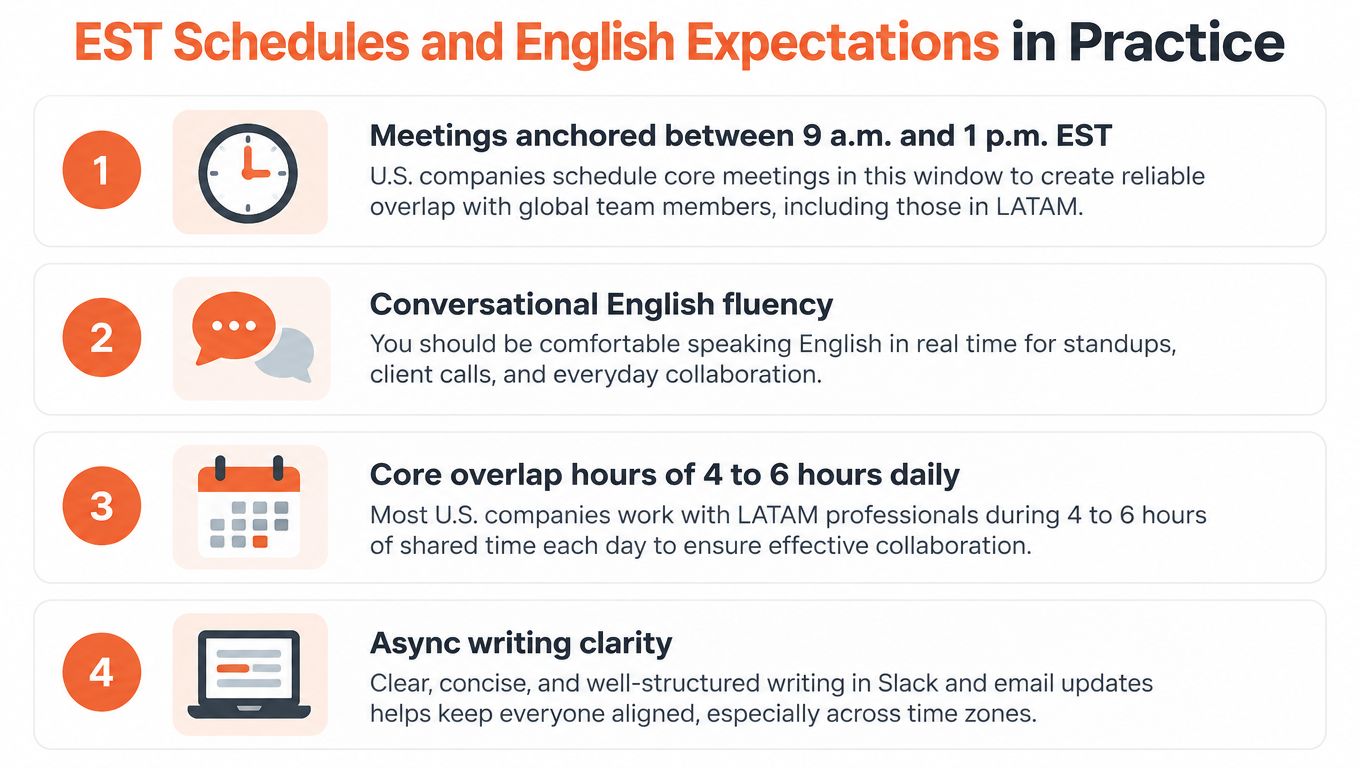
“EST hours” affects your daily routine, not just your calendar. It determines when you start work, join meetings, eat lunch, and handle responsibilities outside the job. Before applying, confirm whether the employer means a fixed Eastern Time schedule, a few hours of overlap, or availability until a stated local time.
U.S. companies often place recurring meetings and customer coverage in the middle of their business day. The relevant question is whether you can be present for the required live interaction without relying on constant schedule changes. Ask for the team's working hours, meeting frequency, expected response window, and whether daylight-saving changes affect the schedule.
Read the wording carefully
Job descriptions often use phrases such as “available until 6 p.m. local time,” “native or bilingual English,” “C1 minimum,” “business writing required,” and “full-day coverage in English.” These requirements carry different implications.
- Customer support agents need conversational fluency for calls and enough writing control to resolve tickets clearly.
- Executive assistants must follow fast conversations, manage U.S. calendars, and write concise updates without repeated clarification.
- SDRs face the strongest spoken-English requirement because prospecting calls, objection handling, and discovery meetings happen live.
- Content and operations candidates can often qualify with excellent written English when meetings are limited and work is mainly asynchronous.
Cross-border client work makes communication quality a practical requirement. More than half of surveyed platform workers served clients abroad, which increases the need for clear written and spoken English during daily collaboration. A language checkbox does not show whether you can explain a problem, confirm an instruction, or respond under pressure.
Test your readiness before applying
Assess whether your current ability is closer to B2 or C1. B2 can support many professional conversations. C1 gives you more control over nuance, persuasion, negotiation, and complex written updates. Clear pronunciation matters, but understanding different accents, interruptions, idioms, and informal workplace language matters just as much.
Record yourself explaining a past project in English. Check whether you can describe the context, action, and result without translating each sentence. For customer-facing roles, practise handling an upset customer. For administrative roles, practise confirming a meeting, clarifying a deadline, and summarising a decision.
Candidates targeting support work should review this remote customer support specialist guide before applying. If unscripted conversation causes you to lose accuracy or structure, improve that skill before pursuing call-heavy roles. A polished CV will not compensate for a communication gap that appears during the interview.
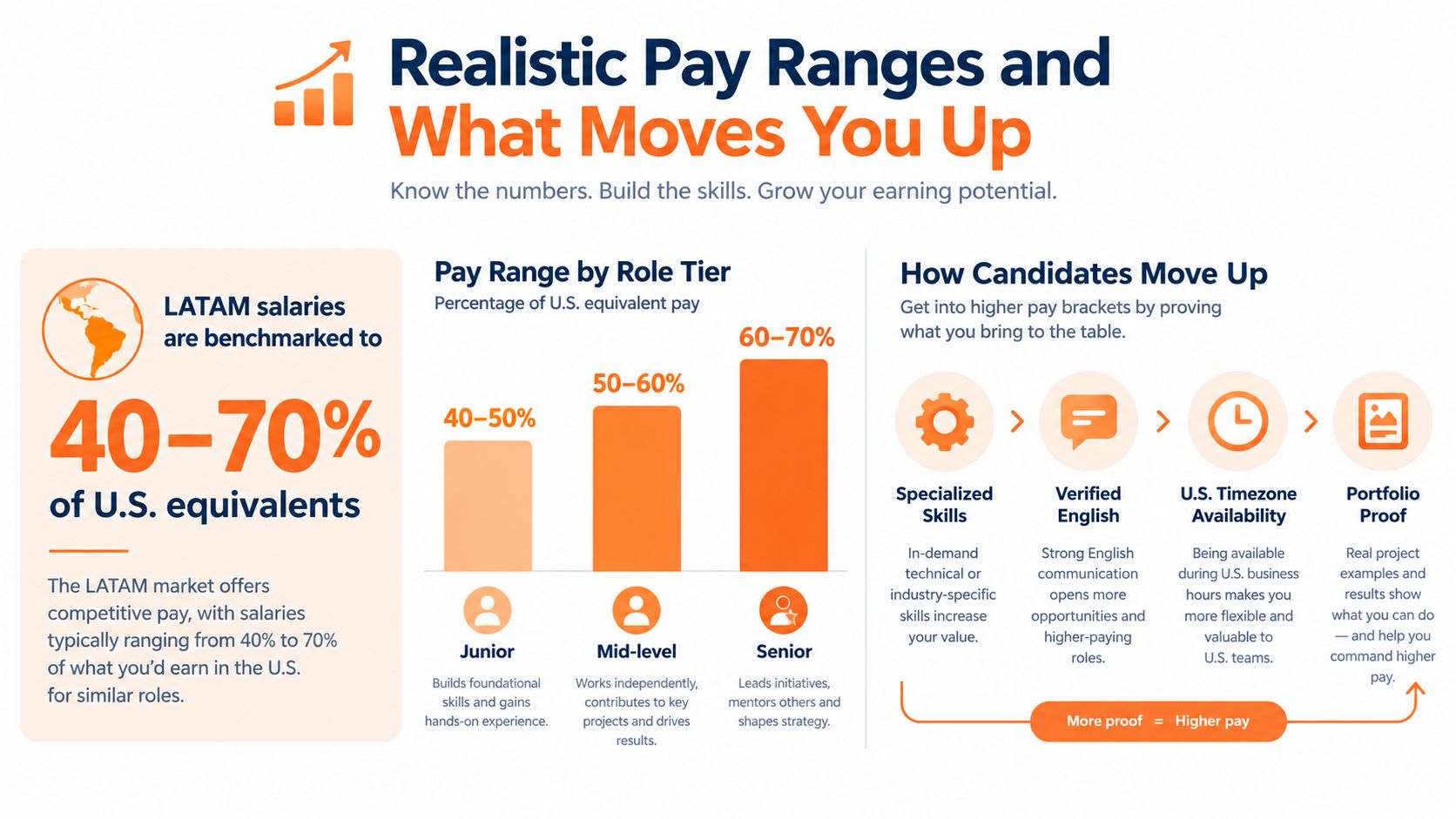
Realistic Pay Ranges and What Moves You Up
Remote pay in Latin America varies by client country, role complexity, English level, experience, contract structure, and whether the employer pays in U.S. dollars or local currency. Don't judge an offer by the headline amount alone. Compare the workload, expected availability, benefits, payment currency, and stability of the contract.
Published salary guidance places general remote roles serving U.S. or European clients at about USD 1,000 to USD 2,400 per month. Entry-level virtual assistant and support work is commonly positioned around USD 1,000 to USD 1,200, while bilingual or executive support can reach USD 1,600 to USD 2,400, according to published LATAM salary guides. The same guidance places local minimum wages across much of Latin America at roughly USD 374 to USD 437 per month, although local wage rules and living costs differ by country.
Entry-level roles
Virtual assistance, junior support, appointment setting, and basic administrative work usually sit at the lower end of the published international range. Candidates move upward by demonstrating more than availability. Calendar ownership, written English, CRM competence, customer de-escalation, bookkeeping accuracy, and process documentation all create value.
A candidate who can manage a founder's inbox, maintain a CRM, coordinate meetings, and produce reliable weekly reporting is more valuable than someone who can only perform isolated data-entry tasks.
Mid-level roles
Experienced customer success specialists, project coordinators, marketing operations professionals, bookkeepers, designers, and technical specialists can compete for stronger compensation. The path upward typically requires ownership, not just task completion.
Useful signals include HubSpot or Zapier workflow knowledge, advanced Salesforce administration, portfolio evidence, client-facing judgment, and the ability to improve a process without waiting for instructions. Certifications help when they support demonstrated work. They don't replace it.
Senior and specialized work
Senior operations leaders, RevOps specialists, engineering managers, and fractional executives negotiate from a different position because they influence revenue, retention, efficiency, or strategic execution. Their compensation can't be reduced to a generic regional average.
Benefits also matter. Paid time off, equity, health coverage, equipment support, and payment reliability can materially change the value of an offer. A higher monthly figure may be less attractive if the contract has unpredictable payment terms or requires constant availability.
Negotiation principle: Price the responsibility you own, not just the number of years on your CV.
Currency movement can also change real take-home pay, especially for professionals paid in local currency. Candidates in Argentina, Brazil, and Colombia should clarify the payment currency, conversion method, payment date, and whether the contract allows renegotiation. Senior candidates often prefer contracts denominated in U.S. dollars because that makes budgeting more predictable, but the contract terms still need careful review.
The following video offers additional context for evaluating remote career decisions and compensation trade-offs.
Where to Find Openings and How to Stand Out
A scattered search produces scattered results. Start with a small number of channels and evaluate each role before spending time on an application.
Dedicated remote boards such as We Work Remotely, Remote.co, and Dynamite Jobs can surface remote-first roles. LinkedIn and Indeed are useful when you apply location, remote-work, seniority, and language filters carefully. Niche communities, including Latinas in Tech and World Nomads communities, can provide context and referrals that a keyword search won't show.
Look for four details before applying:
- Payment clarity: Check whether the listing states a salary, payment currency, or compensation framework.
- Work classification: Understand whether the role is contractor, employee, full-time, or part-time.
- Schedule precision: Treat “U.S. hours” as incomplete until you know the exact overlap expected.
- Responsibility match: Compare the required tools and outcomes with what you can prove.
A talent pool works differently from a single vacancy. You submit your profile once, include your skills and availability, and remain discoverable for future roles that match your background. That can help candidates who aren't selected for the first opening, especially when hiring timelines shift or another employer needs a similar profile later.
One candidate profile should include:
- A targeted CV: Replace duty lists with evidence of the work you handled, the systems you used, and the problems you solved.
- A short English introduction: A concise Loom video can show clarity, confidence, and professional presence.
- A focused LinkedIn headline: State your role, strongest skills, language capability, and availability without stuffing keywords.
- A complete platform profile: Include tools, schedule, location, seniority, and preferred role categories.
For a broader, practical job-search reference, the 2026 playbook for job seekers can help you organize applications and strengthen your materials. Use it alongside a role-specific search, not as a substitute for reading each job description.
A regional job board can also reduce the time spent searching across unrelated sources. See these sites for finding remote work and compare their filters, application requirements, and location policies before committing to a search routine.
Your Next Step Into a Remote Career
Don't apply everywhere. Choose a target role first, then build your search around the requirements that role carries.
If you want customer support, audit your spoken English, ticket-writing ability, escalation judgment, and availability for live coverage. If you want executive assistance, prepare examples involving calendars, inboxes, confidentiality, and competing priorities. If you want SDR work, practice a discovery call and prepare evidence of prospecting, follow-up, and pipeline discipline.
Use this decision sequence:
- Choose one primary role and one backup role. A focused profile is easier to evaluate than a CV that claims to cover administration, marketing, sales, finance, and customer success equally well.
- Set your schedule boundary. State the hours you can reliably work, including any required U.S. overlap.
- Benchmark your pay expectation. Compare responsibilities and contract terms, not just the monthly figure.
- Select one or two search channels. A disciplined search creates better applications than constant platform switching.
- Apply and enter a talent pool. Direct applications target immediate openings. A talent pool protects you against slow hiring cycles and creates another route to future matching.
Joining a talent pool isn't admitting that you aren't ready. It's a practical way to stay visible while employers review candidates, adjust budgets, or open similar roles. Just make sure your profile is complete. An empty profile won't communicate your English level, tools, schedule, or experience for you.
Choose one concrete action within the next 48 hours. Rewrite your CV around a target role, record a one-minute English introduction, or submit your completed talent-pool profile. Remote hiring in Latin America is competitive, but it becomes much more predictable when you treat it as a deliberate process built around evidence, fit, and consistency.
Virtustant Jobs offers a candidate-focused place to review remote openings and submit your information for future matching through its talent pool. Visit Virtustant Jobs to browse opportunities, complete your profile, and take the next step toward a remote role that matches your skills and schedule.