The popular advice says to pick a side first. Choose paralegal if you want the more advanced, better paid career, choose legal assistant if you want administration, and then search by that title. That order will mislead you, especially if you're applying from Latin America, South Africa, or another market to a U.S. firm you've never seen in person. A posting can carry either name and still ask for the other job. The difference between a legal assistant and a paralegal isn't settled by the word at the top of the ad. It's settled by what you'll hand to a lawyer, who reviews it, and where your work must stop. Read for those three things first, and the right column for your skills becomes much clearer.
Duties Not Titles Decide the Difference
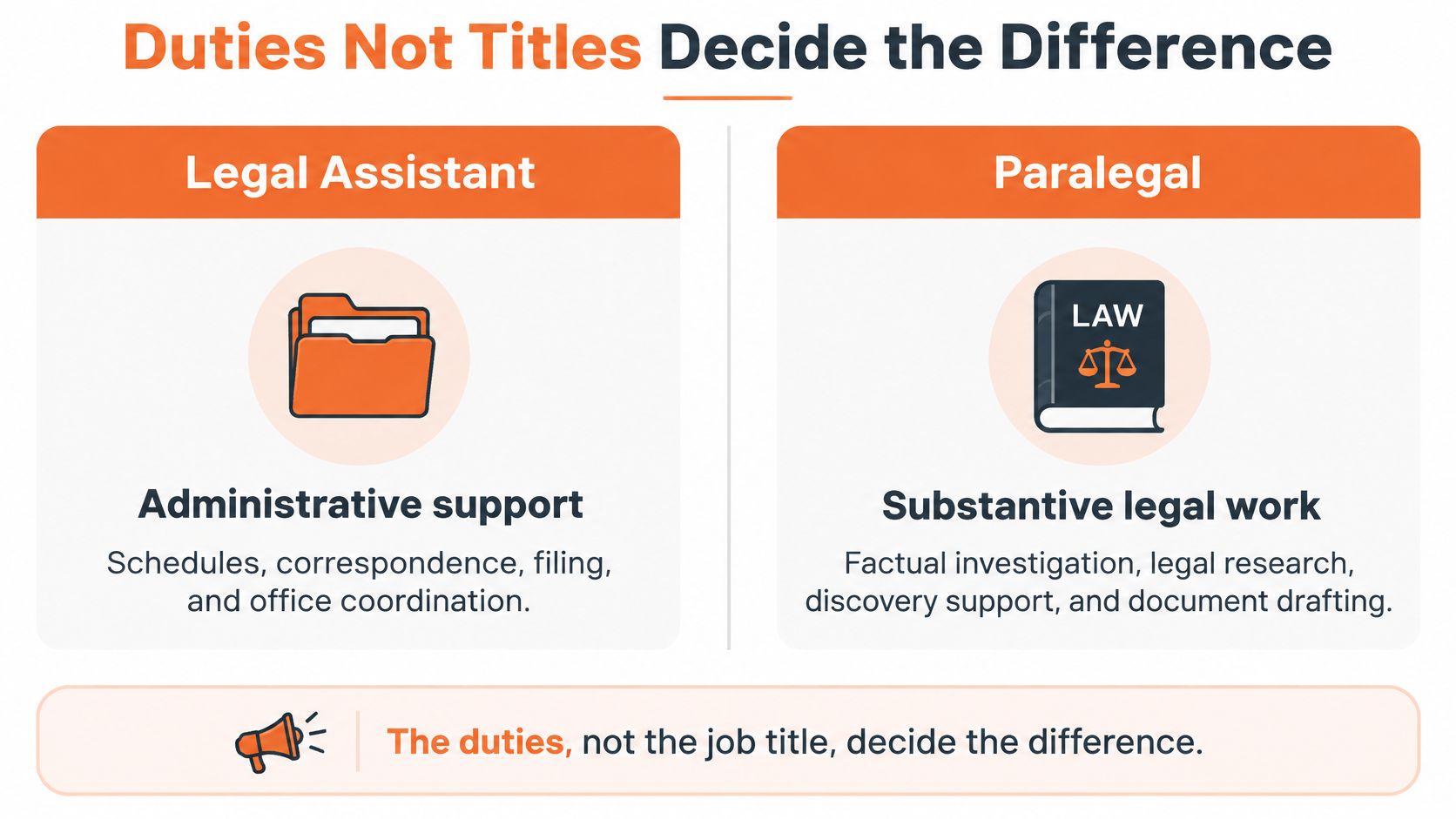
Here's the split you can use today. A paralegal generally does delegated substantive legal work, such as factual investigation, legal research, discovery support, and drafting. A lawyer reviews that work and stays responsible for it. A legal assistant more often keeps the matter moving through calendars and court dates, client intake, correspondence, file organization, proofreading, and billing support.
The labels disappoint for a historical reason. The American Bar Association definition of legal assistant and paralegal shows the American Bar Association approved a definition of "legal assistant" in 1986, then in 1997 defined a "legal assistant or paralegal" as a person qualified through education, training, or work experience who performs specifically delegated substantive legal work for which a lawyer remains responsible. The National Association of Legal Assistants adopted that definition in 2001. The ABA revised it in February 2020 and removed "legal assistant," keeping "paralegal" as the preferred term. Employers didn't all follow at the same pace, so "legal assistant" still appears on ads for both kinds of work.
The visual below puts the two outputs side by side before the fuller table.
Legal Assistant and Paralegal at a Glance
| Criterion | Paralegal | Legal assistant |
|---|---|---|
| Primary output | Delegated substantive legal work such as research, drafting, and discovery support | Workflow coordination such as calendars, intake, files, correspondence, and billing support |
| Typical day | Factual investigation, authority research, evidence review, pleadings, deposition summaries, and case management | Scheduling, client intake, file organization, proofreading, record collection, and billing or CRM updates |
| Education signal | Associate degree or paralegal certificate is a common US entry benchmark, with wide employer variation | Often legal-admin experience, software fluency, and accurate client communication rather than a paralegal credential |
| Supervision | Lawyer remains responsible and reviews work before it is advice, a filing, or a client commitment | Same ban on independent legal advice, with fewer tasks that call for legal judgment |
| Remote screening | Jurisdiction-specific research memo, citations, issue spotting, and redacted drafting | Calendar-conflict resolution, intake validation, file naming, and a clear client email |
| Title reliability | More often signals substantive support, but the duty list still controls | May mean paralegal-level work or purely administrative support |
Neither role is a lawyer. The attorney remains responsible for delegated legal work, and that review step should be visible in any serious posting.
Judge every vacancy by its listed outputs and review checkpoints, not its title. Practice rules vary by jurisdiction, and a confident ad that never names a reviewer is a weaker ad, not a simpler one.
Substantive Case Work Compared with Office Flow
Titles sound abstract until you picture the file landing on a lawyer's desk. Under the definition in the NALA Certified Paralegal Program Handbook, a paralegal performs specifically delegated substantive legal work for which a lawyer remains responsible, including factual investigation, legal and regulatory research, analysis of evidence, preparation of pleadings, deposition or testimony summaries, discovery support, and case management. Legal assistants more commonly handle calendar and court-date management, client intake, file organization, billing support, proofreading, and collecting information or records.
What Paralegal Work Looks Like on Paper
Say a litigation matter arrives with a disputed deadline. The paralegal output might be a short research memo that states the facts given, isolates the legal issue, cites the authority found, and applies it to those facts for attorney review. It doesn't decide the strategy. It gives the lawyer something accurate to decide with.
A second output could be a discovery set or document index. The paralegal organizes the records, spots gaps, and flags a possible privilege question rather than settling it. A third is a deposition summary that separates what the witness said from how anyone characterizes it. A fourth is a draft pleading or form packet that deliberately stops at the revision stage. If that pattern sounds like work you know, compare it carefully with the job duties of a legal secretary, because older titles sometimes overlap with assistant work too.
What Legal Assistant Work Looks Like in Motion
The assistant's outputs keep that same matter from stalling. A court-date calendar with conflicts resolved means nobody discovers a clash the night before. An intake record checked for missing names, contact details, and deadlines means the lawyer isn't chasing basics. A file-naming and records pass means the next person can find the exhibit without guessing.
Then there's the quieter work. A billing or time entry prepared for review. A client email that shares only attorney-approved process information, such as which document is still needed or when a call is scheduled. A reminder sent on time, in the right tone, with no legal conclusion slipped in. That's skilled work, even though it isn't analysis.
Grey zone: Proofreading, collecting records, and organizing evidence appear in both jobs. The split is whether you're asked to analyze authority and exercise legal judgment, or to execute and coordinate accurately.
Remote work adds one useful test. A bilingual candidate might translate a status update or collect documents in Spanish, and that's often exactly why a firm values cross-border support. But explaining what a form legally means for that client is still the lawyer's call. Translating words isn't the same as interpreting consequences.
Try this before you apply anywhere. Write down three outputs you can already produce well, without help, this week. A research memo with citations sits in one column. A clean intake record sits in the other. Let those outputs, not your last employer's title, tell you where your evidence is strongest.
Training and Certificates Employers Screen For
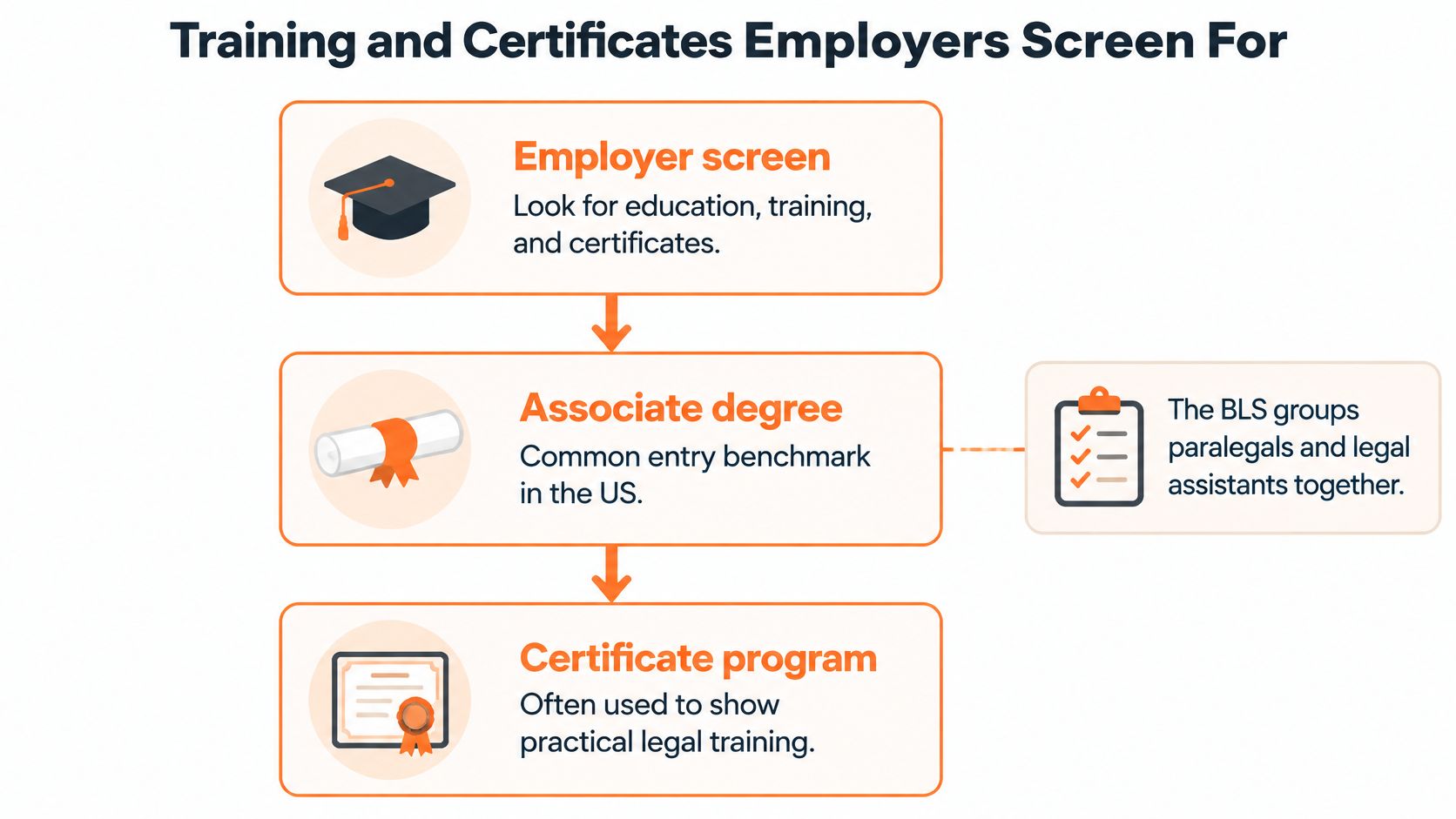
Don't treat a U.S. study path as a universal rule. The Bureau of Labor Statistics entry for paralegals and legal assistants groups both titles into one occupational category and says the occupation typically requires an associate degree or certificate in paralegal studies for entry, while actual hiring varies by employer, jurisdiction, practice area, and prior experience. Because the federal data combine the titles, a certificate can't prove you're entering a separate labor market. It can only show training that a particular employer may value.
The chart below shows how that benchmark usually appears in an employer screen.
A more useful quality test comes from the work itself. Strong paralegal work means you can identify relevant facts, isolate the main legal issue, locate applicable authority, and apply that authority accurately to the facts under attorney supervision. Read those as four separate skills. If you can find authority but can't yet organize facts, or you can spot an issue but your citations are unreliable, you know what to practice next.
The short video below is worth pausing on if you're deciding which track your training currently proves.
Skills Test by Role
| Test area | Paralegal track | Legal assistant track |
|---|---|---|
| Core task | Research memo with citations and issue spotting | Calendar-conflict resolution and intake validation |
| Drafting | Redacted-document drafting for attorney review | Clear client email that shares process information only |
| Records | Document index with a privilege question flagged | File-naming and records-classification exercise |
| Metrics tracked | Turnaround, citation completeness, escalation judgment | Turnaround, factual accuracy, error rate, escalation judgment |
Prepare evidence that matches the column you're chasing. Your CV should name the credential or equivalent experience, the practice area, the software you've used, and one supervised work product described by its outcome. "Prepared a document index for attorney review in a personal injury matter" says more than an inflated former title. A Latin American law degree or local assistant background can be relevant experience, and you should present it accurately. It doesn't by itself authorize U.S. practice, and claiming otherwise will hurt you.
Use one final self-check. If a posting demands a certificate but names no jurisdiction, no review step, and no concrete output, that credential request isn't meaningful yet. Ask what you'd produce in week one before you pay for a course to satisfy a vague ad.
Supervision Rules That Travel with the Work
Working from home in another country doesn't loosen the rules. It makes them easier to break without detection, because there's no lawyer down the hall to overhear a call. That's why the limits matter more for remote candidates, not less.
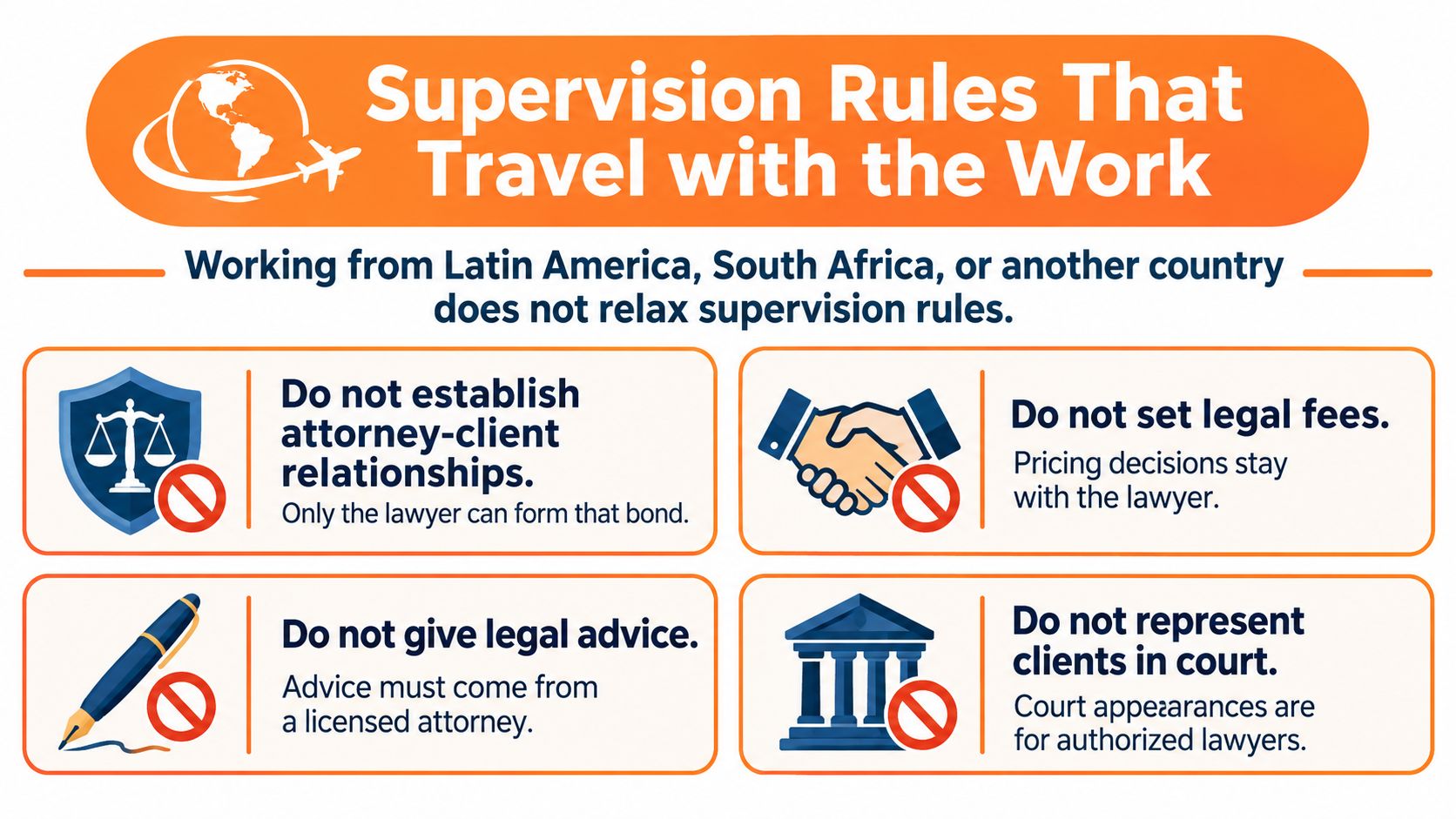
The NALA model standards for paralegals state that paralegals must not establish attorney-client relationships, set legal fees, give legal opinions or advice, represent clients in court unless authorized by applicable rules, or perform work that constitutes unauthorized practice of law, and the supervising lawyer remains responsible for delegated work. Treat that list as your floor, whichever title the ad uses.
The checklist below keeps those boundaries visible.
The Question Remote Applicants Actually Ask
Can you talk to U.S. clients, prepare a filing packet, or walk someone through a form from abroad? Often yes, when the work is factual, scripted, and attorney-approved. You can confirm an appointment, list the documents still missing, explain where a signature line sits, or send a status update the lawyer has cleared.
It becomes a problem when you cross into judgment. Explaining legal consequences, recommending a strategy, predicting an outcome, or sending work no lawyer has reviewed moves you out of support and into advice. The same phone call can be fine in minute one and improper in minute three, which is why "I'm just being helpful" isn't a defense.
Three Moments to Escalate, Not Reassure
- A client asks whether to sign: Record the question exactly, confirm you've passed it on, and route it. Don't say it looks standard.
- A deadline looks missed: Flag the date and the source document to the lawyer at once. Don't tell the client it's probably fine.
- A document seems privileged: Stop, restrict access, and ask for direction. Don't summarize it for convenience.
Good remote behavior is mostly unglamorous. Keep confidential files in the firm's approved system, never in personal cloud storage or a private email account. Follow written instructions as written. Raise the question before you guess, especially when a guess would be hard to undo. Employers notice candidates who can describe that discipline calmly, without sounding afraid of the work.
Your location doesn't create a license, and distance from the office doesn't transfer the lawyer's responsibility to you.
Before accepting broad client contact, ask for the employer's jurisdiction protocol. A firm with clear scripts, review steps, and escalation routes is protecting you as well as its clients.
How to Read a Legal Support Vacancy
Start with the verbs, not the title. Research, draft, summarize testimony, and coordinate discovery point toward paralegal work. Schedule, intake, file, proofread, bill, and organize records point toward assistant work. If both clusters appear, ask one question. Which cluster fills most of week one?
That reading order matters because the boundary is easy to blur in an ad. The New Jersey Advisory Committee on Professional Ethics opinion reflects the principle that paralegal work must receive appropriate attorney supervision and that unsupervised services, including advising clients independently, can constitute unauthorized practice of law. So a posting that promises autonomy without a review path isn't offering freedom. It's shifting risk onto you. If you're unsure where legal support ends and general administration begins, what an administrative assistant does is a helpful comparison point.
Clues That Sort a Remote Legal Posting
| Posting clue | Leans paralegal | Leans legal assistant | Confirm before applying |
|---|---|---|---|
| Duty verbs | Research, draft pleadings, summarize testimony, support discovery | Schedule, intake, file, proofread, bill, organize records | Which outputs fill most of week one |
| Tools named | Research platform and a document system with citation standards | Calendar, CRM, billing software and shared drives | Whether the named software is required on day one |
| Review path | Attorney checkpoints before client-facing legal content | Escalation steps for any legal question | Who reviews the work and how quickly |
| Hours and language | Deadlines that cluster around filings and hearings | Coverage of a stated business window, often US Eastern Time | Time zone overlap, English level and home confidentiality setup |
| Credentials | Paralegal studies, a certificate or equivalent supervised experience | Admin accuracy and client-data experience | Whether a missing certificate actually blocks the application |
Then match your application to the column you've identified. For a paralegal-leaning ad, show a supervised research or drafting example and name the jurisdiction you studied. For an assistant-leaning ad, show accuracy in calendars, intake, records, and client email. In both cases, state your English level, your overlap with the posted hours, and how you'll handle confidential files at home.
Don't copy a U.S. salary figure from a career site into a cross-border expectation. Combined national data can't tell you what a specific remote vacancy pays, and anchoring on a number built for a different labor market leads to bad decisions in both directions. Read the terms attached to the actual posting instead. Once the majority workload and review path are clear, you can decide yes, no, or ask one more question before you apply.
Remote Matters That Call for Each Role
Abstract definitions get easier when you watch a team try to staff real work. Consider four situations and ask which seat you'd fill.
A litigation team behind on discovery. It needs deposition summaries, discovery tracking, and draft pleadings, with the jurisdiction and review checkpoints named. That's a paralegal seat, whatever the ad calls it. The warning sign is a candidate who's excellent at calendars but new to citations accepting drafting that nobody reviews. Enthusiasm doesn't close that gap, and you can read more about how firms describe virtual paralegals if you want a sense of how employers frame remote substantive support.
The team below is the setting most remote legal support feeds into, even when you never enter that room.

A small firm drowning in intake. The need is screening new clients, holding hearing dates, chasing records, and following up on billing. That's a legal assistant seat even if the ad says paralegal, perhaps because the firm thinks the fancier title attracts stronger applicants. The mismatch runs the other way here. A research-trained candidate placed in a pure scheduling seat will be bored within a month and may start adding commentary to client emails just to feel useful. If you're comparing live ads, browsing examples of remote paralegal jobs can train your eye for which duty cluster dominates.
A high-volume immigration, personal injury, or insurance desk. This one often splits cleanly. An assistant runs eligibility intake and document collection, checking that names match across forms and that nothing requested is still missing. A paralegal prepares attorney-reviewed summaries and form packages from what's been gathered. Neither person replaces the other, and a firm that merges both into one hire usually discovers the error rate first.
A solo lawyer hiring one remote generalist. This is the posting to read slowest. One title can't cover substantive drafting and full office flow at full depth, so a good ad writes two duty tiers and says which tier is week-one work. A weak ad lists everything and lets urgency decide daily. Ask which tier you'll be judged on in your first month. The answer tells you whether you're applying for a growth path or for permanent overflow.
Whichever scenario fits, describe your remote readiness in concrete terms. Name your overlap with the stated business hours, often U.S. Eastern Time in these postings. State the English level the ad requires and whether you meet it in writing, on calls, or both. Explain your confidential setup at home, including a private workspace, a secured connection, and the firm's file system only. Vague claims about being organized and detail-oriented won't do that work for you. Specifics will.
Choose the Matching Role and Apply
Pick the column your proven outputs match. If they're research, drafting, and issue spotting under review, pursue paralegal duties. If they're intake, scheduling, records, and client coordination, pursue legal assistant duties. If a posting mixes both, apply only after the majority workload and review path are clear.
Then do three things in order. Write a short CV headline that names the duty cluster and tools, not just your old title. Add your English level, hours of overlap, and one line on confidential file handling. Keep one supervised work example ready for a skills test, matched to the role. If an interview is next, you can prepare for your paralegal interview with questions framed around supervision and escalation, which is where strong candidates separate themselves.
The employment or contractor arrangement can vary by company and vacancy, so read the terms attached to each posting before accepting. Start by creating or completing your Virtustant profile, then review current remote openings as legal support roles are listed. A complete profile also leaves you available for later matches, without any promise of a particular opening or wage.
If your strongest evidence is research and drafting under review, or intake and coordination done accurately, Virtustant Jobs gives you one place to present that evidence clearly and browse remote roles as they're posted. Complete your profile today so hiring companies can match your actual outputs, hours, and English level to the right legal support seat.