
A project manager turns an objective into a controlled plan and coordinates people, money, time, risks and deliverables until the work is complete. You're reading job postings and one says scheduling meetings, another says owning outcomes, and both use the same title. That gap is where many candidates get confused. Understanding what is role of project manager work in practice helps you judge which posting matches your experience, and which one is really asking for an administrator with a bigger title.
What a Project Manager Does in Plain Terms
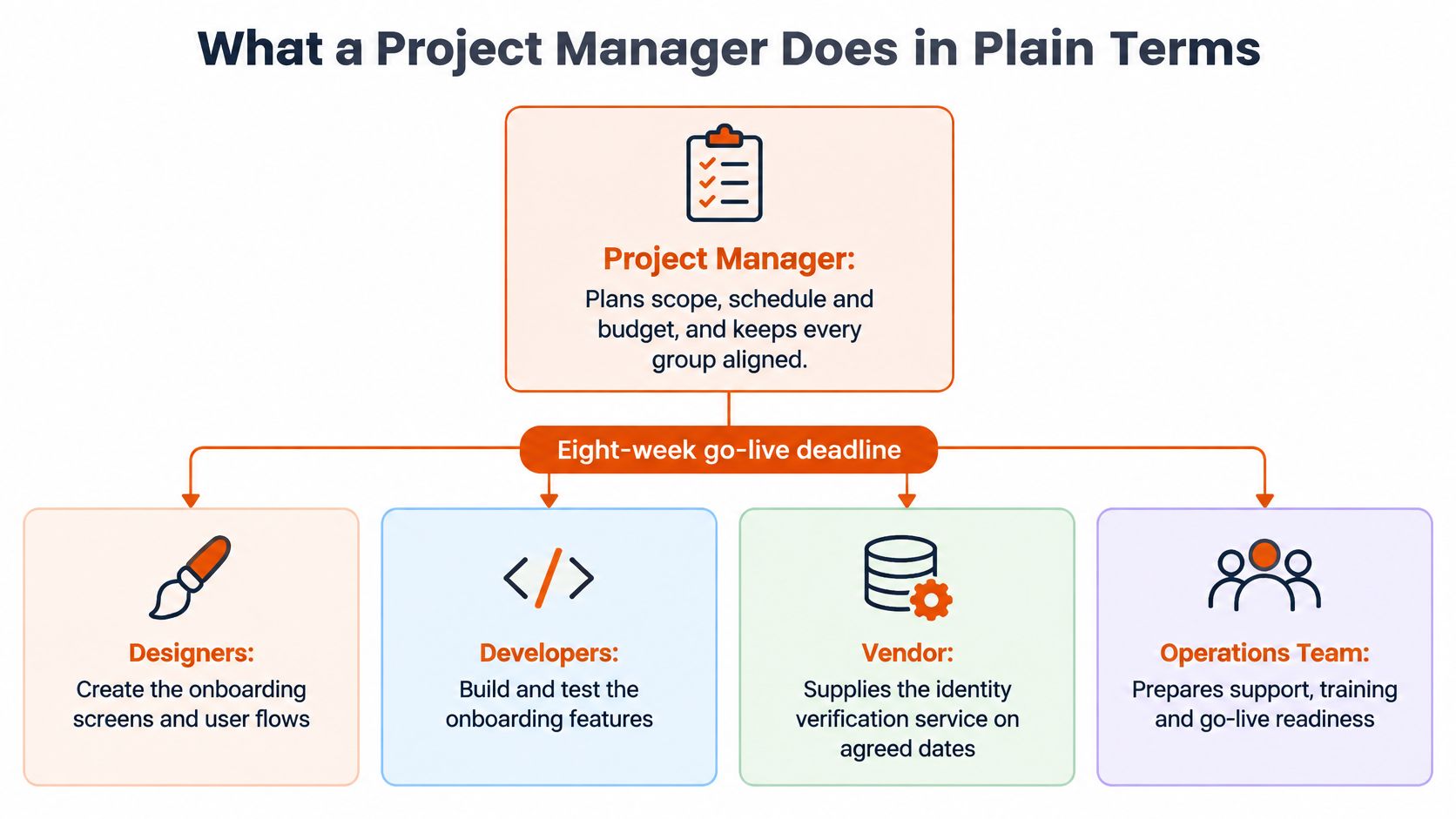
Say a company wants a new client onboarding process live in eight weeks. Designers must create the screens, developers must build them, a vendor must supply identity verification on agreed dates, and operations must prepare support and training. Each group depends on the others, and one late handoff can stall the launch.
Someone has to turn that goal into a sequence of work, assign owners, and keep every group aligned. That's the project manager, and the role is an integrator, not a meeting scheduler. The manager connects the business goal with the daily decisions of the people building the result.
Four Things Protected at Once
The job protects scope, schedule, cost, and quality at the same time, held together by stakeholder alignment. If a client adds a feature, something else moves. The manager makes that trade-off visible early instead of letting the team absorb it without anyone noticing.
Before work starts, the manager breaks the work into activities, estimates cost, assesses risk, and sets a completion timeline. During delivery, the manager tracks milestones, solves problems, talks with stakeholders, and adjusts the plan when requirements change.
The U.S. Bureau of Labor Statistics description of project management specialists covers coordinating budget, schedule, staffing, and procurement, leading technical staff, and sometimes serving as the client's point of contact. That same source puts employment at approximately 947,630 people in May 2023, with a median annual wage of $98,580 in the United States.
A useful test is simple. If you remove the project manager and the work still runs itself, the role was probably administration.
Remote teams feel this role most sharply. Shared schedules, clear ownership, and written decisions replace hallway conversations. Without them, time zone gaps turn small questions into day-long delays.
Responsibilities Across Each Project Phase
Most methods recognize five phases, and the manager's work changes in each one. Candidates often describe only the middle, execution, and miss the setup and closing work that employers test in interviews. The PMI guidance on the project manager as integration owner frames the job as converting strategic objectives into an executable delivery system, including objectives, acceptance criteria, a work breakdown structure, schedule, budget, resources, and risk responses.
Initiation and Planning
In initiation, you confirm why the project exists, who can approve it, and what success looks like. A vague objective here becomes an argument later, so you write down acceptance criteria while everyone still agrees.
Planning turns that agreement into a system. You build the WBS, sequence tasks, estimate effort, assign resources, and record risks with planned responses. For remote work, you also set the status cadence and time zone rules before delivery pressure arrives.
| Phase | What the project manager does | Main outputs |
|---|---|---|
| Initiation | Confirms the objective, identifies stakeholders and agrees success criteria | Project charter, stakeholder list |
| Planning | Builds the WBS, schedule, budget, resource plan and risk responses | WBS, schedule baseline, budget, risk register |
| Execution | Coordinates team work, removes blockers, manages vendors and runs status communication | Status reports, decision log, issue log |
| Monitoring and control | Compares actual progress with the baseline, forecasts outcomes and handles change requests | Variance reports, change requests, forecasts |
| Closing | Obtains formal acceptance, hands over deliverables and reviews lessons learned | Acceptance sign-off, closure report, lessons learned |
Execution, Control, and Closing
During execution, your value is often removing friction. You chase missing approvals, resolve conflicts between teams, keep vendors to their dates, and record decisions so nobody relitigates them next week.
Monitoring runs alongside execution. You compare actual progress with the approved baseline, forecast where the project will land, and negotiate scope, time, and cost trade-offs when reality diverges from the plan.
- Requirements baseline: The agreed version of what you're delivering, so changes are visible.
- Responsibility matrix: Who does, approves, and gets informed for each piece of work.
- Dependency register: Which tasks wait on which other tasks, and who owns each link.
- Decision log: What was decided, by whom, and why, in one searchable place.
Closing is where many projects fail without anyone noticing. You obtain formal acceptance, hand over deliverables with documentation, release resources, and run a lessons learned review while memories are fresh.
One thread runs through all five phases. You're accountable for the decisions, the record of those decisions, and the communication that keeps stakeholders aligned. Task completion alone isn't success. Controlled delivery of the agreed scope is.
How Schedule Control Protects the Budget
Many people treat a schedule as a calendar with nicer formatting. That misunderstanding hides why employers care about schedule skills. A schedule is also a cost control tool, because waiting work still consumes paid time.
The image below shows the everyday reality behind that idea, a manager reviewing progress data rather than just moving dates around.

When a task finishes late, downstream work often waits, and that waiting can increase labor, supervision, equipment, and facility expenses. The U.S. Government Accountability Office cost estimating guide reports that schedule variances are usually followed by cost variances, and that a credible cost estimate must account for schedule slippage effects.
Controls That Make Dates Credible
Strong managers build a logic linked schedule from the WBS. Each task shows its predecessors, meaning what must finish first, and the critical path marks the chain that determines the earliest completion date. Progress gets measured against an approved baseline, not against optimism.
Periodic schedule risk analysis adds realism. It estimates how likely a completion date is, exposes changes in the critical path, and helps quantify the reserve needed for uncertainty.
Say design approval for an onboarding flow slips by four working days. Development can't start, so the build starts four days late. You check which downstream tasks share the same developers, estimate the revised completion date, calculate added contractor or overtime cost, compare options such as splitting the build or reassigning a reviewer, and only then approve a correction.
The short video below walks through schedule thinking in a practical, visual way.
For distributed teams, add owner based deadlines, working calendars that show each person's time zone, and escalation thresholds for missed milestones. A missed date should trigger a defined action, not a surprised message three days later.
Methodologies and Skills That Define the Job
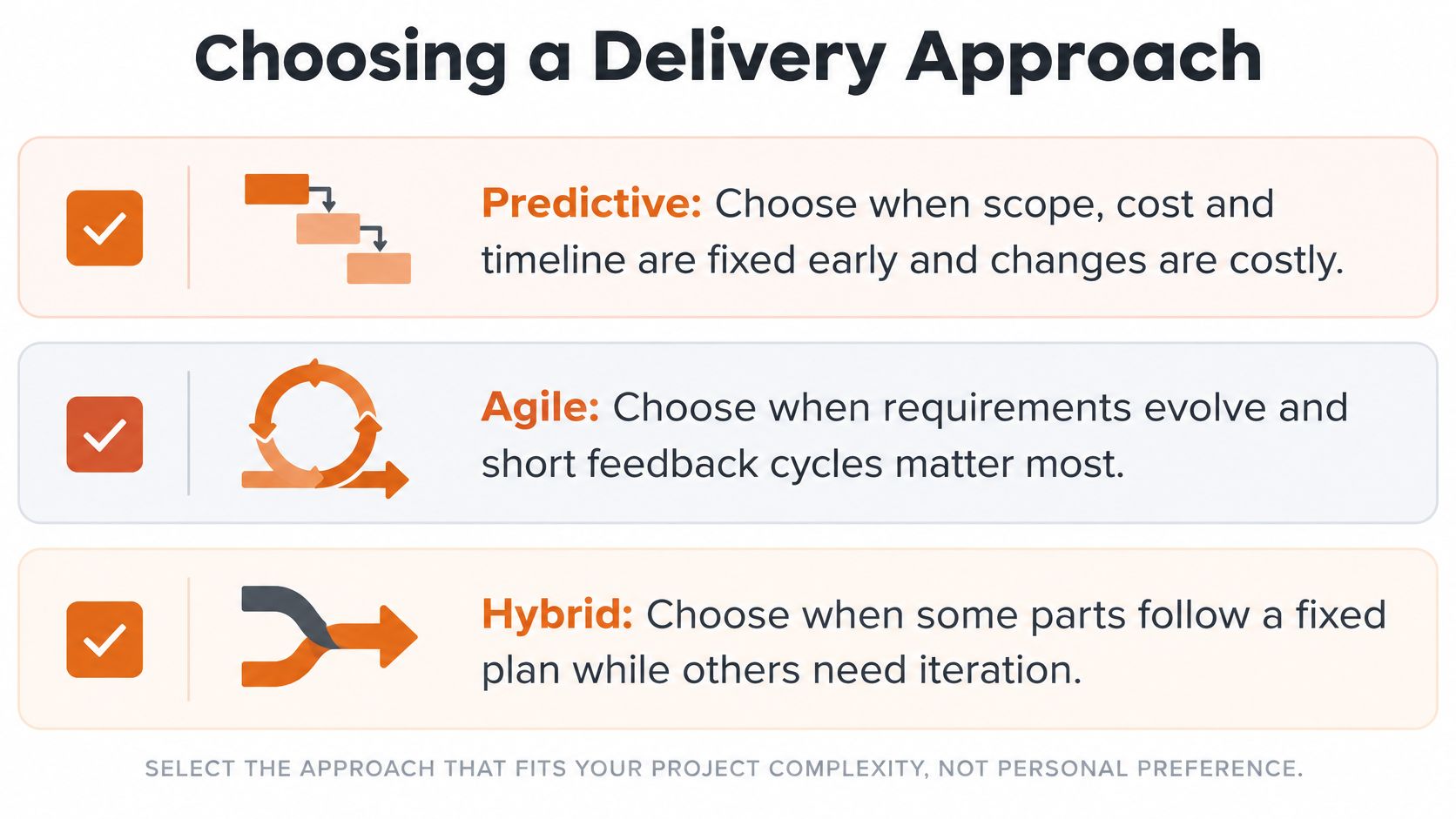
A project manager chooses a delivery approach based on the project's complexity, not personal preference. The PMI examination content outline lists assessing complexity and choosing a predictive, adaptive or agile, or hybrid approach, alongside estimating effort, identifying dependencies, quantifying risk, tracking spending, and creating schedules with milestones.
| Approach | Best when | How the project manager works |
|---|---|---|
| Predictive (waterfall) | Scope is fixed and requirements are clear before work starts | Builds a full baseline plan, runs stage gates and uses formal change control |
| Agile (Scrum or Kanban) | Requirements change often and fast feedback matters | Manages a prioritised backlog, runs short iterations or flow boards and reprioritises each cycle |
| Hybrid | Fixed contractual milestones sit alongside iterative product work | Keeps an outer phase-gate plan and runs iterative delivery inside the phases |
Skill Groups Employers Probe
Planning and analysis comes first. You estimate effort, build schedules, spot gaps, and quantify contingency. Confusing activity with progress is the common failure here, so you tie every task to an output someone can verify.
Financial control means tracking spending against budget, explaining variances in plain language, and preparing financial reporting that a sponsor can act on. You don't need to be an accountant. You do need to know why the numbers moved.
Leadership and communication is where remote candidates win or lose. You'll influence specialists who don't report to you, run difficult conversations about missed dates, and write status updates that state what's done, what's next, and what's at risk.
Business acumen holds the rest together. You understand why the project matters, which requirements create value, and when continuing unchanged stops making sense.
Tools support those skills. You'll use spreadsheets for budgets, scheduling software, task boards, dashboards, and shared document workspaces. If you're comparing work management setups, monday.com for cross-functional collaboration is one example of how teams structure shared boards and ownership, though employers vary widely in what they use.
Interview readiness: Prepare one story each for building a schedule, tracking a dependency, handling a scope change, and choosing a delivery method. Explain the decision, not just the tool.
Seniority Levels and the Coordinator Difference
Titles vary between companies, so read the scope in a posting rather than trusting the label. A small company may call its only delivery lead a coordinator, while a large firm may title an administrator as a project manager.
The photo below reflects the mixed seniority you'll see in project teams, where titles alone don't tell you who owns decisions.

| Level | Typical scope | Main focus |
|---|---|---|
| Project coordinator | Supports schedules, tracking and minutes on a plan someone else owns | Administration and follow-up |
| Project manager | Owns one project from start to close | Plan, budget, risks and stakeholders |
| Senior project manager | Leads complex or high-risk projects across several teams or vendors | Governance, trade-offs and mentoring |
| Program or portfolio manager | Oversees several related projects or the full set of investments | Benefits, priorities and resource allocation |
The Value Ownership Test
A coordinator keeps trackers, minutes, and follow-ups current, usually working to someone else's plan. A project manager owns the outcome. You decide sequencing, propose trade-offs, challenge low value requirements, and recommend whether a project should continue, change, or stop.
PMI's 2025 Pulse of the Profession research emphasizes owning project success beyond scope, schedule, and budget by connecting delivery decisions with stakeholder perceptions, organizational goals, customer outcomes, and measurable value. It highlights technical ways of working, power skills, and business acumen as central capability groups.
Apply that test to any posting. Look for ROI, customer outcomes, benefits realisation, portfolio alignment, and stakeholder governance. If the posting lists only scheduling and meeting notes, you're looking at coordination work.
Describe your own level candidly. State the number of projects, team size, budget range, and the decisions you personally owned. Accurate scope beats an inflated title in interviews.
Deliverables and KPIs Employers Look For
Employers judge project managers by evidence, not by duty lists. A CV that says you managed projects and led teams tells a reviewer almost nothing. Numbers, even modest ones, show what changed because you were there.
If you're preparing an application, browsing remote project manager job descriptions on Virtustant helps you see which results employers ask about most. Match your examples to that language without copying it.
| KPI | What it shows | How to present it |
|---|---|---|
| Schedule performance | Earned work compared with planned work, showing whether the project is ahead or behind | Planned versus actual milestone dates |
| Cost performance | Earned value compared with actual cost | Budget at start and at close, with the reason for any variance |
| Milestone hit rate | Share of milestones delivered on time | Milestones met out of total planned |
| Scope change volume | How many change requests were approved or rejected | Number of changes and how each one was handled |
| Risk closure | Share of logged risks resolved or formally accepted | Top risks, the response chosen and the outcome |
| Benefits realisation | Business result against the expected benefit | Before-and-after measure such as time saved, errors reduced or revenue affected |
| Stakeholder satisfaction | Feedback from sponsors, clients and team members | Survey results or specific feedback summarised |
Connect Delivery to Business Results
PMI research on benefits during project execution reports that organizations identify communicating with business owners about benefits related issues as a primary responsibility in 63% of cases. Revisiting expected benefits appears in 46% of cases, and ensuring benefits remain aligned with organizational strategy appears in 38%.
Mirror that in applications. Name the outcome your project affected, such as revenue, customer satisfaction, efficiency, quality, or compliance, and describe how you reported progress to stakeholders. Candidates in design led fields can see a related angle in project management for design professionals, where deliverables tie closely to client approval cycles.
Use honest before and after figures. State the planned and actual dates, the starting and closing budget, and the reason for any gap. A rough, truthful figure is more convincing than a polished vague claim.
Remote Project Management from Latin America
Remote project management from Latin America usually means working with clients or teams in the United States, Canada, or Europe. Postings often set an overlap window, such as 9 AM to 5 PM Eastern Time, and you should read that requirement exactly rather than assuming flexibility. If time zone language confuses you, the Virtustant guide to South American time zones explains how regional offsets affect working hours.
Plan your day around the overlap. Block shared hours for calls and decisions, protect focus time outside them, and set response windows you can keep every day. Consistency builds more trust than occasional late night heroics.
Written Communication Is the Core Skill
Send concise status updates with three parts, what's completed, what's next, and what's blocked. Keep a decision log, share meeting notes the same day, and escalate risks in writing with an owner and a date. If you're polishing how you present this experience, you can browse program manager resume examples to see how senior candidates phrase outcomes and scope.
Professional English matters for client calls and documentation, and postings often state a required level such as C1. Check your readiness candidly before applying. Clear, simple sentences beat complex ones, especially in status writing where ambiguity creates rework.
Tools and AI Literacy
Expect spreadsheets for budgets and trackers, shared scheduling and task boards, and dashboards for status. Employers care less about which brand you've used and more about whether your boards show owners, dates, and dependencies clearly.
An Association for Project Management survey of 1,000 project professionals reported in January 2025 found 70% had integrated AI into everyday processes, with strong benefits in performance analysis, data analysis, and administrative work. Use AI to summarize meetings or draft reports, then check every output, protect confidential client information, and keep accountability for decisions yourself.
Before applying, prepare four things. A time zone plan, a sample written status update, one example of a schedule you built, and clarity on the currency and payment terms stated in the posting.
Confirm the Fit and Take Your Next Step
Three questions tell you most of what you need to know. Do you enjoy coordinating several people toward one outcome? Can you explain the planning decisions behind a schedule you have built, including the trade-offs you accepted? Are you comfortable writing clear updates in the languages a role requires?
If you answered yes to most of them, the project manager path is worth pursuing. If your experience sits closer to tracking and administration, a coordinator role is a realistic first step. Many project managers built toward full ownership from exactly there.
Apply the same distinction to every posting you read. A role that assigns you decisions, trade-offs, and a result to own is project management; one that stays with logging tasks and chasing updates is coordination.
Start with concrete actions. Create your Virtustant profile with your project history, tools, and language level, then browse current remote openings and check each listing against that ownership test. If you are still comparing where to search, the Virtustant guide to the best sites for remote work gives useful context for evaluating platforms.
Complete your profile fully so your CV details match what postings ask for. Joining the talent pool keeps you visible for project roles that open later.
Virtustant Jobs connects qualified candidates across Latin America with remote project management and operations roles that state their schedules, tools, and language requirements up front. Build your profile, add the project outcomes and KPIs you can defend in an interview, and apply to roles that match your seniority through Virtustant Jobs.