You may understand debits, accruals, reconciliations, and financial statements, yet a remote interview can still challenge you in unexpected ways. The interviewer may need to see how you use accounting software, check your own work, investigate an unexplained variance, explain a finding in clear English, and stay dependable while working across countries and time zones.
These accounting interview questions are organized around the evidence remote employers need, not just textbook definitions. You'll find eight question categories, answer-building frameworks, realistic remote-work examples, and practical preparation steps for candidates pursuing opportunities through Virtustant. Before practicing, review each role's requirements for software, accounting functions, schedule, experience, and language level. You can also review this remote work vocabulary for HR if you're preparing for cross-border hiring conversations.
1. Technical and Software Proficiency Questions
Remote accounting work depends on your ability to complete workflows accurately without someone sitting beside you. Interviewers may ask, “Walk me through how you'd reconcile a bank account in QuickBooks?” or “How have you used pivot tables, XLOOKUP, or INDEX-MATCH in Excel?” They may also ask about cloud accounting systems, multi-currency transactions, or the way you preserve an audit trail.
Answer with a process, not just a list of software names. Explain what information you start with, which checks you perform, how you investigate exceptions, and what evidence you retain. If you've used Excel but not the employer's preferred platform, show how you'd transfer the same accounting logic into QuickBooks, Sage, NetSuite, Google Sheets, or another system.
A survey of accounting practitioners in Nigeria reported proficiency of 76% for Excel, 38% for QuickBooks, 42% for Sage, and 8% for XBRL, while 90% reported never having used XBRL. Because this was a country-specific sample rather than a global benchmark, it shouldn't be treated as a measure of LATAM talent. It does show why employers should assess transferable workflows instead of assuming that every candidate has used the same platform. The findings are available in this accounting software proficiency survey.
Practical rule: Be precise about what you can perform independently, what you've done with supervision, and what you're currently learning.
Before the interview, list the accounting systems and spreadsheet functions you've used on your Virtustant profile, with an honest proficiency level. Practice explaining a bank reconciliation or aging schedule aloud, and include certifications such as QuickBooks training in your application when relevant. If you're applying from LATAM to a cross-border role, prepare to discuss how you'd work with both local requirements and the reporting conventions used by a U.S.-based client.

Clear documentation matters in accounting just as it does in other distributed roles. The same habits that help you streamline accounting data entry workflows can help you explain your work during a remote interview. For broader remote-work preparation, Virtustant also publishes guidance related to remote project manager jobs, where structured updates and independent execution are equally important.
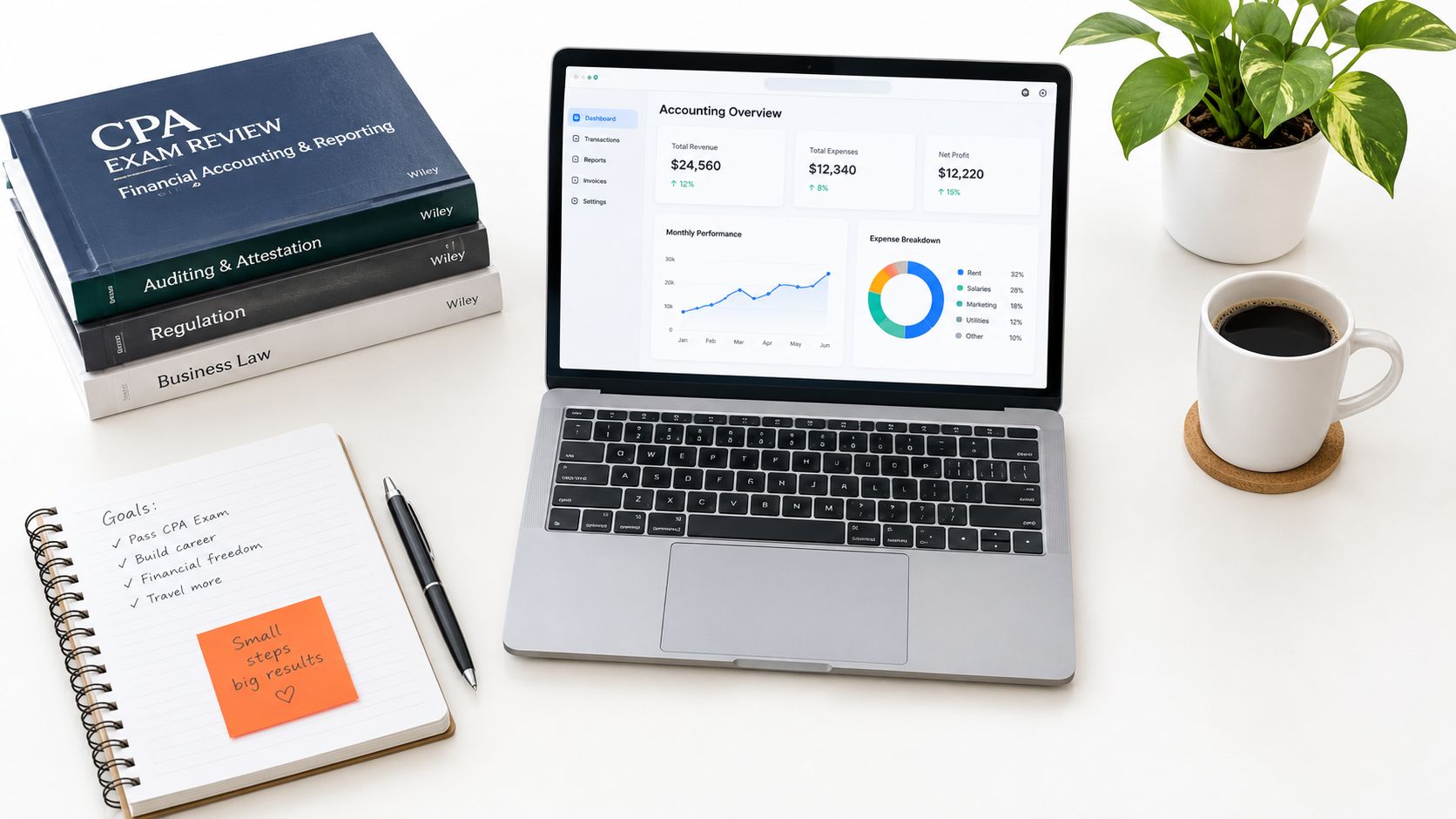
Here's a short visual prompt you can use while practicing how you describe financial dashboards and accounting workflows:
2. Experience and Work History Questions
A remote hiring manager may ask you to describe the accounting work behind your job titles. You might need to explain your accounts-payable and accounts-receivable responsibilities, the most demanding close you supported, or how you handled recurring tasks across time zones. These questions show whether your experience matches the role and whether you can work with appropriate independence.
Start with the function, then add the working context. Cover transaction coding, reconciliations, invoice review, collections, month-end support, reporting, and communication with auditors or managers. Explain the industry, transaction complexity, systems used, and review process so the interviewer can understand the level of responsibility you held.
Use this work-history lens:
- Function: Name the accounting processes and type of organization involved.
- Volume: Describe the regular workload or frequency without overstating your contribution.
- Systems: Identify the software, spreadsheets, reporting tools, or documentation methods you used.
- Review level: Clarify what you completed independently, what required approval, and how issues were escalated.
For example, a LATAM candidate discussing a U.S.-based client could explain how they worked with a different chart of accounts, documented local-versus-client reporting requirements, and scheduled updates across time zones. A candidate moving from office-based work into a remote role can show readiness through examples of task tracking, deadline management, written follow-ups, and clear handoffs.
“I've performed this process independently, and I know which decisions require review” is stronger than claiming universal expertise.
Prepare a concise explanation for career transitions or gaps. Focus on skills you maintained and the work you are ready to perform now. Keep your profile, dates, and interview explanation consistent, and be ready to verify employment history with documentation such as reference letters or payroll records. If you are considering adjacent remote work, reviewing what an administrative assistant does can help you identify transferable strengths in scheduling, documentation, and coordination.
3. Analytical and Problem-Solving Questions
Remote employers need to know what you'll do when the numbers don't agree and immediate help isn't available. You may be asked how you'd investigate a general-ledger discrepancy, identify a repeated vendor issue, automate a manual process, or prioritize several reconciliations with the same deadline.
Don't jump straight to a correction. Start by defining the problem and confirming the period, account, source reports, and materiality expected by the company. Then trace the transaction, compare the supporting evidence, identify whether the issue is timing, classification, duplication, omission, or a posting error, and document your conclusion. Finish by explaining who you'd notify and what control could prevent recurrence.
For example, if a remote manager reports an unexplained variance, your answer might follow this sequence:
- Reproduce the variance: Confirm the report filters, accounting period, currency, and source balances.
- Trace the entries: Compare the general ledger with the subledger, bank records, invoices, approvals, and adjustment history.
- Test the explanation: Determine whether the difference is a timing issue, coding problem, missing entry, duplicate, or unusual transaction.
- Document and escalate: Record the evidence, explain the proposed treatment, and request approval where policy requires it.
- Improve the process: Recommend a validation step, exception report, or review control without weakening segregation of duties.
A short work sample can reveal these abilities more clearly than conversational questions. Hiring research reports a predictive-validity coefficient of approximately r = 0.54 for work-sample tests and indicates that work samples correlate with subsequent performance more strongly than unstructured interviews. For an accounting role, a 20–30 minute assessment could test bank-reconciliation logic, accruals, prepaid expenses, variance analysis, error identification, and spreadsheet formula auditing. See the guidance on accounting skills assessments for new hires.
Use the STAR method for past examples, but spend most of your answer on the action and reasoning. In a remote setting, also explain how you'd send a written summary, attach supporting evidence, and make your recommendation understandable to a manager working in another time zone.
4. Compliance, Accuracy, and Attention to Detail Questions
Accuracy is more than saying, “I double-check my work.” A strong answer shows the actual controls you use before a transaction, reconciliation, tax filing, or report reaches another person. Explain how you compare source documents, review unusual items, confirm period cut-off, preserve approvals, and record assumptions.
A useful question is, “How would you handle an entry when you're unsure whether it complies with company policy?” A dependable answer should include pausing the posting when appropriate, identifying the relevant policy or accounting principle, gathering evidence, asking a specific question, documenting the decision, and escalating a material or unusual issue. Avoid presenting speed as a reason to bypass review.
For bookkeeping roles, explain the difference between a journal and a ledger. The IRS recordkeeping guidance describes a journal as a record of each business transaction based on supporting documents, while a ledger contains totals from the journals. The same guidance says electronic systems must preserve complete and accurate records that remain accessible, and generally recommends recording transactions daily rather than reconstructing incomplete records at month-end.
Use a control-based answer framework
When asked how you maintain quality, connect each habit to a risk:
- Source evidence: Match invoices, receipts, deposit slips, canceled checks, or approvals to the transaction.
- Period control: Confirm that the entry belongs in the correct accounting period.
- Review control: Use a checklist, exception report, or independent review for sensitive work.
- Audit trail: Preserve the reason for an adjustment, the approver, and the supporting documentation.
- Escalation: Raise uncertainty instead of choosing a treatment without consultation.
Remote work increases the value of written evidence because the next reviewer may not share your schedule or context. If you're applying to a role supporting a U.S. client, discuss how you'd learn the client's policies and distinguish them from local requirements. Don't claim that one accounting framework automatically answers every compliance question.
5. Communication and Remote Collaboration Questions
An accounting answer can be technically correct and still fail if nobody understands what action to take. Interviewers may ask how you'd explain a financial report to a non-accountant, document a complex process, resolve a misunderstanding, or work with colleagues across time zones.
Use a simple communication pattern: state the issue, explain the business effect, provide the evidence, recommend the next step, and identify the deadline or owner. For example, instead of writing, “The reconciliation is off,” you could explain that a bank fee appears on the statement but not in the ledger, attach the statement reference, state the proposed entry, and ask the reviewer to approve or clarify the treatment.
Written clarity matters particularly for LATAM candidates working with English-speaking managers. You don't need to use complicated language. Short sentences, consistent labels, explicit dates, and well-organized attachments make your work easier to review. If you're bilingual in English and Spanish, mention where that ability helps, such as communicating with local vendors while reporting findings to a U.S.-based manager.
Remote collaboration questions may include:
- “How do you provide an update when a task is delayed?”
- “How do you document a recurring close process?”
- “How do you respond when a manager is offline and a transaction needs clarification?”
- “Which communication tools have you used, and how do you decide between chat, email, and a meeting?”
Name tools you've used, such as Slack, Microsoft Teams, Asana, Google Drive, or a ticketing system. Then describe the behavior behind the tool. A message in Teams doesn't prove collaboration, but a dated status update with the open question, evidence, and next action does.
A strong remote answer makes the next person's job easier. It gives them enough context to continue the work without asking you to repeat the entire history.
Also verify the role's working hours before the interview. If the posting aligns with U.S. business hours, explain when you're available, how you handle handoffs, and how you'll remain responsive during the agreed schedule.
6. Behavioral and Situational Questions
Behavioral questions ask what you did in the past. Situational questions ask what you would do in a hypothetical case. Both help an interviewer assess integrity, self-direction, reliability, and judgment when an accounting task becomes uncomfortable or unclear.
Common prompts include, “Tell me about a mistake you made,” “Describe a time you had to meet a difficult deadline,” and “What would you do if a colleague cut corners on compliance?” Don't choose an example where everything worked perfectly. Select a real situation where you noticed a risk, took responsibility, communicated appropriately, and changed your process afterward.
Use STAR, but keep the accounting context visible:
- Situation: What was happening, and why did it matter?
- Task: What were you responsible for?
- Action: What did you check, decide, communicate, and document?
- Result: What changed, and what did you learn?
Suppose you discovered that a recurring invoice had been coded to the wrong account. A useful answer would explain how you verified the source document, checked whether earlier periods were affected, informed the responsible reviewer, corrected the entry through the approved process, and added a review step for similar invoices. That demonstrates accuracy, judgment, and prevention rather than merely admitting an error.
For a disagreement about an accounting entry, show respect without surrendering professional judgment. Listen to the other person's reasoning, refer to evidence and policy, propose a review by the appropriate decision-maker, and document the final treatment. For a compliance concern, explain that you'd avoid accusations, preserve relevant information, and use the company's escalation channel.
Candidates moving into remote work should also discuss how they stay organized without constant supervision. Mention your task list, calendar blocks, status updates, documentation habits, and approach to asking for help. The same preparation principles can support candidates reviewing sales interview questions, especially the need to describe decisions through specific examples rather than broad personality claims.
7. Financial Analysis and Reporting Questions
Employers may want more than someone who can post transactions. They may ask how you interpret a variance, build a report, explain declining revenue, or identify the business meaning behind a trend. Your answer should connect accounting records to decisions while staying within the level of responsibility you've held.
Start with the report and the question it should answer. A budget-versus-actual analysis might require you to separate volume, timing, price, coding, and one-time effects. A cash report might require you to distinguish cash movement from accounting profit. A dashboard should help a manager identify an exception or decide where to investigate, not just display attractive charts.
IFRS describes financial statements as a structured representation of financial position and performance that helps users assess economic prospects and management's stewardship. IAS 1 identifies a statement of financial position, a statement of profit or loss and other comprehensive income, a statement of changes in equity, a statement of cash flows, and related notes as the main components. It also generally prohibits offsetting assets and liabilities or income and expenses unless an IFRS standard permits or requires it.
Explain the connection between statements
A clear interview answer might say that the income statement shows performance over a period, the balance sheet shows assets, liabilities, and equity at a point in time, and the cash-flow statement explains movements in cash. Then give a practical example. A recorded sale can affect revenue and receivables without immediately creating a cash inflow, while a loan can increase cash without being revenue.
Financial data analytics and visualization were identified as a priority development area by 53% of firm leaders in a 2025 workforce report, alongside AI and cloud-platform capabilities. That finding appears in the PICPA 2025 workforce and talent insights report. For candidates, the practical lesson is to prepare one example of turning a spreadsheet or report into a concise business explanation.
If you're interviewing for a bookkeeping role, focus on reliable reporting and useful exception analysis. For a controller or analyst role, discuss review controls, close management, cash-flow interpretation, financial-statement analysis, and how you communicate limitations in the data.
8. Learning Ability and Adaptability Questions
A candidate doesn't need to know every accounting platform before starting a new role. The interviewer does need evidence that you can learn responsibly, ask useful questions, and apply a new process without weakening controls.
Expect questions such as, “Tell me about a time you learned accounting software quickly,” “How do you stay current with accounting standards?” or “Which accounting skill would you develop next?” Avoid answering with a list of courses alone. Explain what changed in your work after the training, which part you practiced independently, and how you verified that you were applying the new knowledge correctly.
A good learning example includes five parts:
- Starting point: Identify the system, process, or rule you didn't yet know.
- Learning method: Describe documentation, guided practice, webinars, professional resources, or supervised work.
- Verification: Explain how you tested entries, reconciliations, permissions, or report outputs.
- Application: Show the task you completed after learning.
- Next step: State how you'd continue improving without overstating mastery.
For remote roles, connect adaptability to written instructions and independent execution. You might explain how you reviewed a company's chart of accounts, created a process note, tested a sample transaction, recorded open questions, and requested review before handling the workflow alone. That answer is stronger than saying you're a fast learner.
The labor market can also create opportunities for candidates who show potential alongside proven reliability. A Controllers Council survey found that 53% of respondents reported no finance-and-accounting talent shortage, 33% reported minor shortages, and 10% reported significant shortages. The same survey reported that controller and assistant-controller roles were hardest to fill at 34%, followed by bookkeeping or financial-reporting roles at 27%. These findings are presented in the 2025 Corporate Accounting Talent Study.
Don't claim experience you don't have. Separate proven skills from adjacent skills, then explain the learning plan that connects them.
8-Point Accounting Interview Question Comparison
| Category | 🔄 Implementation complexity | Resource requirements | ⭐📊 Expected outcomes | 💡 Ideal use cases | ⚡ Key advantages |
|---|---|---|---|---|---|
| Technical and Software Proficiency Questions | Moderate–High, hands‑on demos and version variation | Access to software/demo accounts, certifications, practice time | ⭐ High, clear, measurable readiness; 📊 indicates tool fit and onboarding speed | Remote bookkeepers, controllers, roles requiring specific platforms | ⚡ Rapidly verifies operational competence; reduces training time |
| Experience and Work History Questions | Low–Moderate, chronological review and verification | Resume, references, quantified achievements, employment records | ⭐ Medium, shows reliability and scope; 📊 aids role matching | Mid/senior hires and roles needing proven scale or industry experience | ⚡ Efficient background screening; reveals trajectory and fit |
| Analytical and Problem‑Solving Questions | High, scenario work and on‑the‑spot reasoning | Case data, scenario prep, Excel/analytical tool examples | ⭐ High, demonstrates independent troubleshooting; 📊 drives process improvements | Reconciliation, variance analysis, automation and root‑cause roles | ⚡ Identifies proactive problem solvers and process thinkers |
| Compliance, Accuracy, and Attention to Detail Questions | Moderate, technical/regulatory depth required | Knowledge of GAAP/IFRS/local regs, audit examples, checklists | ⭐ High, reduces risk and improves audit readiness; 📊 ensures accuracy | Tax, audit, control roles and positions with regulatory exposure | ⚡ Minimizes errors and compliance breaches; builds trust |
| Communication and Remote Collaboration Questions | Moderate, evaluates clarity and documentation skills | Writing samples, examples of remote tool use, timezone strategies | ⭐ Medium, improves stakeholder alignment; 📊 reduces misunderstandings | Remote roles working with non‑finance teams or across time zones | ⚡ Enhances clarity, reduces rework, supports async workflows |
| Behavioral and Situational Questions | Low–Moderate, structured storytelling (STAR) | Prepared examples, reflection on past incidents, scenarios | ⭐ Medium, predicts culture fit and autonomy; 📊 signals retention potential | Assessing soft skills, remote readiness, stress and conflict handling | ⚡ Reveals work style, judgment, and self‑management |
| Financial Analysis and Reporting Questions | High, requires business acumen and analytical depth | Access to reports, dashboard skills, KPI and forecasting tools | ⭐ High, delivers strategic insights; 📊 informs management decisions | Finance manager, analyst, controller, strategic reporting roles | ⚡ Drives actionable insights and supports decision‑making |
| Learning Ability and Adaptability Questions | Low–Moderate, evidence of growth mindset and quick learning | Certifications, courses, examples of self‑directed learning | ⭐ Medium, signals long‑term potential; 📊 indicates adaptability | Entry‑level hires, growth‑stage companies, evolving tech stacks | ⚡ Predicts quick upskilling and resilience to change |
Turn Practice Into Your Next Remote Opportunity
Good preparation starts with the job description, not a generic list of accounting interview questions. For each target role, mark the required accounting functions, software, reporting framework, schedule, communication expectations, and level of independence. Then prepare answers that match those requirements instead of repeating the same professional summary for every application.
Build at least one specific example for each major evidence area. Your technical example might explain a reconciliation or spreadsheet workflow. Your analytical example should show how you investigated an error or variance. Your behavioral example should demonstrate responsibility under pressure. Your remote-collaboration example should show how you documented a handoff, communicated across time zones, or explained a financial issue in writing.
Practice aloud. Remote interviews make your voice, pacing, and explanations especially important because the interviewer may have fewer informal signals than they would in an office. Record yourself answering a question, then remove vague phrases such as “I handled everything” and replace them with the process you followed, the evidence you reviewed, and the decision you made.
Prepare for practical follow-ups. If an interviewer asks how you'd post an adjustment, be ready to explain which evidence you'd request first and how you'd prevent recurrence. If they ask about a software platform you haven't used, describe the comparable workflow you know and the steps you'd take to learn the new interface. If they ask about a financial statement, explain how the statements connect rather than reciting isolated definitions.
Your preparation should also reflect the realities of cross-border work. Verify whether the role requires U.S. business hours or another fixed schedule. Confirm the expected English level, especially if you'll explain financial findings to clients or managers. If you're in LATAM, be ready to discuss how you handle local accounting knowledge alongside the reporting practices, documentation standards, or systems used by an international employer. If the role involves bilingual communication, identify the situations in which you can support both English-speaking stakeholders and local contacts.
Update your CV and Virtustant profile so the interview doesn't introduce skills that your application never mentions. List software accurately, describe accounting functions clearly, include relevant training, and explain remote or autonomous experience. A profile that shows your actual capabilities gives you a stronger foundation for discussing trainability without exaggerating your experience.
Before applying, read the posting carefully. Virtustant listings can specify responsibilities, tools, schedules, experience, and language expectations. That detail helps you decide whether to apply now, strengthen a skill first, or target a related finance role where your current experience is a closer match.
When you're ready, complete your application information, browse the current remote job openings, and consider joining the Virtustant talent pool. Keep a private preparation document with your strongest examples, software workflows, questions for hiring managers, and availability. Review it before each interview so your answers remain specific to the role.
Virtustant Jobs is one option for candidates seeking remote positions with international companies, with structured listings and standardized applications. It includes finance and legal roles such as bookkeeper, controller, and CFO positions, alongside opportunities in other remote functions. The right opportunity still depends on your qualifications, schedule, language ability, and fit with the employer's requirements, so approach each application with accurate information and realistic preparation.
Your next step is practical. Match your experience to a target role, rehearse four evidence-based examples, verify the schedule and language expectations, and submit an application that supports the story you'll tell in the interview.
Virtustant Jobs offers remote job listings for candidates across Latin America, including finance roles where software fluency, accuracy, and cross-border communication matter. Visit Virtustant Jobs to review relevant opportunities, complete your application information, and connect your accounting experience with remote career options.