You've polished your CV, created profiles on remote platforms, and searched for bookkeeping roles from Latin America. Then you open a posting and see the same requirements repeated: QuickBooks Online, reconciliations, English communication, U.S. business hours, and experience with month-end close. The good news is that these requirements are specific. You can prepare for them, prove them, and position yourself around them.
Remote bookkeeping jobs are a practical route into cross-border work, but generic applications rarely succeed. Employers want someone who can keep financial records accurate, communicate clearly across time zones, protect sensitive data, and complete recurring tasks without constant supervision. Here's how to build that profile and apply with evidence instead of vague claims.
Why Remote Bookkeeping Is a Real Opportunity Right Now
Bookkeeping remains essential even when companies automate parts of the work. Businesses still need people to review transactions, code invoices, reconcile bank accounts, investigate discrepancies, and support month-end reporting. Cloud accounting has changed where the work happens, not removed the need for reliable financial control.
The U.S. labor market illustrates the scale of the occupation. Bookkeeping, accounting, and auditing clerks represented about 1,532,400 jobs, while the Bureau of Labor Statistics projected a 6% decline through 2035 and still expected approximately 144,100 openings each year from replacement needs alone, according to this labor market analysis. That combination matters. Automation may reduce some routine work, but turnover, retirements, and ongoing operational needs continue to create openings.
Why LATAM candidates can compete
Remote hiring gives companies access to professionals beyond their local commuting areas. For Latin American candidates, that creates an opportunity to work with U.S.-based teams while bringing relevant accounting experience, strong organization, and overlapping working hours.
The strongest candidates don't present themselves as inexpensive substitutes for local staff. They present themselves as dependable operators who can follow a process, identify exceptions, document work, and communicate before a small issue becomes a close problem. Cost can influence hiring, but accuracy and reliability determine whether the relationship lasts.
The role has also become more standardized. By 2024 to 2026, remote bookkeeper pay benchmarks commonly clustered in the mid-$40,000s to low-$50,000s annually. One dataset reported an average of $50,573, with a typical range from $41,000 to $57,500, while another wage source reported a national median of $49,210 per year, or $23.66 per hour, for bookkeeping, accounting, and auditing clerks, as summarized in this remote bookkeeping compensation overview. Treat these figures as market benchmarks, not promises for a particular role or country.
Practical rule: Don't sell yourself as someone who can “help with numbers.” Show exactly which financial processes you can own and how you keep them controlled.
What makes the path accessible
A degree can help for some positions, but practical evidence often carries more weight for entry-level and mid-level remote work. A clean reconciliation sample, a well-organized close checklist, a strong QuickBooks Online profile, and confident English communication can make your capabilities easier to assess.
Start by identifying the work you can already perform. Then close the gaps that appear repeatedly in job descriptions. Remote bookkeeping is viable because the work is structured, measurable, and increasingly supported by cloud tools. That makes it a better target than an undefined search for “any remote job.”
What Employers Actually Require From Remote Bookkeepers
A LATAM candidate can be technically strong and still lose a remote bookkeeping role by missing the employer's working hours or struggling to explain basic accounting decisions in English. Employers hire remote bookkeepers to keep financial workflows accurate and dependable across borders. Your profile must show control over transaction coding, bank and credit card reconciliations, accounts payable, accounts receivable, reporting, and follow-up.
U.S.-focused postings commonly request advanced QuickBooks Online experience, strong Excel or Google Sheets skills, and English communication, along with responsibility for transactions, reconciliations, AP/AR, and financial reports, as shown in this bookkeeper job posting. Treat these requirements as a description of the daily work, not as keywords to copy into your CV. Confirm that your available hours overlap with the client's schedule, then state that availability clearly.
Separate required skills from useful extras
A certification can support your application, but it cannot replace practical evidence. Employers want to know how you respond when the ledger differs from the bank statement, an invoice lacks documentation, or a client submits an unclear expense.
| Requirement | How Critical | Tips for Candidates |
|---|---|---|
| QuickBooks Online | Required for many U.S.-focused roles | Name the workflows you use, including transaction review, bank feeds, reconciliations, and reporting |
| Excel or Google Sheets | Required for analysis and control | Mention formulas, sorting, filtering, exception tracking, and account schedules you can handle |
| English communication | Required for cross-border collaboration | Practice explaining a discrepancy in plain English, verbally and in writing |
| AP and AR | Frequently expected | Describe invoice entry, payment tracking, customer balances, and follow-up processes |
| Month-end close | Important for stronger roles | Show which tasks you completed, reviewed, documented, or handed off |
| Formal certification | Helpful, not universal | Use it to support practical evidence rather than as your only qualification |
Experience expectations vary. Some postings ask for 1+ years, others ask for 3+ years, while some expect ownership of month-end or year-end close, according to this remote bookkeeper role listing. Read each posting closely and match your CV to the requested level. Do not present routine data entry as full-cycle bookkeeping.
How to position transferable experience
Administrative professionals can convert relevant duties into bookkeeping language without overstating their background. If you maintained purchase records, tracked invoices, checked documents, managed spreadsheets, or followed approval workflows, describe the process, system, and result. Customer service professionals may also have useful experience handling billing questions, documenting cases, and resolving discrepancies.
Write the evidence, not the title. Replace “supported the finance team” with the records you checked, the software you used, the reports you maintained, and the issues you escalated. Candidates who need context for translating administrative duties into remote work can review what an administrative assistant does. For LATAM applicants, that translation matters because employers must quickly understand how previous local experience applies to a distributed U.S. workflow.
Essential Tools and Certifications for Your Profile
Your learning plan should follow employer demand, not whichever course appears first in a search result. Build the tool stack that lets you perform the core work, then add credentials that make your competence easier to verify.
QuickBooks Online deserves priority for candidates targeting U.S.-focused remote bookkeeping jobs. It appears frequently in role requirements, and certification can signal that you understand the platform's basic workflow. It still isn't a substitute for hands-on practice. Create realistic exercises involving transaction categorization, bank feed review, reconciliation, adjustments, and financial reports.

Prioritize tools by workplace value
QuickBooks Online should be your first platform if your target postings mention it repeatedly. Learn how transactions move from source documents to the ledger and how reconciliations expose errors.
Excel or Google Sheets remains important because bookkeepers often need to organize exports, compare balances, prepare schedules, and flag exceptions. Focus on practical spreadsheet control rather than collecting advanced functions you can't explain.
Receipt capture, expense management, file-sharing, and communication tools matter because remote bookkeeping depends on evidence. You should know how to name files consistently, preserve supporting documentation, and leave clear notes for another person reviewing your work.
A useful comparison is simple:
- Certification improves credibility: It gives recruiters a quick signal that you've completed structured learning.
- Software practice proves usability: It shows you can work with the platform and complete tasks.
- Process documentation demonstrates maturity: It tells employers you understand repeatability, review, and handoffs.
- English communication protects accuracy: It helps you clarify missing information before recording a transaction.
If you're comparing systems for independent work, this guide to find contractor bookkeeping software can help you evaluate bookkeeping tools in a practical context.
Prepare for U.S. working hours
Time-zone compatibility is part of your professional profile, not a minor scheduling detail. LATAM bookkeeping roles may align with U.S. business hours, including schedules such as 11 AM to 3 PM EST for part-time work or 8:30 AM to 5:30 PM ET for full-time positions, as seen in current LATAM bookkeeping job listings.
State your availability clearly in your CV and profile. If you can work the required Eastern Time schedule, say so using the employer's terminology. If you can't, don't imply flexibility that you won't be able to maintain.
Building Application Materials That Stand Out
A LATAM candidate can lose a remote bookkeeping role before the interview if the CV looks like a general office résumé. Hiring managers need to see bookkeeping ownership, software experience, reliable written English, and availability that fits the employer's working hours.
Your application should answer three questions quickly: What bookkeeping work have you performed? Which tools can you use? How do you protect accuracy when working remotely?
Rewrite your CV around outcomes and ownership
Use a focused headline such as “Bookkeeper with QuickBooks Online, reconciliations, AP/AR, and month-end close experience.” Do not use a broad title that hides the role you want.
Organize your experience around responsibilities that match remote bookkeeping work:
- Transaction control: Explain how you recorded, categorized, reviewed, or corrected transactions.
- Reconciliation work: Name the accounts you reconciled and describe how you investigated differences.
- Close support: State whether you prepared schedules, posted adjustments, reviewed balances, or completed reporting tasks.
- Remote coordination: Mention written updates, shared workpapers, cloud systems, and handoffs across time zones.
- Communication: Show how you explained financial issues to clients, managers, vendors, or colleagues outside finance.
Use measurable accounting experience when you have it, but never invent metrics. “Completed monthly bank reconciliations and documented unresolved exceptions for review” carries more weight than “helped with bookkeeping.” If your experience is limited, include a portfolio exercise or supervised project and explain the workflow you followed.
Experience requirements vary by employer, and some roles expect full-cycle close ownership. Make the level you can handle obvious instead of forcing a recruiter to infer it from vague job titles.
Your CV also needs to work on the platforms where remote employers recruit. Match relevant terms from the posting, keep formatting simple for automated screening, and state your country, English level, software, and working-hour availability. A recruiter should understand your fit without opening several attachments or translating unclear phrases.
Build a small proof portfolio
A portfolio can demonstrate ability without exposing confidential client data. Create sanitized examples such as a reconciliation template, a month-end checklist, an AP aging tracker, or a short process document showing how you would investigate a balance difference. Label each item clearly and explain the control it supports.
Your cover letter should add context rather than repeat the CV. Mention the employer's software, schedule, or client type, then connect that requirement to one relevant example from your background. Two specific paragraphs beat a long personal history.
Before submitting, use a structured HR resume data parser to find missing information or inconsistent formatting. Treat the output as a quality check, not a substitute for judgment. Review the final version yourself, especially the English wording, dates, software names, and contact details.
Application standard: Every important requirement in the posting should appear in your application with evidence, context, or a clear explanation of how you're closing the gap.
Navigating the Remote Bookkeeping Interview Process
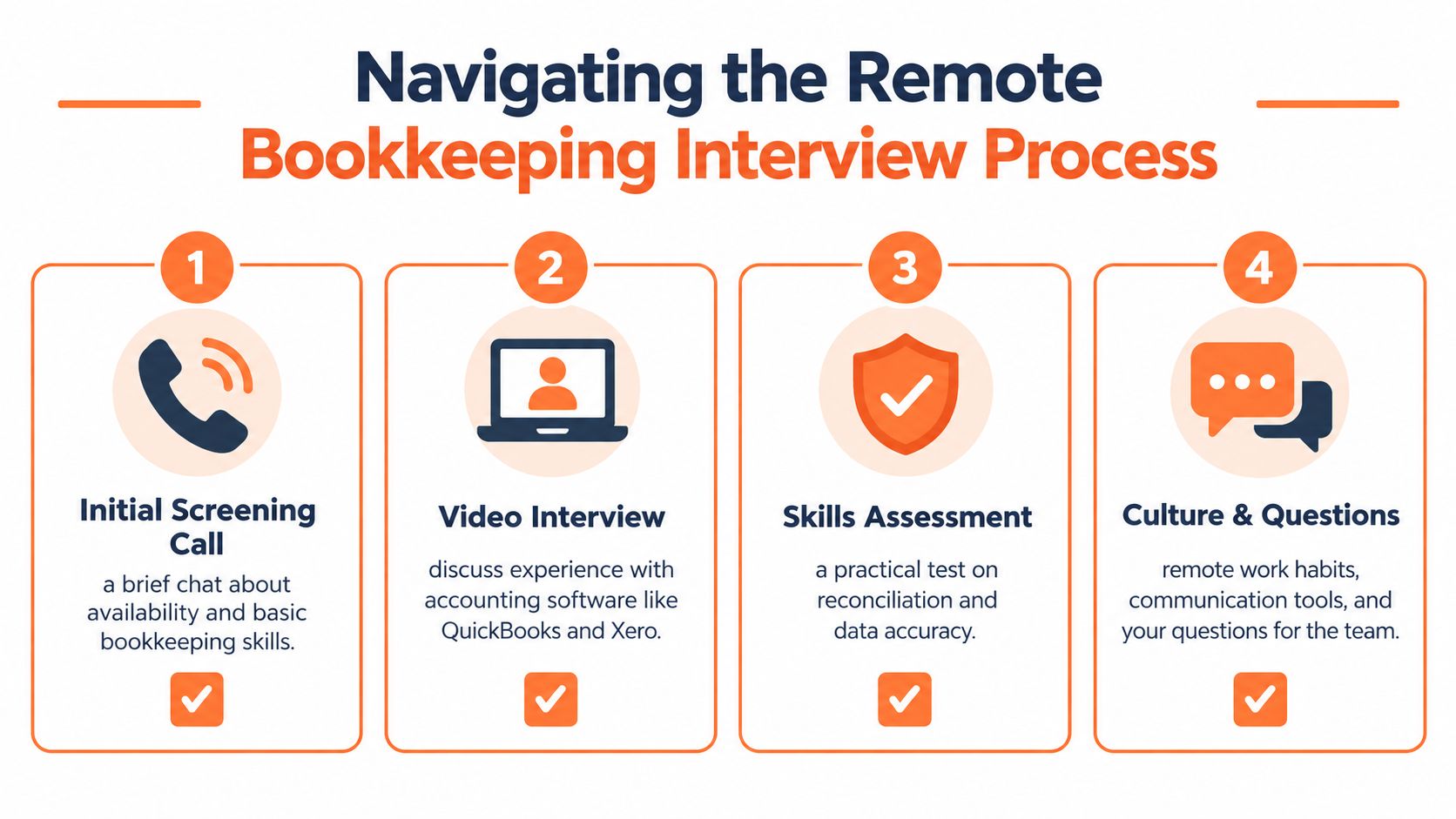
A remote bookkeeping interview often starts casually. The recruiter asks about your experience, English level, availability, and familiarity with accounting software. Then the conversation becomes more practical. You may need to explain a reconciliation, review a mock transaction list, or describe how you'd handle missing documentation.
Consider a realistic scenario. A U.S.-based hiring manager shows you a bank statement and a ledger with a mismatch. A weak answer says, “I'd check the numbers.” A stronger answer explains that you'd confirm the statement period, compare opening and closing balances, inspect unreconciled transactions, check duplicates and timing differences, document the exception, and escalate anything requiring approval.
That answer demonstrates technical thinking and remote discipline. You're showing the interviewer how you work, not just claiming that you're detail-oriented.
Prepare for each stage
During the initial call, answer directly. Give your location, working-hour availability, English level, years of relevant experience, and primary software. Avoid vague phrases such as “I'm flexible with anything” if the role has a defined schedule.
In the technical interview, explain your process out loud. If asked about AP, describe how you would receive an invoice, validate the supporting information, code it, route it for approval, record it, and track payment. If asked about a close, distinguish between tasks you can complete independently and items requiring review.
Remote employers also evaluate how you manage access and approvals. Safe remote bookkeeping workflows separate initiation, approval, recording, and reconciliation permissions, review access periodically, and handle exceptions daily so errors don't accumulate before month-end.
A useful answer might sound like this:
Strong interview response: “I wouldn't approve and reconcile my own transaction without a review step. I'd document the exception, notify the appropriate person, and keep the item visible until it's resolved.”
When discussing your home setup, focus on reliability and confidentiality. Explain how you'll work during the required U.S. hours, communicate status, store files securely, and avoid exposing client information in shared spaces. You don't need to overshare personal details. You need to show that your working environment supports controlled financial work.
For candidates comparing regional schedules and expectations, this guide to South America time zones can help you describe your availability accurately.
Finish by asking useful questions. Ask which accounting platform the team uses, how reconciliations are reviewed, who approves transactions, what the close calendar looks like, and how the team communicates exceptions. Those questions make you sound like someone preparing to operate inside a system, not someone focused only on getting hired.
Next Steps to Launch Your Remote Bookkeeping Career
You don't need to wait until every skill feels perfect. You need a clear standard for readiness and a disciplined application process.
Start with a gap review. Compare your current CV against several target postings and mark each repeated requirement: QuickBooks Online, spreadsheet ability, AP/AR, reconciliation, English, close support, and schedule alignment. Choose the most common missing skill and practice it before adding another course to your list.
Then create application assets that you can reuse without becoming generic:
- Update your profile: Add specific tools, bookkeeping tasks, English level, location, and U.S. time-zone availability.
- Prepare proof: Keep a sanitized reconciliation example, close checklist, and process document ready to share when appropriate.
- Track applications: Record the role, date, required tools, schedule, experience threshold, and follow-up status.
- Customize the first paragraph: Connect your strongest relevant experience to the employer's actual bookkeeping needs.
- Review before applying: Check that your CV and answers match the requested seniority and software.
Don't scatter applications across roles you can't support. A smaller set of well-matched applications gives you better interview preparation and clearer feedback. If a posting requires full-cycle close ownership and you have only transaction-entry experience, apply only if you can explain the gap and show a credible path to the required work.
The U.S. benchmark remains active despite a projected 6% decline in overall employment, with about 170,000 openings per year on average from 2024 to 2034 for bookkeeping roles, according to this remote bookkeeping market overview. Competition therefore favors candidates who can show certifications, accurate close work, and strong reconciliation performance, not applicants who submit more forms.
Use a LATAM-focused job platform, professional networks, and specialized finance listings together. This guide to the best sites for remote work can help you organize your search instead of relying on one source. Review new openings consistently, keep your profile current, and treat every interview or rejection as information about the next gap to fix.
Remote bookkeeping is a career built through visible reliability. Learn the tools, communicate in clear English, align your schedule, document your processes, and apply when your evidence matches the role.
Virtustant Jobs connects qualified candidates with remote opportunities and provides a place to complete your candidate information for roles such as bookkeeping. Visit Virtustant Jobs to review current opportunities, create your profile, and submit applications that reflect the skills and availability remote finance teams need.